India-Italy Partnership Enters Transformative Phase, Say PM Modi and Giorgia Meloni in Joint Op-Ed

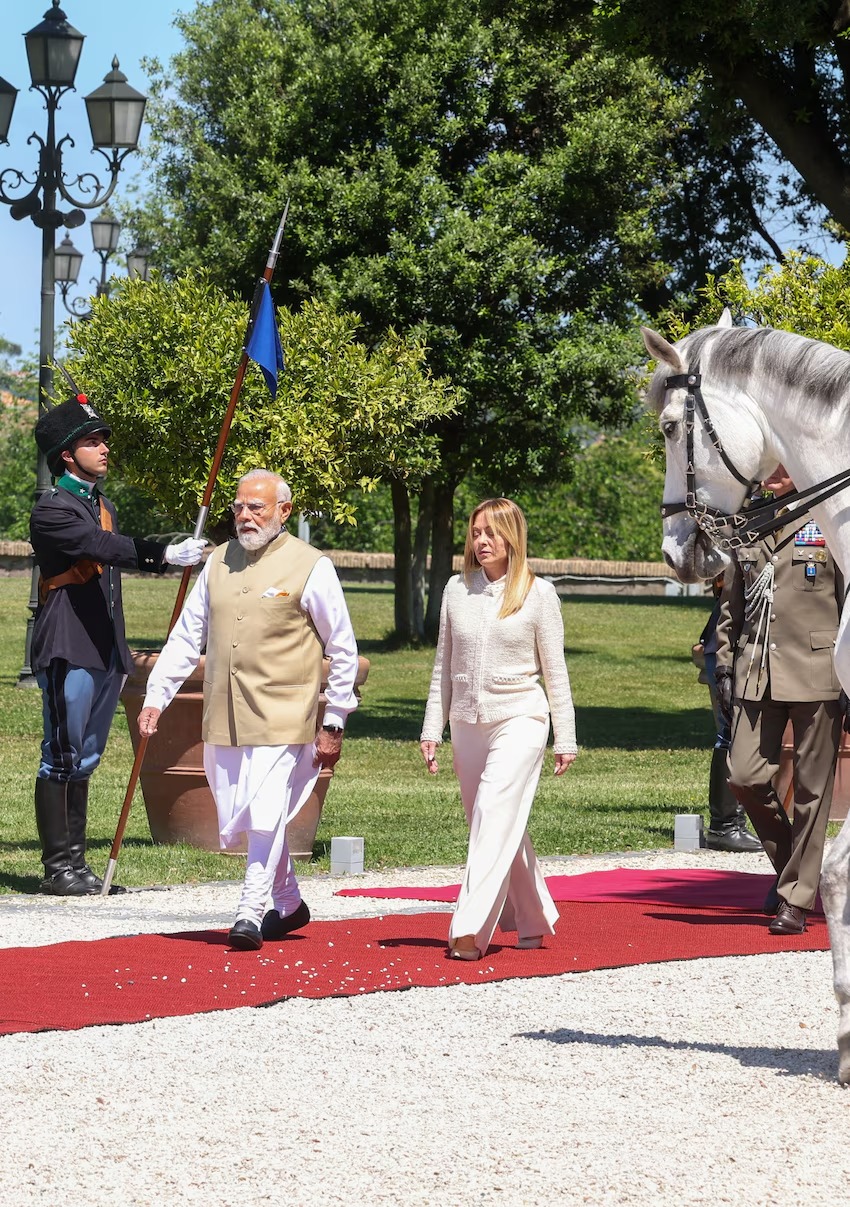
Rome, May 2026 : Prime Minister Narendra Modi and Italian Prime Minister Giorgia Meloni on Wednesday declared that India and Italy are entering a decisive and transformative phase in bilateral relations, driven by shared democratic values, innovation, strategic cooperation, and deep-rooted cultural connections that place people at the centre of future global development.
In a joint op-ed released during PM Modi’s official visit to Italy, the two leaders outlined an ambitious roadmap for expanding cooperation across sectors ranging from trade and technology to defence, energy, artificial intelligence, space, and global connectivity.
Prime Minister Modi shared details of the article on X, describing the India-Italy relationship as a “Special Strategic Partnership” shaped by a common vision for the future.
“Penned an op-ed with PM Meloni on how India-Italy ties have reached a decisive stage. Ours is a Special Strategic Partnership driven by innovation, shared democratic values and a common vision for the future,” PM Modi wrote.
In the article, both leaders emphasised that the relationship between India and Italy has evolved significantly in recent years, moving beyond traditional diplomatic engagement to become a strategic and forward-looking partnership.
“In recent years, our ties have expanded with unprecedented momentum, evolving from a cordial friendship into a special strategic partnership grounded in the values of freedom and democracy, and a common vision for the future,” the two leaders wrote.
Highlighting the rapidly changing global landscape, Modi and Meloni said the international system is undergoing profound transformation and that India and Italy are positioning themselves as trusted partners capable of addressing emerging challenges through stronger political coordination and institutional cooperation.
“At a time when the international system is undergoing a profound change, the partnership between Italy and India is guided by regular exchanges at higher political and institutional levels, and is gaining a new and higher dimension that combines our economic dynamism, societal creativity, and millennia-old civilisational wisdom,” the article stated.
The two leaders underlined that prosperity and security in the 21st century will increasingly depend on innovation, energy transition, and strategic sovereignty. They stressed that both countries are committed to diversifying and deepening their bilateral engagement by combining their complementary strengths.
“Our cooperation mirrors our shared awareness that prosperity and security in the 21st century will be shaped by the ability of nations to innovate, manage energy transitions, and strengthen strategic sovereignty,” they wrote.
One of the major themes of the joint article was economic cooperation and industrial collaboration. The leaders said India and Italy are seeking to create a “powerful synergy” by integrating Italy’s expertise in design, advanced manufacturing, and supercomputing with India’s rapidly growing economy, engineering talent, and innovation-led startup ecosystem.
“This is not a simple integration, but a co-creation of value where our respective industrial strengths amplify one another,” the two Prime Ministers stated.
They also highlighted the importance of the proposed India-European Union Free Trade Agreement, saying it would significantly strengthen trade and investment relations between India and Italy.
The leaders expressed confidence that bilateral trade could cross the Euro 20 billion mark by 2029, with increased focus on sectors such as defence and aerospace, clean technologies, machinery, automotive components, chemicals, pharmaceuticals, textiles, agri-food, and tourism.
“We want to reach and exceed the Euro 20 billion target for trade between Italy and India by 2029,” they wrote.
Referring to industrial cooperation, the article noted that the globally respected “Made in Italy” brand naturally complements India’s “Make in India” initiative.
“Made in Italy has always been synonymous with excellence worldwide, and today it finds a natural synergy with the high-quality goals of the Make in India initiative,” the leaders said.
The article further highlighted the growing industrial presence of companies from both countries. According to the leaders, more than 1,000 Indian and Italian businesses are now operating across both markets, strengthening supply chain integration and long-term economic cooperation.
Technology and innovation emerged as central pillars of the future India-Italy partnership. Modi and Meloni described Artificial Intelligence, quantum computing, advanced manufacturing, critical minerals, and digital infrastructure as sectors that would shape the next era of global transformation.
“India’s dynamic innovation ecosystem, coupled with a highly skilled professional talent pool, and Italy’s advanced industrial capabilities, make our cooperation in these sectors both natural and strategic,” the article noted.
Particular emphasis was placed on responsible and ethical development of Artificial Intelligence. The two leaders stressed that AI must remain human-centric and inclusive, especially in the context of the Global South.
“India and Italy see AI as a powerful instrument for inclusive development, especially for the Global South, where digital public infrastructure and accessible multilingual technologies can bridge divides rather than deepen them,” they wrote.
The article linked India’s concept of “MANAV” — which places human beings at the centre of technology — with Italy’s advocacy of “algor-ethics,” a framework promoting ethical and human-focused technological development rooted in the country’s humanist traditions.
“Building on India’s vision of MANAV and Italy’s leadership in promoting a human-centric algor-ethics, our partnership seeks to ensure that AI acts as a catalyst for social empowerment,” the leaders said.
They strongly argued that technological development must not threaten democratic values, human dignity, or individual freedoms.
“Technology cannot replace individuals or undermine their fundamental rights, nor be used to manipulate public debate or alter democratic processes,” they cautioned.
Space cooperation also figured prominently in the joint vision. Modi and Meloni said India’s achievements in satellite technology and space exploration complement Italy’s strengths in aerospace engineering, creating opportunities for collaborative innovation and next-generation space technologies.
On defence and security, the leaders pledged deeper cooperation in strategic technologies, maritime security, counter-terrorism, cyber security, and efforts to combat transnational criminal networks and trafficking.
“Our collaboration will help ensure the security of critical maritime routes and strengthen resilience against threats such as terrorism, cyber-crimes, drug trafficking and human trafficking,” the article said.
Energy cooperation was identified as another major area of engagement. Both countries are working together on renewable energy, green hydrogen, smart grids, resilient infrastructure, and sustainable industrial transitions.
The leaders highlighted India’s growing ambitions in green hydrogen production and said they align well with Italy’s expertise in renewable infrastructure and its role as an energy gateway to Europe.
The article also referred to collaboration under several India-led international initiatives, including the International Solar Alliance, the Coalition for Disaster Resilient Infrastructure, and the Global Biofuels Alliance.
The two Prime Ministers further underlined the strategic significance of emerging connectivity corridors linking the Indo-Pacific and Mediterranean regions. According to them, these regions should no longer be viewed separately but as interconnected economic and geopolitical spaces.
“Both India and Italy are located at the heart of two crucial hubs of the global economy — the Indo-Pacific and the Mediterranean — which are increasingly interconnected,” they wrote.
The leaders referred to the emerging “Indo-Mediterranean” corridor as a key strategic link connecting Europe and the Indian Ocean through trade, energy, technology, and digital flows.
They also praised the India-Middle East-Europe Economic Corridor (IMEC), calling it a transformative initiative that could significantly improve transport, infrastructure, energy connectivity, and digital integration across regions.
In the concluding section of the article, Modi and Meloni stressed that the India-Italy relationship is ultimately rooted in people, shared values, and civilisational wisdom.
“We can address our shared challenges by drawing upon the profound partnership and the enduring cultural ties between our nations,” they wrote.
The leaders also invoked Indian philosophical ideas such as “Dharma” and “Vasudhaiva Kutumbakam” — the world is one family — saying these principles resonate strongly with Italy’s Renaissance-inspired humanist traditions.
“Our shared vision aims to lay the foundation for a strong and forward-looking India-Italy partnership with our people at the centre,” the two leaders concluded.


Solar Defence Showcases Indigenous ‘Bhargavastra’ Counter-Swarm Drone System to Indian Army
New Delhi, July 2026 : Solar Defence and Aerospace Ltd. (SDAL) on Friday showcased its ind…

Solar Defence Showcases Indigenous ‘Bhargavastra’ Counter-Swarm Drone System to Indian Army
New Delhi, July 2026 : Solar Defence and Aerospace Ltd. (SDAL) on Friday showcased …