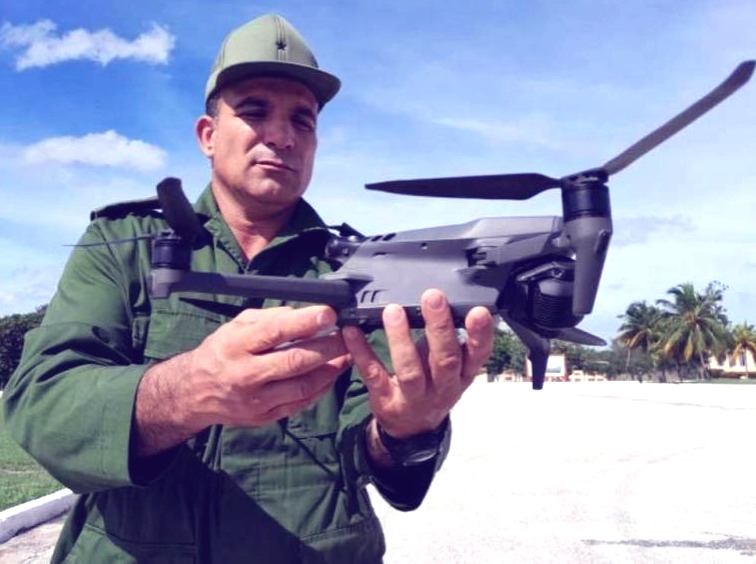
US Intelligence Services Taken Aback After Cuba Acquires Russian And Iranian Drones.

Havana; May 2026: Amid rising tensions in the Caribbean islands, US intelligence reports have highlighted a quiet but significant shift within Cuba’s Revolutionary Armed Forces (FAR). According to the intelligence reports, the integration of drone warfare capabilities into Cuba’s territorial defence structure has accelerated, with these drones reportedly acquired from Russia and Iran .
According to these assessments, the accumulation of more than 300 of these unmanned systems is not solely for surveillance or defence purposes. US officials assert that high-ranking officers of the Cuban Revolutionary Armed Forces (FAR) have discussed scenarios in which these platforms could be employed against high-value strategic targets, such as the Guantanamo Bay Naval Base, US Navy warships, and even military installations located in South Florida. Although these discussions are interpreted as contingency plans and not imminent operations, the fact that they are being considered reflects the growing importance that drones have acquired in military doctrine.
The use of unmanned systems has a clear rationale: to compensate for the structural limitations of Cuban military power with low-cost, high-impact strategic tools. For decades, the bulk of the Cuban Revolutionary Armed Forces’ arsenal has relied on Soviet-made equipment and that of decades old Warsaw Pact satellite states, forcing them to adopt asymmetric strategies against a technologically superior adversary. In this context, unmanned aerial vehicles offer an effective alternative for surveillance, reconnaissance, and even attack, without requiring the investments associated with conventional systems.
Various open sources and comparative analyses with international inventories, such as those studied by the Stockholm International Peace Research Institute (SIPRI), allow us to infer what kind of capabilities might be being integrated into the Armed Forces. In the case of Iran, one of the partners mentioned in the reports, systems such as the Shahed-136, a loitering-type attack drone widely used in recent conflicts, and the Mohajer-6, designed for reconnaissance and light attack missions, stand out. Both models are characterized by their relatively low cost and their ability to overwhelm defences, making them typical tools of asymmetric warfare.
For its part, Russia has developed and deployed various types of tactical drones, including adapted variants of Iranian designs, such as the Geran unidirectional attack drones, as well as platforms for intelligence gathering and combat support. Military cooperation between Moscow and Havana, underpinned by recent agreements, strengthens the possibility of technical assistance or the transfer of these systems.
In addition to these external acquisitions, there is a nascent effort at domestic development. Cuba has produced lightweight drones primarily for observation, disaster monitoring, and support of internal operations. While these platforms lack the sophistication of combat models, they reflect an intention to build domestic capabilities in an environment marked by technological constraints similar to the Iranian experience.
The growing prominence of drones in the Cuban arsenal coincides with an intensification of Operation Southern Spear in the region, in which the United States Southern Command (SOUTHCOM) has deployed a significant number of assets and military personnel, as well as creating two commands (US Space Forces South and Autonomous Warfare Command), as part of its surveillance and control strategy in the Caribbean. This exchange of capabilities by the Cuban Revolutionary Armed Forces (FAR), although indirect, has been interpreted by US intelligence analysts as a sign of technological competition in a geopolitical space historically sensitive for the United States.
Despite the alarm generated by these reports, US intelligence assessments themselves qualify the scope of the threat. Intelligence officials indicate that there is no evidence of immediate preparations for an attack, and they consider Cuba’s potential to remain limited compared to US military power. In that sense, the drone arsenal could be more a matter of deterrence and defensive preparedness than a direct offensive strategy.
The development of these capabilities, however, alters the strategic balance in the Caribbean by introducing an element of uncertainty. Unlike traditional systems, drones allow for more flexibility, lower-cost power projection and a profile that is more difficult to detect or neutralise. In an escalation scenario, their use could significantly complicate SOUTHCOM’s conventional military response.
Thus, beyond the current size of the arsenal or Havana’s immediate intentions, the advancement of its drone program confirms a global trend: the progressive shift toward more decentralised, adaptable, and technologically accessible forms of warfare. In the Cuban case, this transformation takes on particular significance, redefining, albeit partially, the power dynamics just 90 miles off the south eastern coast of the United States.
Team Maverick.





Parle Products Thanks PM Modi as “Melody” Toffee Gift Goes Viral on Global Stage
New Delhi, May 2026 : Parle Products Pvt Ltd on Wednesday expressed gratitude to Prime Min…

Parle Products Thanks PM Modi as “Melody” Toffee Gift Goes Viral on Global Stage
New Delhi, May 2026 : Parle Products Pvt Ltd on Wednesday expressed gratitude to …