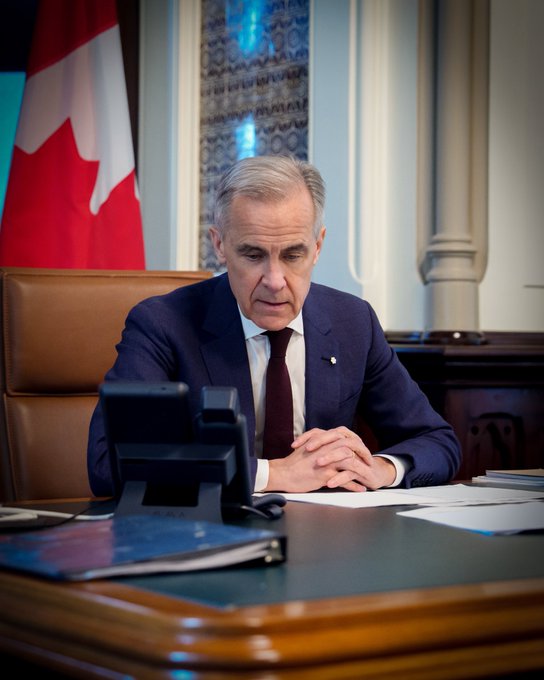
Canada’s Feud With The United States Moves Into Military Realm.

Washington DC; May 2026: The Pentagon has announced this week that the US is pulling out of a joint military board with Canada, which marked a new flash point in a simmering feud between US President Trump and Canadian Prime Minister Mark Carney.
Carney played down the decision today (20th May 2026, Wednesday), but the move elicited an angry response from others in Canada, who widely see it as a warning shot to Ottawa as it looks to diversify its military purchases and scale back its reliance on the US
“I think it’s a symbolic blow from a Canadian sense to have that measure taken by Pentagon’s policy chief Elbridge Colby”, said David Perry, President of the Canadian Global Affairs Institute. “But I think it’s maybe also a bit of a wake-up call about how we’ve treated some of these unique forums of cooperation, that can’t just treat them as historical artifacts”.
The Permanent Joint Board on Defence was created during World War II and is composed of military and civilian advisers for high-level consultation on matters of mutual importance. It typically meets once a year.
In his statement announcing its suspension, Colby chided Canada for not investing enough in the modernisation of its military and pointed to Carney’s remarks during the World Economic Forum in January, when the Canadian Prime Minister had rallied “middle powers” to create a united bulwark to superpowers.
Asked about the decision today, Carney noted Canada was spending 02% of its gross domestic product on defence for the first time since the fall of the Berlin Wall in 1989, including a $ 40 billion investment in the North American Aerospace Defence Command, a joint military organisation that serves as the primary early-warning mechanism for foreign threats. “I mean, it has a long heritage”, Carney said of the joint board, “but I wouldn’t overplay the importance of this”.
Canadian defence experts said the suspension of the board was unlikely to undercut cross-border cooperation, given that the two countries have other channels and forums for communication, but they warned it highlights a souring of US-Canada relations that poses risks for both sides. “If you’re going to send a message and call a hiatus to an advice-giving board, this is a good one to do it, because it’s really not going to have big consequences”, said Andrea Charron, Director of the Center for Defence and Security Studies at the University of Manitoba. “Now, what’s prompted this is anyone’s guess”, she added.
President Trump’s frustrations with Carney are plentiful:
- The former banker (Mike Carney) has campaigned on standing up to Trump and has preached the value of self-reliance and diverse global partnerships since entering office last year;
- Canada and the US are renegotiating a trade agreement hammered out during Trump’s first term;
- Canada turned to Australia last year on a major deal to build its Arctic Over-the-Horizon Radar system; and it’s reviewing a deal to buy dozens of US-made F-35 fighter jets, with an eye toward purchasing some Swedish aircraft instead.
Whatever the reason, she argued America can’t afford to push away Canada, especially as it seeks to increase its presence in the Arctic, which is an imperative that Trump has highlighted with his efforts to expand US control over Greenland. “We are the second-largest country in the world, and our radar systems and satellite systems give the US advance warning, which they desperately need in an Arctic context, because it’s the fastest avenue of attack”, Andrea Charron said.
Perry, who hosts the Canadian Global Affairs Institute’s “Defence Deconstructed” podcast, said the US will continue to be Canada’s most important relationship, despite Carney’s rhetoric projecting greater autonomy. He argued the Pentagon’s move this week reflected a complacency in Canada, which he said has not used platforms like the Permanent Joint Board on Defence to proactively advance cooperation with the US on particular priorities.
“I don’t think it’s great, just in terms of the symbolism and how it fits within the wider public discussion and narrative about Canada-US relations”, he said. “But at the same time, I can imagine a scenario where somebody in the Pentagon said, ‘Well, what’s on the agenda for this next meeting?’ and thought that the answer was underwhelming”.
At the same time, he said Carney has placed a high priority on increasing defence spending, as Canada finally reached a 02% target first agreed to in 2014, which had eluded Carney’s predecessor, Justin Trudeau.
Carney has committed to reaching 3.5% by 2035, an ambitious target that still falls short of Trump’s 05% target for NATO members.
Imran Bayoumi, an associate director with the Geo Strategy Initiative at the Atlantic Council’s Scowcroft Center for Strategy and Security, said meeting that goal will be far harder than the 02% milestone. The 02% “includes moving the Coast Guard to the Department of National Defence, salary increases, that kind of stuff. And it does all help Canada’s position in the world, but it’s not like a clear ramp-up in defence spending”, he said.
“I think Canada can meet the 3.5% target, if it wants to. It’ll certainly require some sort of broader societal mindset shift”, he added. Bayoumi said Canadians are well aware that they can’t continue to rely on the United States for its national security, “but I don’t know that that recognition is translated into an acceptance of the kind of spending trade-offs on social programs, for example: that increased defence spending would require”.
In the short term, he predicted the Carney administration would continue to play down the rift and avoid decisions that risk escalation. “I think you’ve seen kind of a split screen from the Carney government. On one hand, they’re very happy and willing to play into this need to distance Canada from the US”, he said. “At the same time, I think you know Canada has acted quite pragmatically when it comes to relations with the US”.
Charron said both countries will be in a weaker position as long as their tensions play out in public.
“None of this political rhetoric serves anyone’s purposes but China and Russia. So, I would really like all the political sniping to stop, and this is where the Permanent Joint Board on Defence was really helpful, because it was a secret meeting, so you could have these, you know.
Team Maverick.





End of an Era: Cristiano Ronaldo Bids Farewell to the FIFA World Cup After a Record-Breaking International Career
Dallas, July 2026 : One of football’s greatest chapters came to a close on Tuesday a…

End of an Era: Cristiano Ronaldo Bids Farewell to the FIFA World Cup After a Record-Breaking International Career
Dallas, July 2026 : One of football’s greatest chapters came to a close on …