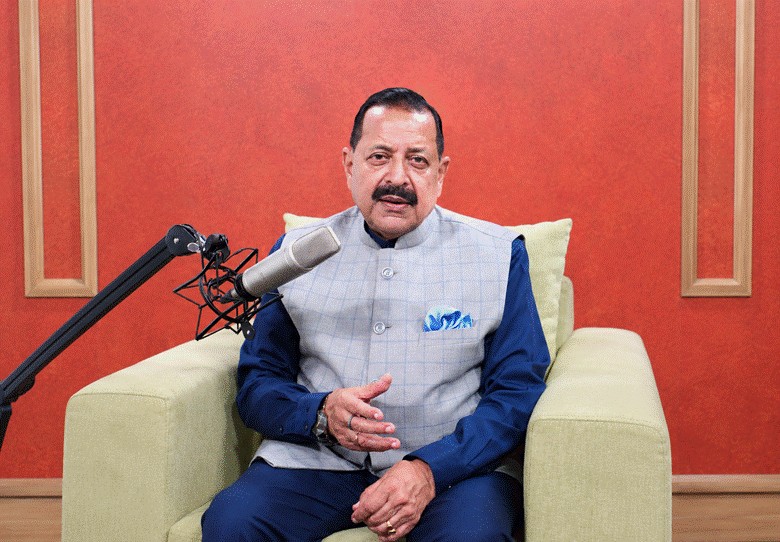
12 years of technological transformation has laid the foundation of 2047: Dr Jitendra Singh

Union Minister of State (Independent Charge) for Science & Technology, Earth Sciences, and Minister of State for PMO, Personnel, Public Grievances, Pensions, Atomic Energy and Space, Dr Jitendra Singh said that the last 12 years of technological transformation has laid the foundation for 2047 and under PM Narendra Modi, India has moved from being a technology follower to a technology leader. This transformation has fundamentally altered India’s position in the global scientific landscape as well, he added.
During a podcast with Doordarshan News, Dr Jitendra Singh said that for decades, India largely adopted technologies developed elsewhere, often entering new technological domains years after leading nations. Today, he said, India is increasingly participating in the development of frontier technologies at the global level and, in several sectors, is helping shape the future direction of innovation itself.
“The last twelve years have witnessed India’s transition from a technology follower to a technology leader. The scientific capabilities, innovation ecosystem and technological infrastructure created during this period have laid the foundation for Viksit Bharat @2047,” Dr Jitendra Singh said.
Dr. Jitendra Singh said, PM Modi brought science and technology to the centre of national policy making, encouraging greater participation of the private sector, promoting innovation-led entrepreneurship and ensuring that scientific advancements translate into benefits for citizens. This approach, he said, has enabled India to build a technology ecosystem that supports economic growth, strategic capability and public service delivery simultaneously.
Referring to India’s growing stature in frontier technologies, Dr Jitendra Singh said the country has registered major advances in space, nuclear energy, quantum technologies, biotechnology, artificial intelligence and clean energy. He said these sectors are collectively creating the scientific and technological foundation required for a developed India by 2047.
On the space sector, the Minister said India has built one of the world’s most dynamic space ecosystems following the opening of the sector to private participation. He said the number of space startups has grown from single digits to more than 400, while India’s space economy, currently estimated at around USD 9 billion, is projected to expand significantly in the coming years.
Dr Jitendra Singh said India’s space achievements have transformed public engagement with science and inspired a new generation of innovators and entrepreneurs. He added that space technologies today support communications, infrastructure planning, governance, disaster management, agriculture and national security, making them increasingly relevant to everyday life.
The Minister described the advancement of the Prototype Fast Breeder Reactor as a major milestone in India’s long-term energy strategy. He said the achievement takes forward the three-stage nuclear programme envisioned by Dr Homi Jehangir Bhabha and strengthens India’s pathway towards energy security and self-reliance.
Dr. Jitendra Singh said recent reforms enabling greater private sector participation in the nuclear sector have opened new opportunities for startups, entrepreneurs and technology-driven enterprises. The reforms, he added, are expected to accelerate innovation and expand India’s capabilities in advanced energy technologies.
Highlighting progress under the National Quantum Mission, Dr Jitendra Singh said India has already achieved nearly half of its targeted 2,000-kilometre quantum communication capability within the initial years of implementation. He said the pace of progress reflects India’s growing competence in one of the world’s most strategic technology domains. The Minister said quantum communication technologies will play a crucial role in strengthening secure communications, defence preparedness and next-generation digital infrastructure, positioning India among a select group of countries working at the cutting edge of quantum science.
On biotechnology, Dr Jitendra Singh said India is preparing for a biotechnology-driven industrial transformation through the BioE3 Policy. He said the future economy will increasingly be shaped by advances in biotechnology, genetics and bio-manufacturing, and India is taking proactive steps to establish leadership in these domains. He referred to ongoing initiatives in genome sequencing, rare disease diagnosis and treatment, indigenous drug development and gene-therapy breakthroughs as examples of India’s growing scientific capability. He said these developments are strengthening the country’s ability to deliver solutions with both national and global relevance.
Speaking about Artificial Intelligence, the Minister said AI is emerging as a transformative force across governance, healthcare, agriculture, communications, scientific research and public service delivery. He said India is pursuing a balanced approach that combines human expertise with AI-enabled systems to improve efficiency, innovation and citizen-centric governance. Dr Jitendra Singh said the IndiaAI Mission is creating a strong foundation for future leadership in advanced digital technologies through investments in computing infrastructure, datasets, innovation and emerging applications.
The Minister said India’s broader innovation ecosystem has expanded rapidly over the last decade, reflected in the country’s rise as one of the world’s leading startup destinations, significant growth in patent filings, improved global innovation rankings and increasing scientific publications. He said India is no longer viewed merely as a consumer of technologies developed elsewhere but is increasingly recognised as a nation capable of generating original innovations and solutions for global challenges.
Referring to clean energy, Dr Jitendra Singh said India is pursuing a diversified strategy encompassing nuclear energy, green hydrogen, solar power and emerging ocean-based energy systems. These initiatives, he said, are aligned with the country’s long-term commitment to sustainable development and net-zero emissions by 2070.
The Minister said the next phase of India’s growth will increasingly be driven by underexplored sectors such as the blue economy, deep ocean resources, Himalayan bio-resources, advanced biotechnology and next-generation manufacturing technologies. He said India possesses unique natural and scientific advantages in many of these domains and is well-positioned to convert them into engines of national growth.
Concluding, Dr Jitendra Singh said that the journey of the last twelve years should be viewed as the beginning of a larger national transformation. He said the scientific confidence, technological capabilities and innovation ecosystem built during this period have positioned India to emerge as a leading knowledge economy and achieve the vision of Viksit Bharat @2047.

Indian Railways Recommends Premature Retirement of Five Group A Officers
New Delhi, Aug 2026 : Indian Railways has recommended the premature retirement of five Gro…

Indian Railways Recommends Premature Retirement of Five Group A Officers
New Delhi, Aug 2026 : Indian Railways has recommended the premature retirement of five …