United States Strikes Iran Again.

Tehran/Washington DC; July 2026: At around 06:30 hours (IST) today (Thursday – 09th July 2026), the CENTCOM has issued a press release that:
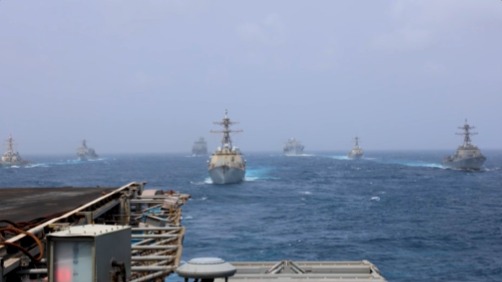
“At the direction of the Commander in Chief, US Central Command forces have started conducting additional strikes against Iran to further degrade their ability to threaten freedom of navigation in the Strait of Hormuz. The United States is holding Iran accountable for recent unjustified aggression against commercial shipping and civilian crews freely navigating a vital international waterway”.
Today (09th July) early morning, Kuwait said it was “confronting hostile missile and drone attacks”. Emergency sirens also sounded in Bahrain. The two countries did not specify the source of the threats, but Iranian counterattacks against US allied Gulf states have closely followed previous US strikes on Iran.
Hours earlier, at Ankara on the sidelines of the NATO Summit, US President Donald Trump had vowed to “hit Iran hard again tonight”. When asked about the three-month-old ceasefire between the two countries, which has repeatedly been mired by on-and-off fighting, he told reporters: “As far as I’m concerned, it’s over”.
After today’s strikes began, Trump reiterated on Truth Social that “it will get much worse” if Iran attacks more ships. The latest round of fighting could endanger already tenuous peace negotiations between the U.S. and Iran. The two sides signed a memorandum of understanding last month to extend their ceasefire by 60 days, reopen the Strait of Hormuz, end a U.S. blockade on Iranian ports and begin easing sanctions on Iran. The two countries also agreed to hold two months of further talks to tackle thorny issues like the fate of Iran’s nuclear program.
Since then, there have been a handful of military exchanges between the U.S. and Iran, and both countries have accused each other of violating the deal. Commercial ships have begun returning to the Strait of Hormuz, easing oil prices, but Iran has continued to push for some degree of control over the strait — a demand the U.S. has rejected.
WHY IS THIS ESCALATION –
After the US and Iran finally agreed an interim deal last month (June 2026) to reopen the Strait of Hormuz and extend a ceasefire, Donald Trump told the “ships of the World, start your engines. Let the oil flow!”
Yet in three and a half weeks since the US president announced the strait would be open “toll free”, the passage of ships, and flow of oil, has at best been a stalemate with intermittent tenuous stop-start, as the vital waterway remains the key point of contention. With the recent attacks by IRGC on Tuesday (07th July 2026), a fresh exchange of strikes broke out between the US and Iran, Trump said he believed their fragile ceasefire was “over”.
Mediators are persuasive in keeping the diplomatic process on track, but their task is constantly being challenged by two competing forces: Trump’s push to get ships moving through the strait quickly to ease an energy crisis ahead of US midterm elections, and Iran’s resistance to any dilution of its control over the waterway. This has fostered a repeated cycles of tit-for-tat attacks. Each time Iran targets shipping in the strait that is not using the routes it wants, the US responds by striking the Islamic republic and Tehran retaliates.
For Iran, the strait, which it had never closed before the US and Israel launched the war on February 28, has become its most powerful source of leverage as it has raised the costs of the conflict to the global economy. Iran is now loath to fully relinquish the key card it holds in negotiations that are supposed to focus on a final settlement.
“Iran does not want to cede its leverage over the strait, its weapon of mass disruption, before a broader deal is reached on US economic relief”, said Ellie Geranmayeh, of the European Council on Foreign Relations. “For Trump, the reopening of the strait is at the heart of the memorandum of understanding, and without it, he will be under immense pressure by Republican hawks to resume war with Iran”, while further adding that: “The two sides should have come up with a mutually acceptable protocol for the strait before they signed the MoU. The longer the absence of such an understanding continues, the more deadlocked the strait becomes, and the more likely that Washington and Tehran return to full-blown war”.
Under the MoU signed last month, Tehran agreed to allow ships through the strait without charge during a 60-day extension of the April 8 ceasefire. In return, the US would lift its naval blockade on Iranian ports. Iran would demine the strait within 30 days, with traffic supposed to gradually return to prewar levels. Furthermore, as a financial incentive, the US granted Tehran a waiver to sell its crude and oil-related products in dollars.
But Tehran said it would impose “service fees” in future. The precarious deal was swiftly tested as Tehran insisted ships use a route close to its coastline where it can monitor traffic through the waterway, through which about a fifth of the world’s oil and liquid natural gas passed before the war.
The US, however, has encouraged vessels to transit near the coast of Oman, whose territorial waters flow through the waterway. That has enabled American warplanes to provide air cover to ships since the end of May. The emergence of the alternative route has frustrated Iran as it has reduced its control, said a diplomat briefed on the matter.
That friction came to the fore days after US Vice-President JD Vance led a high-level delegation to Switzerland on June 21 for the first round of high-level talks on a final settlement, including a deal on the Islamic republic’s nuclear programme. The parties agreed to set up a hotline to avoid incidents in the strait, counter miscommunications and co-ordinate on shipping as mines were cleared.
But within days, Iran had fired at a ship as it warned vessels not to use what it called unauthorised routes. That triggered a cycle of retaliatory attacks. The warring parties then held several days of talks in Qatar, one of the lead mediators, last week.
Those negotiations focused on the strait as disputes over the waterway detracted from the already challenging diplomatic push for progress on a nuclear deal within the 60-day ceasefire extension. While, the mediators believed they had made tentative progress; but then the latest attacks erupted, further rattling an already nervous shipping industry. Even before that, shipping companies had warned that it would take time to restore confidence and bring down insurance premiums.
The US-Iran talks had been expected to resume on July 12, after this week’s days-long funeral of Iran’s assassinated supreme leader, Ayatollah Ali Khamenei, was completed. But in the current impasse, it was not clear if they would now go ahead. Trump said yesterday (Wednesday – 08th July; IST) that negotiators “can talk, but I think they’re wasting their time”.
Under the MoU, the future status of the strait was supposed to be discussed between Iran, Oman and other Gulf states. But since the interim deal was signed on June 17, Iran has attacked 05 vessels along Oman’s coast, including tankers belonging to Saudi Arabia and Qatar, despite the latter’s role in mediation. Iran’s powerful Revolutionary Guards have been hailing ships over the radio and telling them to change course to the Iranian route, said people with knowledge of the situation.
In a sign of escalating tensions, alongwith the mounting US’s frustration, Donald Trump asserted on Tuesday (07th July) it was revoking the waiver on Iran oil sales.
The UK’s Maritime Trade Operations (UKMTO) Centre that day increased the threat level to “severe”. This would “have an effect on the feasibility of ships to take the risk to go through”, one shipping executive said.
Arsenio Dominguez, secretary-general of the International Maritime Organization (IMO), said yesterday (08th July) that he has urged “shipowners, ship operators and all relevant authorities to avoid exposing seafarers to unnecessary danger by transiting the strait”.
More than 570 vessels have passed through the strait since the MoU, of which almost three-quarters have been exiting the Gulf, according to Lloyd’s List Intelligence. More than 150 transits have been crude oil tankers. Despite the strikes, a handful of ships, including 01 belonging to the French container shipping line CMA-CGM and 01 Indian cargo carrier, sailed through on Wednesday morning following the route set out by Iran. But several ships that appeared to have been heading for the Omani route early yesterday, including the Indian-owned crude oil tanker Lila Vadinar and an Adnoc-operated LPG tanker, made U-turns, according to ship-tracking data. Others including Singaporean tanker Mercury Hope appeared to divert course from the Omani to Iranian coastal route.
Team Maverick.






The Ukrainian Alchemist Who Tricks Russian Missiles Into Thinking They’re Flying Over Peru.
Kyiv; July 2026: As Russia escalates its recent strikes on Ukraine killing several, and da…

The Ukrainian Alchemist Who Tricks Russian Missiles Into Thinking They’re Flying Over Peru.
Kyiv; July 2026: As Russia escalates its recent strikes on Ukraine killing several, and …