India Showcases Unique ‘Duck Drop’ Capability, Becoming Asia’s Only Nation to Demonstrate Airborne RHIB Insertion

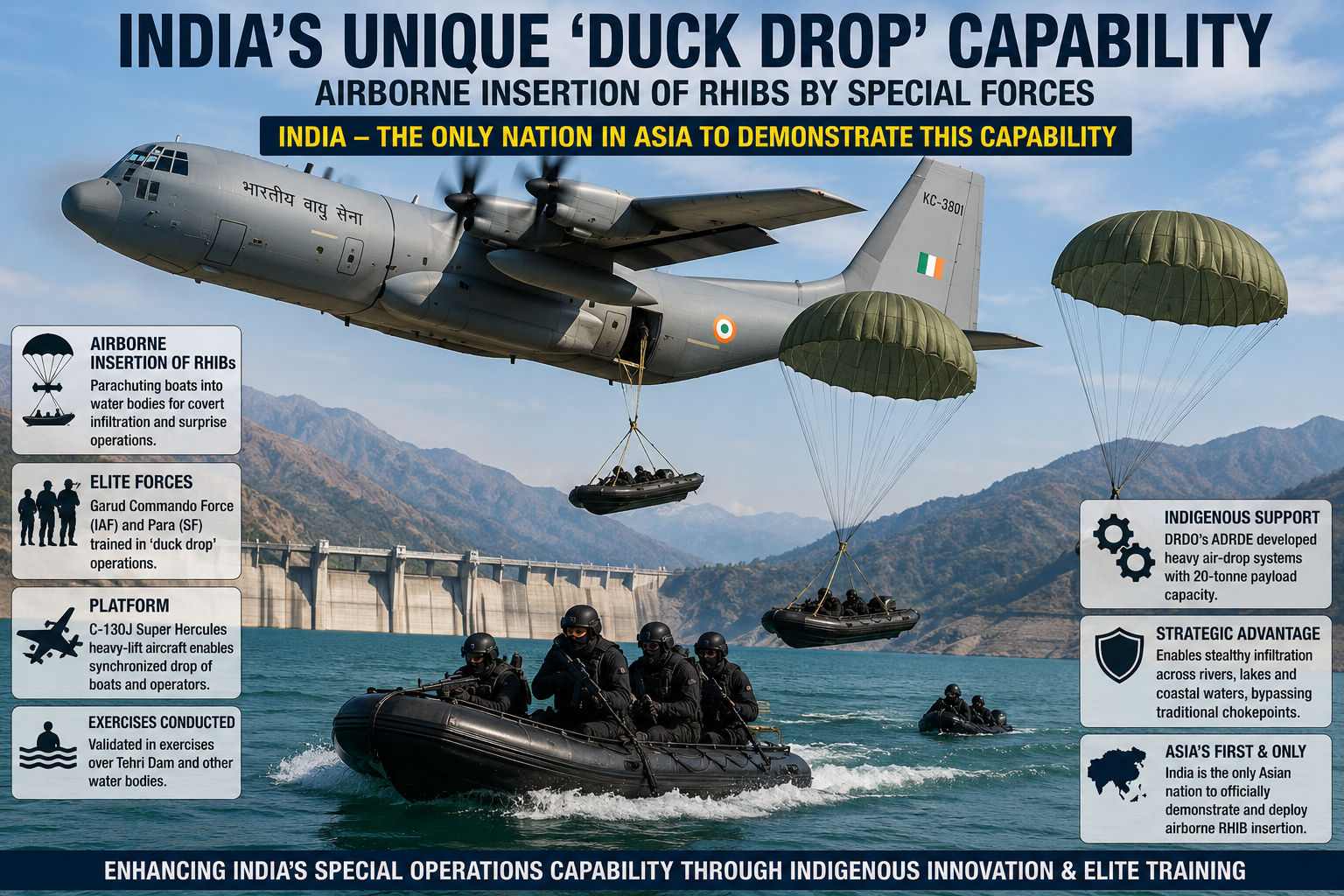
New Delhi, July 2026 : India has emerged as the only country in Asia to officially demonstrate and operationally deploy the airborne insertion of Rigid-Hulled Inflatable Boats (RHIBs) using a specialised military technique known as the “duck drop.” The capability enables elite Indian special forces to parachute military boats directly into lakes, rivers and coastal waters from heavy-lift aircraft, allowing them to launch covert operations in areas that are difficult to access through conventional routes.
The unique capability has been developed and refined by elite units such as the Garud Commando Force of the Indian Air Force and the Para (Special Forces) of the Indian Army. It combines advanced airborne insertion techniques with specialised equipment and indigenous aerial delivery systems, significantly enhancing India’s ability to conduct unconventional warfare and special operations.
At the heart of the operation is the Lockheed Martin C-130J Super Hercules, one of the Indian Air Force’s most versatile tactical transport aircraft. The aircraft is capable of simultaneously dropping RHIBs and specially trained commandos into designated water bodies with remarkable precision. Once the boats land safely under parachutes, commandos quickly regroup, recover the craft and begin their mission, enabling rapid infiltration into hostile or inaccessible areas.
This method allows special operations teams to avoid conventional coastal landings or river crossings, reducing the risk of detection while increasing operational surprise. Such capabilities are particularly valuable in missions involving counter-terrorism, hostage rescue, reconnaissance, maritime security, cross-border infiltration and operations deep behind enemy lines.
India has already validated this capability during military exercises conducted over the Tehri Dam reservoir in Uttarakhand, where commandos successfully practised airborne insertion into inland water bodies. These exercises simulated real-world scenarios involving riverine and reservoir-based operations, allowing troops to rehearse covert infiltration under conditions resembling those found in contested border regions.
The “duck drop” concept reflects the growing importance of multi-domain warfare, where air, land and water operations are integrated into a single coordinated mission. By deploying RHIBs directly from transport aircraft, Indian special forces can establish operational footholds in strategically important waterways, bypass enemy defences and rapidly project force into otherwise inaccessible areas.
Supporting this sophisticated capability is India’s expanding indigenous defence manufacturing ecosystem. The Defence Research and Development Organisation (DRDO), through its Aerial Delivery Research and Development Establishment (ADRDE), has played a key role in developing advanced heavy air-drop systems required for such operations.
Working in collaboration with Indian private industry, ADRDE has developed aerial delivery platforms capable of safely transporting payloads weighing up to 20 tonnes. These systems have successfully undergone extensive testing at the Mahajan Field Firing Ranges in Rajasthan, where they demonstrated the ability to airdrop armoured personnel carriers and other heavy military platforms using twin 28-foot extractor parachutes.
Although these systems are designed for a variety of military payloads, the technology and expertise developed through these programmes also strengthen India’s ability to deploy RHIBs and specialised equipment during airborne special operations. Indigenous development reduces dependence on imported technologies while providing greater flexibility for future upgrades tailored to Indian operational requirements.
Military experts note that the airborne insertion of RHIBs is far more than a technological achievement—it represents a sophisticated operational doctrine that demands extensive planning, coordination and training. Pilots, aircrew and special forces personnel must execute highly synchronised procedures to ensure the boats and commandos land safely and are immediately ready for combat operations.
The tactic provides commanders with several strategic advantages. Forces can infiltrate through rivers, lakes and coastal waters without relying on ports or established landing zones, enabling surprise attacks, intelligence-gathering missions and rapid deployment into sensitive areas. Such flexibility is increasingly important as modern military operations require rapid response across diverse terrains.
India’s successful demonstration of this capability also reinforces the country’s emphasis on Atmanirbhar Bharat and the Make in India initiative in the defence sector. The collaboration between DRDO, domestic industries and the armed forces has created an indigenous ecosystem capable of supporting advanced military technologies that were once available only through foreign suppliers.
Globally, only a handful of militaries possess operational expertise in airborne RHIB insertion. While several countries maintain highly capable special operations forces, India is currently the only nation in Asia to have publicly demonstrated and operationalised this specialised capability.
As India’s armed forces continue to modernise, the integration of elite training, advanced transport aircraft and indigenous aerial delivery systems is expanding the country’s ability to conduct complex multi-domain operations. The “duck drop” capability not only strengthens India’s special operations forces but also underscores its growing position as a leader in unconventional warfare and advanced military innovation in the Indo-Pacific region.
(The content of this article is sourced from a news agency and has not been edited by the Mavericknews30 team.)




Operation Southern Readiness 26-2 Commences At Southern Naval Command, Kochi
Operation Southern Readiness 26-2, a four-day multinational maritime security trainin…
Operation Southern Readiness 26-2 Commences At Southern Naval Command, Kochi
Operation Southern Readiness 26-2, a four-day multinational maritime security training engagement, commenced at Southern Naval …