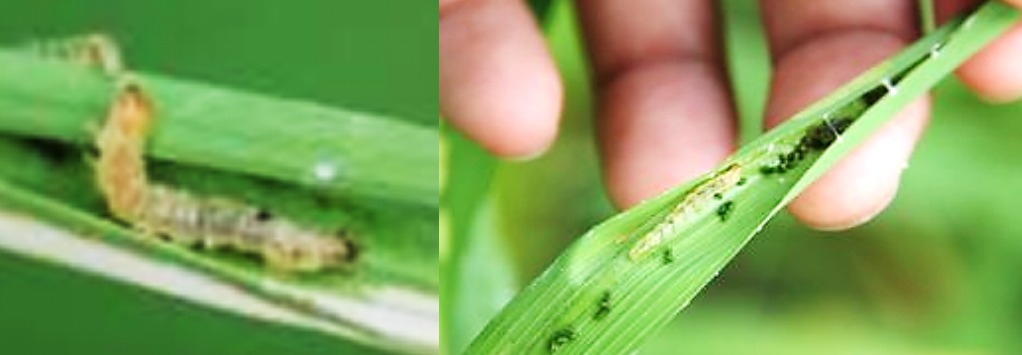
Leaf folder caterpillar invasion devastates jhum fields in Khawzawl District.

A sudden outbreak of leaf folder caterpillars has caused significant damage to jhum cultivation in three villages under Khawzawl district, affecting over 80 farming families, officials from the district Agriculture and Farmers’ Welfare office said on Sunday.
Following reports from affected villagers, a team, led by Assistant District Agriculture Officer Lalrammuana, was dispatched on Saturday to assess the situation in Vangtlang, Chalrang and New Chalrang.
According to the preliminary survey, paddy fields in Chalrang and New Chalrang — which share a common jhum area — have been infested by swarms of ‘Cnaphalocrocis medinalis’, commonly known as the leaf folder caterpillar. Of the 210 farming families cultivating in the area, around 70 have reported severe infestation.
In the neighbouring Vangtlang village, paddy plots belonging to at least 80 families have also come under attack, with 10 families reporting high concentrations of the pests. Reports have also emerged of maize fields being affected in parts of Khawzawl town and Neihdawn village. In response, agriculture officials have distributed insecticides and pesticides to the affected farmers along with instructions on proper usage. Authorities remain cautiously optimistic that timely intervention will prevent the infestation from significantly reducing the upcoming harvest.
Leaf folder caterpillars are the larval stage of certain moths, known for their habit of rolling or folding leaves around themselves for protection and feeding. These caterpillars then feed within the folded leaf, often creating transparent or whitish streaks on the leaf as they consume the green tissue. Adult moths are medium-sized (8-10 mm long and 16-20 mm wing expanse). They are light brown with shiny, brownish-yellow wings adorned with dark, broad margins and 2-3 dark vertical stripes. Eggs are oval, creamy white. Newly emerged larvae are dull white or light yellow with a brown head, but soon turn green once feeding starts. Fully-grown larvae are slender and 20-25 mm long.
Leaf folder caterpillars primarily damage plants by feeding on the leaves, causing visible streaks or patches on the foliage. In severe infestations, the damage can lead to a scorched or whitish appearance of the entire field. Plants are particularly vulnerable to leaf folder damage during their early growth stages.
Biological Control: Natural enemies like parasitic wasps can help control leaf folder populations; ratooning needs to be avoided; The filed should be flooded and ploughed after harvesting if possible; grassy weeds should be removed from fields and borders; the density of planting should be reduced.
Chemical Control: In severe cases, insecticides may be necessary, but it’s best to consult with local agricultural experts for recommendations.
Resistant Varieties: Some resistant varieties of rice include Cauvery, Akashi, TKM 6, TKM 12, ADT 46, TPS 2, TPS 3, ADT 44, PY 4, Kairali, Ahalya, Kunju Kunju varna, Kunju Kunju Priya, Reshmi (PTB 44), Neeraja (PTB 47) and Deepthi.
Team Maverick








CM Yogi directs action on 2,200 proposals: Budget to be released by July 15, projects to be launched on the ground from August 15
CM takes a tough stand during PWD review, warns of action over delays in pending projects …

CM Yogi directs action on 2,200 proposals: Budget to be released by July 15, projects to be launched on the ground from August 15
CM takes a tough stand during PWD review, warns of action over delays in …