‘Suna Besha’ epitomises Triumph and Solidarity.

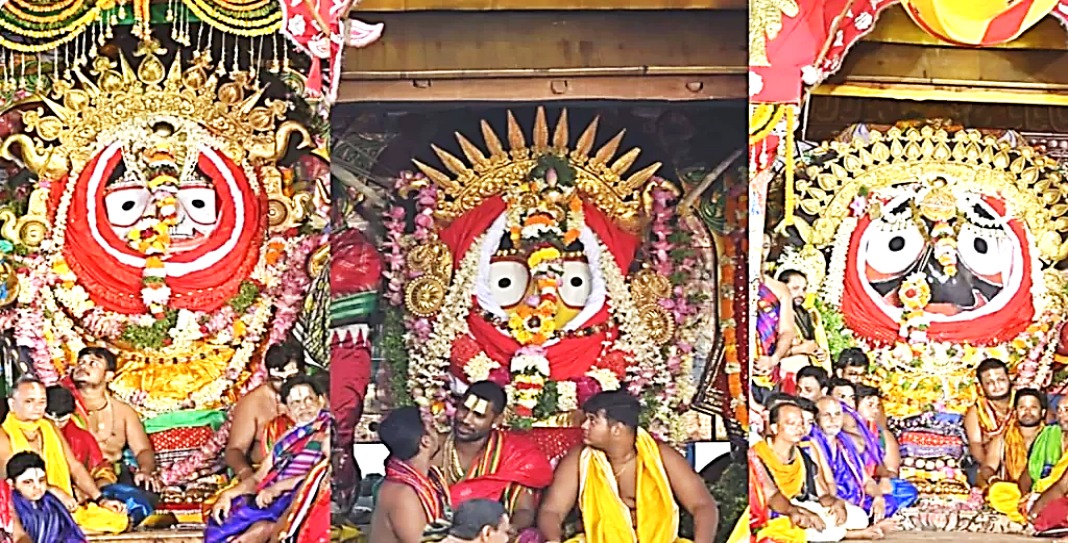
‘Suna Besha’, the ornamental extravaganza is being celebrated with paramount rejoice and gaiety at the Singhadwara of the famous Jagannath Temple in Puri, Odisha, today on 06/07/2025. This also marks, the conclusion of the Ratha Yatra, paving the way for the deities to move inside the temple’s sanctum during the Niladri Bijay ritual on 08th. July, 2025, marking the end of the Rath Yatra festival. The gold ornaments are carefully removed and returned to the Bhitara Bhandaraghara, guarded by temple police and storekeepers.
Several thousands of devotees, enthusiast’s throng all along for a glimpse of the extravaganza displayed for viewing; A belief that a glimpse of the Lord during Suna Besha can wash away sins, fulfill wishes, and bring spiritual liberation amidst deep spiritual awakening and connection with the eternal.
Suna Besha, also known as Rajadhiraja Besha; Raja Besha; Bada Tadhau Besha; and Rajarajeshwara Besha, is an event when the deities Jagannath, Balabhadra and Subhadra (the presiding deities of Jagannath Temple, Puri, India) are adorned with gold jewelleries.
As per the Puri Temple’s Doctrine, Suna Besha is observed 5 times during a year. It is commonly observed on [Pousha Purnima] Purnima (January), Bahuda Ekadashi (July), Dasha Hara (October), Kartik Purnima (November), and Dola Purnima (March). The name Suna Besha is derived from two words, ‘Suna’ meaning “gold” and ‘Besha’ meaning “costume”
The most revered Suna Besha event is observed, on Bahuda Ekadashi during the Rath Yatra, on the chariots placed at the Lion’s Gate (also called Singhadwara; the other four Besha’s are observed inside the temple on the Ratna Singhasana (gem studded altar).
On this occasion gold plates are decorated over the hands and feet of Jagannath and Balabhadra; Jagannath is also adorned with a Chakra (disc) made of gold on the right hand while a silver conch adorns the left hand. However, Balabhadra is decorated with a plough made of gold on the left hand while a golden mace adorns his right hand.
As per Hindu Mythology, during the reign of Ananga Bhima Deva, the king of Utkal, Lord Jagannath was declared as ‘Utkal Samrat’ or “Lord of the Nation” in the 13th century, and by then the Jagannath Temple at Puri had been built by him in 1198.
According to temple history, Suna Besha was introduced during the reign of King Kapilendradeva in 1460 A.D. When Kapilendradeva (r.1434-1466 AD) returned home triumphant after winning wars over the rulers of the Deccan (Southern India) he brought a huge bounty which was carried in 16 cart loads (on 16 elephants is also mentioned). The trophies which he collected consisted of diamonds and gold. On the advice of the prominent Tadhau Karana servitor of Jagannath Temple, Puri, Kapilendradeva donated all the looted bounty to Lord Jagannath, this Besha was also called Bada Tadhau Besha named after the Tadhau Karana servitor of Jagannath temple Puri from Karana community. He instructed the temple priests to get ornaments crafted out of the gold and diamond he had donated to adorn the deities on the occasion of the Ratha Yatra festival. Since then, the deities, Jagannatha, Balabhadra and Subhadra are decorated with these jewelleries after the Bahuda Yatra.
The ornaments used in the Suna Besha are both intricate and symbolic, each piece carrying spiritual significance. Some of the key ornaments include:
- Suna Hasta (Golden Hands): Gold plates shaped like hands, adorned on the deities’ arms.
- Suna Payar (Golden Feet): Gold plates for the feet, symbolizing divine grace.
- Suna Mukuta (Golden Crown): Elaborate crowns encrusted with gems, signifying royalty.
- Suna Mayur Chandrika: Golden peacock feather worn by Lord Jagannath, representing his identity as Lord Krishna.
- Suna Chulapati – Golden ornament worn traditionally on the forehead to increase the beauty of the face
- Suna Kundal (Golden Earrings): Ornate earrings that enhance the deities’ divine appearance.
- Suna Rahurekha: Half-square-shaped golden aura around the deities’ faces, symbolizing their divine radiance.
- Suna Mala: Gold necklaces in various designs, adding to the regal splendor.
- Padma Mala – Lotus Shaped
- Sevati Mala – Shaped Like Small Sun Flower
- Kadamba Mala – Kadamba Flower Design (Round ball shape)
- Kante Mala – Big Gold Beads Design
- Agasti Mala – Moon Shaped flower design
- Mayur Mala – Shaped in Peacock feathers
- Champa Mala – Shaped liked Yellow Champa Flower
- Suna Chakra – Golden Wheel
- Suna Gada – Golden bludgeon
- Suna Padma – Golden lotus
- Rupa Sankha – Silver conch
- Chakra and Conch (for Lord Jagannath): Gold chakra (disc) on the right hand and a silver conch on the left, symbolizing his divine powers.
- Plough and Mace (for Lord Balabhadra): Gold plough on the left hand and a golden mace on the right, representing strength and protection.
- Kireet and Shri Payara: Crowns and ornaments symbolizing royal power.
- Chandra Surjya: Moon and sun discs, denoting cosmic balance.
These ornaments, some weighing up to 150 tolas (approximately 1.7 kg) each, are crafted with to the edge precision and are stored under heavy security in the temple’s treasury when not in use. The total weight of the gold used in the Suna Besha was historically reported to be over 208 kg, though current estimates suggest that 20–30 designs are now used due to practical considerations.
Team Maverick

Netanyahu Meets Trump at White House for Eighth Bilateral Talks Amid Regional Tensions
Jerusalem/Washington, July 2026 : Israeli Prime Minister Benjamin Netanyahu arrived at the…
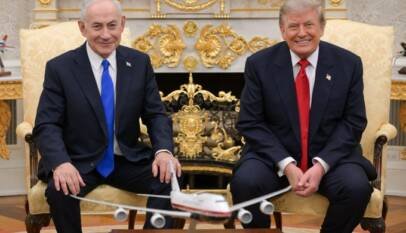
Netanyahu Meets Trump at White House for Eighth Bilateral Talks Amid Regional Tensions
Jerusalem/Washington, July 2026 : Israeli Prime Minister Benjamin Netanyahu arrived at the White House …