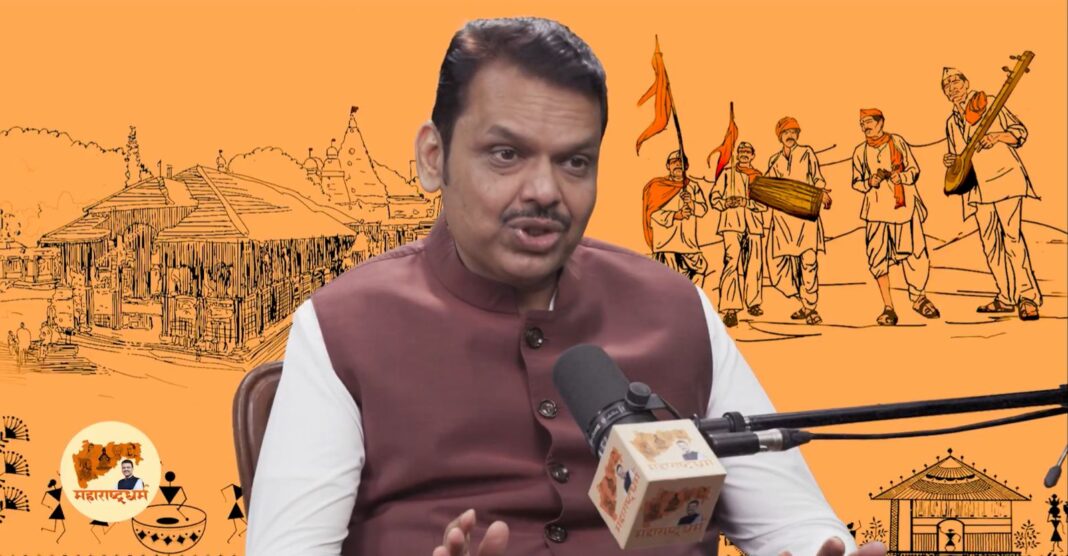
“Maharashtra Dharma… Never Stopped, Never Broke!”

CM Devendra Fadnavis Launches Special Podcast Series on Maharashtra’s Spiritual and Cultural Legacy
Mumbai – “From the abhangs of Saint Dnyaneshwar to the sword of Shivaji Maharaj, from the fearless reforms of Mahatma Phule to the vision of Bharat Ratna Dr. B.R. Ambedkar – Maharashtra’s legacy is a living chain of values that never broke and continues to evolve,” said Chief Minister Devendra Fadnavis as he launched a special podcast series titled ‘Maharashtra Dharma’ on the auspicious occasion of Ashadhi Ekadashi.
The podcast was inaugurated with an insightful conversation between CM Fadnavis and renowned scholar and author Dr. Sadanand More, a descendant of Sant Tukaram Maharaj and an expert in spiritual literature.
Fadnavis noted that though not direct descendants of saints and reformers, today’s citizens are heirs to their legacy of thought, sacrifice, and vision. “Preserving and advancing their ideals is not just our responsibility, but our ‘Maharashtra Dharma’ – not a religion, but a living ethical code that tells us to think wisely, act selflessly, and stand bravely,” he emphasized.
A Journey through Maharashtra’s Glorious Past
The first episode, titled “Maharashtra Dharma: Foundation and Growth,” traces the spiritual and cultural roots of Maharashtra. Fadnavis discussed everything from the Ramayana and Mahabharata, to Buddha’s teachings, and the Bhakti movement that deeply influenced the state. He explored how saints and sages contributed to Maharashtra’s ethos and how this spiritual foundation inspired political and social reform.
The episode was streamed on CM Fadnavis’ social media platforms and received enthusiastic responses from listeners.
Maharashtra – A Land of Divine Footprints
Fadnavis began by stating that the story of Maharashtra starts with divine footsteps, with references found in the Ramayana’s Dandakaranya and Mahabharata’s Vidarbha region. He recalled legends of Rukmini’s rescue by Krishna, the Pandavas’ stay in Chikhaldara, and the spiritual messages of Lord Buddha, which were engraved into stone in Ajanta’s silent hills. “Maharashtra didn’t just listen to Buddha’s teachings – it preserved them in caves, memory, and soul,” he said.
The land also became a haven for saints, thinkers, and spiritual seekers. The Karveer Peeth, founded by Adi Shankaracharya in the south, symbolizes Maharashtra as a bridge between North and South India.
Pandharpur Wari – A Living Tradition
“Maharashtra’s soil began to speak through its saints,” said Fadnavis, referring to the Bhakti movement. From Chakradhar Swami’s egalitarian Mahanubhav sect to the wari tradition of humility and devotion, the state nurtured a rare form of cultural democracy. He praised the contributions of Sant Dnyaneshwar, Muktabai, Namdev, Eknath, and Tukaram, calling their teachings universal. “Their abhangs didn’t just preach – they created a walking, talking culture,” he said, adding that this tradition survived Mughal and British invasions, remaining unbroken even today.
He also highlighted how Artificial Intelligence has entered the Pandharpur Wari, showing how tradition and technology can co-exist.
From Shivaji’s Sword to the Maratha Empire
Fadnavis paid tribute to Chhatrapati Shivaji Maharaj, emphasizing his fight for Dharma, not power. “He wasn’t just a warrior; he was a symbol of moral governance,” he said, describing how Shivaji’s values were shaped by his mother, Rajmata Jijabai.
He recounted how Sambhaji Maharaj, Peshwa Bajirao I, and Mahadji Shinde further expanded the Maratha empire, even reaching Delhi and pushing the Maratha sword to the banks of the Yamuna. “These were not just battles – they were assertions of cultural pride and national unity,” he said.
Celebrating Courageous Women
The CM also celebrated courageous women like Maharani Tarabai, who led the resistance against Aurangzeb, Umabai Dabhade, and the legendary Ahilyabai Holkar, who laid the foundation of social justice in a male-dominated era.
“These women were not just rulers – they were strategists, warriors, and social reformers,” said Fadnavis.
Maharashtra – The Cradle of Social Reform
“Maharashtra didn’t just give birth to warriors; it produced defenders of Dharma, thinkers of nationalism, and architects of modern India,” he said.
He narrated how Mahatma Jyotiba Phule challenged caste and patriarchy, while Savitribai Phule defied societal norms to pioneer women’s education. He lauded Lokmanya Tilak for turning tradition into a tool of revolution and Dr. B.R. Ambedkar for defeating discrimination with intellect and education.
“Ambedkar was not just the architect of India’s Constitution. His Mahad Satyagraha, educational reforms, and caste annihilation movement laid the moral foundation of New India,” said Fadnavis.
The podcast also acknowledged Pandita Ramabai’s efforts for widows’ rights, Gopal Ganesh Agarkar’s rationalism, Sant Gadge Baba’s emphasis on inner purity, and Karmaveer Bhaurao Patil’s mission to educate the marginalized.
The rural wisdom of Rashtrasant Tukdoji Maharaj, author of Gram Gita, also found mention, showcasing Maharashtra’s unmatched contribution to rural empowerment.
Maharashtra Dharma – A Living Value System
Reiterating his core message, CM Fadnavis said:
“Maharashtra Dharma is not a religion. It is a living value system. It teaches us to think with reason, act with compassion, and rise with courage. From the poetic ovi of Dnyaneshwar to the sword of Shivaji, from the bravery of Phule to the intellect of Ambedkar, this chain has never broken and continues to guide us forward.”
He concluded by sharing that Riddhapur, the land of Govindprabhu, Guru of Chakradhar Swami, has now become the site of the Marathi Language University, which has recently begun functioning – a testament to the legacy of knowledge that Maharashtra continues to uphold.
Note: The ‘Maharashtra Dharma’ podcast is available on all major platforms and CM Fadnavis’ official social media.





Andhra Pradesh Announces Cash Incentive for Higher Births as CM Naidu Pushes Population Growth Agenda
Amaravati, May 2026: In a significant policy shift aimed at addressing declining birth rat…
Andhra Pradesh Announces Cash Incentive for Higher Births as CM Naidu Pushes Population Growth Agenda
Amaravati, May 2026: In a significant policy shift aimed at addressing declining birth rates, …