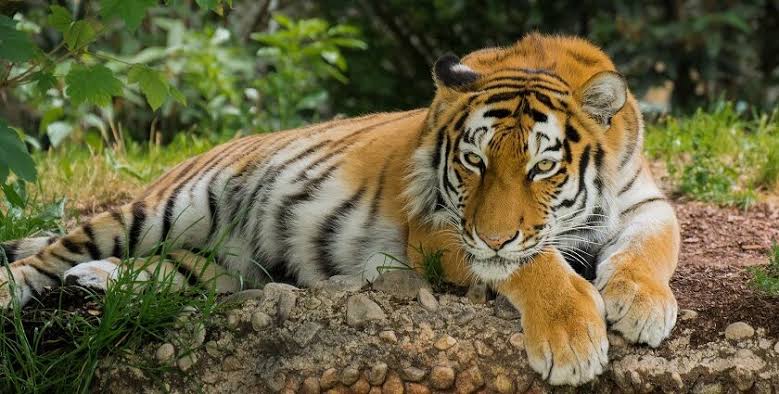
Tiger: Not Just a Predator, But the Breath of the Ecosystem!

In Indian culture, the tiger is not merely a wild animal, but a symbol of power, courage, and ecological balance. From being the mount of Goddess Durga to being engraved on the cannons of Chhatrapati Shivaji Maharaj, its influence is deeply embedded in Indian history. Every year on July 29, International Tiger Day is observed—not just for the animal, but to awaken our collective environmental consciousness.
Though the tiger stands at the top of the food chain as an apex predator, its presence indicates the overall health of the ecosystem. A single tiger occupies approximately 50 to 100 sq. km, and in doing so, helps protect numerous plant and animal species, as well as water sources within its territory. It’s rightly said: Save the tiger, and you save the forest; save the forest, and you save human life.
India once had around 40,000 tigers, but due to reckless hunting and deforestation, the number fell drastically to just 1,400 by 1972. In response, the historic Project Tiger was launched. Today, thanks to sustained efforts, India is home to 3,167 tigers—the highest in the world.
In Maharashtra, Jalgaon district is increasingly contributing to tiger conservation. The Yawal Forest Division has recorded the return of tigers since 2011. Research confirms that tigers migrate from Melghat to Yawal via Waghdaari and Vadoda ranges. In 2024, clear images of a tiger were captured on trap cameras, and in 2025, sightings were also reported from Gautala-Autramghat. According to Assistant Conservator of Forests Samadhan Patil, two tigers are currently in transit in Yawal, and another, known as the “Banana Tiger,” is occasionally spotted in Muktainagar. Recent pugmarks found along the Pal Jungle Safari route also hint at active tiger presence, with the safari expected to begin soon.
Adding to these developments, on May 12, 2024, during Buddha Purnima, a special wildlife census was conducted under the full moon across seven forest zones: Chopda, Vaijapur, Adavad, Devjhiri, Yawal (East-West), and Raver. The event, involving 80 nature enthusiasts, recorded 584 wild animals from 39 machans (observation platforms). Species observed included herbivores like nilgai, chinkara, barking deer, sambar, four-horned antelope, blackbuck, and carnivores like leopards, wolves, foxes, jungle cats, jackals, and bears. Most notably, one tiger and four leopards were sighted in Raver—highlighting the coexistence of various species in tiger habitats.
The success of these conservation efforts is not just a win for the Forest Department but for the entire district. It was made possible by the cooperation of the district administration, enthusiastic nature lovers, and dedicated leadership from Ms. Ninu Somraj (Chief Conservator), Mr. Jameer Shaikh (Deputy Conservator), Mr. Samadhan Patil, and ground-level forest officers and staff.
Saving the tiger is not just about preserving one species—it’s about securing our climate, water, soil, forests, and ultimately, our future. To truly honor this mission, we must combat deforestation, raise our voices against poaching, enhance environmental education, and promote responsible tourism.
On this International Tiger Day, let us pledge:
“Save the Tiger, Save the Forest, Save Life!”








FIFA World Cup 2026: France, Spain, England and Argentina Set for Blockbuster Semi-final Showdowns
July 2026 : The FIFA World Cup 2026 has reached its decisive stage with four of world foot…

FIFA World Cup 2026: France, Spain, England and Argentina Set for Blockbuster Semi-final Showdowns
July 2026 : The FIFA World Cup 2026 has reached its decisive stage with …