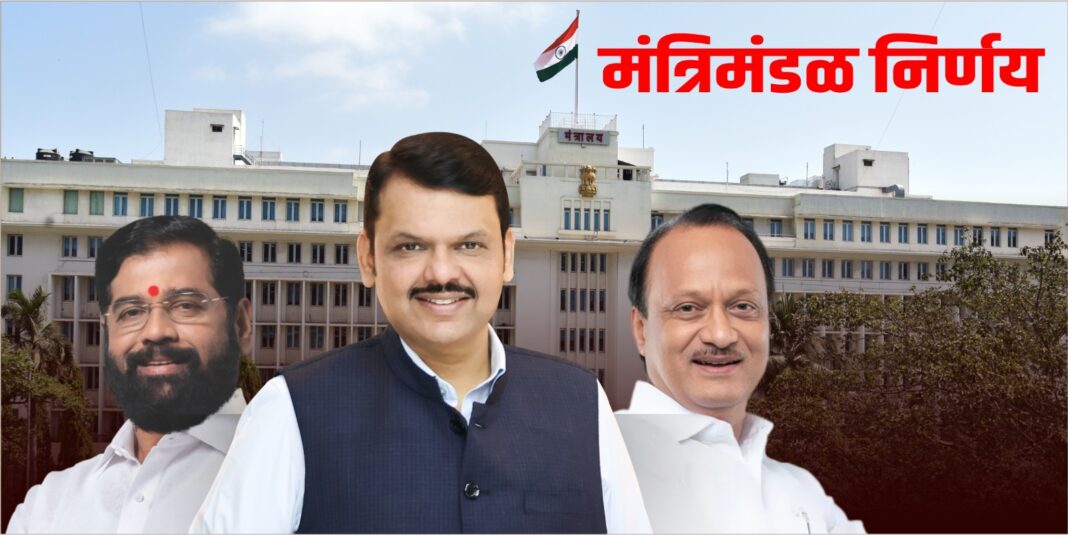
Maharashtra Cabinet Decision

Maharashtra Startup, Entrepreneurship, and Innovation Policy 2025 Announced; Target of 1.25 Lakh Entrepreneurs and 50,000 Startups in Five Years
The Maharashtra Startup, Entrepreneurship, and Innovation Policy 2025 was approved in today’s Cabinet meeting chaired by Chief Minister Devendra Fadnavis. Under this policy, it is planned to nurture 1.25 lakh entrepreneurs and establish 50,000 startups in the next five years. This initiative aims to make Maharashtra the leading state in terms of startups and unicorns, while also creating employment and establishing the state as a global hub for innovation. Special encouragement will be given to startups led by women, youth, and those from urban and rural areas.
Maharashtra currently has the highest number of startups in India. As of May 31, 2025, the state has 29,147 startups, which account for 18% of the total startups in the country. A contemporary policy has been crafted to create a more effective ecosystem for these startups. The policy focuses on developing a robust ecosystem for innovators, entrepreneurs, and investors.
One of the key highlights of this policy is the Chief Minister’s “Maha-Fund”, a Rs. 500 crore fund aimed at supporting 25,000 early-stage entrepreneurs with mentorship, incubation, and financial assistance.
To develop adequate infrastructure, micro-incubators will be established in ITIs, polytechnics, and educational institutions across the state. Additionally, Regional Innovation and Entrepreneurship Hubs will be set up in every administrative division. These hubs will focus on sectors like AI, DeepTech, FinTech, MedTech, Cybersecurity, and Sustainability. A “Maharashtra Innovation City” will be developed over 300 acres, bringing together startups, corporates, educational institutions, and the government. This Innovation City will serve as a nucleus for research and innovation.
Startups selected under Maharashtra Startup Week will have the opportunity to work directly with government departments and will be awarded pilot work orders up to Rs. 25 lakh. Financial support will also be provided for patent registrations, product quality certifications, and participation in domestic and international exhibitions. A dedicated mechanism will be established to provide credit assistance to startups that secure work orders from public institutions and other credible clients.
It will be mandatory for every government department to allocate 0.5% of their annual budget towards promoting innovation and entrepreneurship. All schemes under this policy will be implemented through the Maharashtra State Innovation Society.
The policy has been developed with active participation from citizens, startups, academic institutions, incubators, investors, and subject matter experts. Based on their feedback, provisions for regional incubation support, simplified incentive processes, digital literacy, and entrepreneurial skill development have been incorporated.
Under this policy, the Department of Skills, Employment, Entrepreneurship, and Innovation will be recognized as the nodal department. The implementation of the policy will be entrusted to the Maharashtra State Innovation Society, which will be allocated funds every financial year. Additionally, all departments will be required to earmark 0.5% of their available funds for promoting entrepreneurship and innovation.
The Maharashtra State Innovation Society, established in 2017, will be further strengthened to ensure the effective implementation of this new policy. The Society will have a General Body and a Governing Council. The Chief Minister will be the Chairman of the General Body. Secretaries and Principal Secretaries from departments like Industry, Planning, Finance, Agriculture, Public Health, Medical Education, Information Technology, Urban Development, Environment, Transport, School Education, Higher and Technical Education will be members of this General Body. Industry associations, business leaders, and domain experts will also be included as members. The Governing Council will execute the decisions taken by the General Body.
The policy aims to prioritize high-potential sectors such as Artificial Intelligence, FinTech, AgriTech, MedTech, Semiconductors, Cybersecurity, BioTech, SpaceTech, Blockchain, Quantum Computing, Smart Infrastructure, Mobility, and DeepTech.




China Open: Lakshya, Sindhu and Ayush Shetty Advance to Second Round After Gritty Wins
Changzhou (China), July 2026 : India’s top badminton stars Lakshya Sen, P.V. Sindhu …

China Open: Lakshya, Sindhu and Ayush Shetty Advance to Second Round After Gritty Wins
Changzhou (China), July 2026 : India’s top badminton stars Lakshya Sen, P.V. Sindhu and …