
In another major political turn around Germany decides to pause supports for Israel.

The worsening humanitarian crisis in Gaza and Israel’s plans to expand military control over the enclave have pushed Germany to curb arms exports to Israel, a historically fraught step for Berlin driven by a growing public outcry. Conservative Chancellor Friedrich Merz, hitherto a staunchly pro-Israel leader, made the announcement on Friday arguing that Israel’s actions would not achieve its stated war goals of eliminating Hamas’s militants or bringing Israeli hostage’s home.
It is a bold move for a leader who after winning elections in February said he would invite Benjamin Netanyahu to Germany in defiance of an arrest warrant against the Israeli prime minister issued by the International Criminal Court. The shift reflects how Germany’s come-what-may support for Israel, rooted in its historical guilt over the Nazi Holocaust, is being tested like never before as the high Palestinian civilian death toll in Gaza, massive war destruction and images of starving children are chipping away at decades of policy. “It is remarkable as it is the first concrete measure of this German government. But I would not see it as a U-turn, rather a ‘warning shot’“, said Muriel Asseburg, a researcher at the German Institute for International and Security Affairs.
It caps months of the German government sharpening its tone over Israel’s escalating military campaign in the small, densely populated Palestinian enclave, though still shying away from tougher steps that other European countries and some voices in Merz’s ruling coalition were calling for.
The suspension of arms deliveries to Israel would affect just those that could be used in Gaza.
The move reflects a hardening mood in Germany, where public opinion has grown critical of Israel and more demanding that its government help ease a humanitarian disaster – most of the 2.2 million population is homeless and Gaza is a sea of rubble.
According to an ARD-Deutschland TREND survey released on Thursday, a day before Merz’s announcement, 66% of Germans want their government to put more pressure on Israel to change its behaviour. That is higher than April 2024, when some 57% of Germans believed their government should criticise Israel more strongly than before for its actions in Gaza, a Forsa poll showed.
Despite Germany helping air drop aid to Gaza, 47% of Germans think their government is doing too little for Palestinians there, against 39% who disagree with this, the ARD-Deutschland TREND this week showed.
Most strikingly perhaps, only 31% of Germans feel they have a bigger responsibility for Israel due to their history – a core tenet of German foreign policy – while 62% do not. Germany’s political establishment has cited its approach, known as the “Staatsrason”, as a special responsibility for Israel after the Nazi Holocaust, which was laid out in 2008 by then-Chancellor Angela Merkel to the Israeli parliament. Reflecting that stance days before his most recent trip to Israel in July, Merz’s Foreign Minister Johann Wadephul told Die Zeit newspaper that Berlin could not be a “neutral mediator”.
“Because we are partisan. We stand with Israel”, he said, echoing similar statements by other conservative figures in Merz’s party. But Merz’s junior coalition partner, the Social Democrats (SPD), had already been more explicit in wanting to put sanctions against Israel on the table.
Adis Ahmetovic, an SPD foreign policy spokesperson, said suspending weapons shipments was only the first step. “More must follow, such as a full or partial suspension of the (European Union) Association Agreement or the medical evacuation of seriously injured children, in particular“, Ahmetovic told Stern magazine. “Furthermore, sanctions against Israeli ministers must no longer be taboo“.
Critics had argued that Germany’s approach has been overly hesitant, weakening the West’s collective ability to apply meaningful pressure for an end to the fighting and restrictions on humanitarian aid to the Israeli-besieged enclave. Germany had hitherto even been cautious about a modest sanction such as supporting the partial suspension of Israel’s access to the EU’s flagship research funding initiative.
There are other reasons for Germany’s reluctance to criticise Israel beyond its Nazi past, analysts say, including its strong trading relationship with Israel and the United States. Germany is Israel’s second biggest weapons supplier after the U.S., but also buys arms from Israel as part of a massive revamp of its armed forces since Russia’s invasion of Ukraine in 2022. That includes the Arrow-3 missile interception system.
Last week, Israeli defence company Elbit Systems announced a $260 million deal with Airbus to equip the German Air Force’s A400M planes with directed infrared defence systems. “German arrogance should be avoided“, Volker Beck, a former member of parliament and the head of the German-Israeli Society, told Reuters. “If Israel were to retaliate by restricting arms deliveries to Germany, the future of German air security would look grim“.
Team Maverick






Coal Mine Gas Explosion in China’s Shanxi Province Kills 82, Rescue Ops Continue
Taiyuan, May 2026 : A devastating coal mine gas explosion in north China’s Shanxi Province…
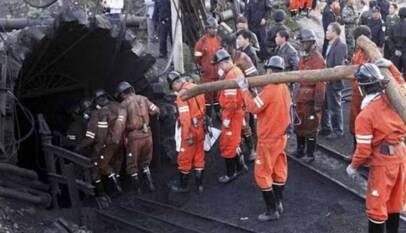
Coal Mine Gas Explosion in China’s Shanxi Province Kills 82, Rescue Ops Continue
Taiyuan, May 2026 : A devastating coal mine gas explosion in north China’s Shanxi …