Yunus Unveils Seven-Point Roadmap for Rohingya Repatriation, Urges Global Action in Cox’s Bazar Dialogue

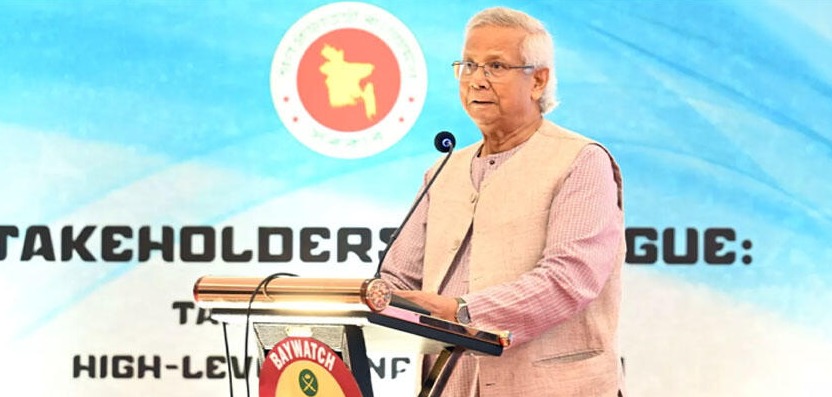
Aug 2025 : Chief Adviser Muhammad Yunus has called for urgent, coordinated international action to secure the safe, voluntary, dignified, and sustainable return of the Rohingya people to their ancestral homes in Myanmar’s Rakhine State. Presenting a seven-point proposal at a high-level stakeholders’ dialogue in Cox’s Bazar today, Yunus emphasized that the world must move beyond rhetoric and act decisively to end one of the most pressing humanitarian crises of our time.
“We must not be held hostage to mere rhetoric; the time for action is now,” Yunus declared, addressing the gathering as chief guest.
The special session, held as part of a three-day international conference, began with a one-minute silence in memory of victims on the “Rohingya Genocide Remembrance Day.” Delegates, diplomats, and humanitarian leaders joined hands to renew calls for a permanent resolution to the crisis that has displaced over 1.3 million Rohingyas, most of whom now reside in Bangladesh’s Cox’s Bazar—the world’s largest refugee settlement.
A Crisis That Extends Beyond Bangladesh
Yunus underscored that the Rohingya crisis is not merely Bangladesh’s burden but a global responsibility. He urged the international community to share the weight, contribute resources, and exert political pressure on Myanmar to end persecution and facilitate safe repatriation.
“The Rohingya issue and its sustainable resolution must remain alive on the global agenda. Until they return home, the world must stand beside them,” he said.
Highlighting the spirit of solidarity shown earlier this year, Yunus recalled how, during Ramadan in March, he and UN Secretary-General Antonio Guterres shared an Iftar with more than 100,000 Rohingya refugees in Cox’s Bazar.
“We clearly heard the Rohingyas’ heartfelt desire to return home as soon as possible,” he said.
Seven-Point Proposal for Repatriation
Unveiling his detailed plan, Yunus stressed that the solution lies in Myanmar, where the crisis originated. His seven-point roadmap included:
- Right to Return: Speedy, voluntary, and sustainable repatriation of Rohingyas to Rakhine without delay.
- Sustained Aid: Donors must close gaps in the 2025–26 Joint Response Plan and ensure long-term funding.
- End Violence: Myanmar authorities and the Arakan Army must stop attacks, guarantee Rohingya security, prevent further outflows, and allow internally displaced persons to return.
- Dialogue: Establish a platform for inclusive dialogue to restore rights, reduce tensions, and foster reconciliation.
- Global and Regional Role: ASEAN, neighboring countries, and the wider international community must promote peace, stability, and combat cross-border crimes.
- Oppose Ethnic Cleansing: All stakeholders must firmly reject ethnic cleansing and adjust relations with Myanmar accordingly.
- Accountability: Strengthen processes at the International Court of Justice (ICJ) and International Criminal Court (ICC) to ensure justice for genocide and crimes against humanity.
Yunus described this plan as a beacon of hope, urging all nations and institutions to act with greater resolve and urgency.
Global Leaders and Bangladesh Officials Weigh In
At the dialogue, Bangladesh’s High Representative for the Rohingya Issue and National Security Adviser Khalilur Rahman demanded concrete international action for repatriation.
“We need to continue what we are doing—but with stronger commitments from all sides,” Rahman said.
Adviser for the Ministry of Disaster Management and Relief Faruk E. Azam, Bir Protik, Foreign Secretary Asad Alam Siam, and Raouf Mazou, UNHCR’s Assistant High Commissioner for Operations, also addressed the gathering, echoing calls for collective burden-sharing and justice.
Remembering Rohingya Genocide
The session coincided with the eighth “Rohingya Genocide Remembrance Day.” Yunus recounted the harrowing days of August 2017, when nearly 800,000 Rohingyas fled Myanmar in just a few weeks to escape mass killings, arson, and widespread atrocities.
With visible emotion, Yunus said:
“It is our moral responsibility to take the right side of history and stop armed actors from executing their horrible design of ethnic cleansing. Waiting for the last Rohingya to leave Rakhine would be a historic blunder.”
He described refugees arriving at Bangladesh’s borders with “fearful and shattered eyes” and shared stories of systematic persecution, denial of nationality, forced deportation, mass killings, rape, torture, and destruction of property.
Bangladesh, he said, opened its borders in 2017 despite its own resource constraints, driven by empathy and compassion.
Challenges of Hosting 1.3 Million Rohingyas
Bangladesh currently shelters 1.3 million Rohingya refugees, with an additional 32,000 babies born each year in the camps. By contrast, fewer than 500,000 Rohingyas remain in Myanmar, reflecting continued persecution and outflows.
Yunus acknowledged the immense sacrifices of Bangladeshi citizens, especially host communities in Cox’s Bazar, who have borne the social, economic, and environmental impacts of the crisis.
“The impact on our economy, resources, society, and governance has been immense. I thank our host community for their wholehearted support and sacrifices for the Rohingya,” he said.
However, he admitted that domestic resources are stretched to the limit, leaving Bangladesh unable to sustain the crisis without robust international aid.
A Call for Justice and Global Solidarity
Yunus emphasized that accountability is essential to breaking the cycle of violence. He urged stronger enforcement of ICJ measures, enhanced ICC proceedings, and international solidarity with Rohingyas’ struggle for justice.
“Your solidarity with the Rohingya voice could be a beacon of hope for them in reversing their marginalisation and persecution as the starting point of their return to their homeland,” he said.
Yunus concluded by linking the Cox’s Bazar dialogue to the upcoming United Nations General Assembly (UNGA) High-Level Conference in New York.
“I hope that this dialogue contributes substantially to shaping a roadmap for an expedited and permanent solution to the Rohingya crisis,” he said.
Looking Ahead
The dialogue ended with a sense of urgency, unity, and cautious optimism. While Bangladesh continues to shoulder the heaviest responsibility, Yunus reminded the world that the Rohingya tragedy is a regional and global crisis requiring immediate and collective action.
“Effective international engagement is more necessary today than ever before. Let us join hands and declare our determination to ensure justice, accountability, and dignified return for the Rohingya people,” he urged.
As Bangladesh marks another year of hosting more than a million displaced Rohingyas, Yunus’s seven-point proposal may serve as a turning point—transforming sympathy into action, and rhetoric into results.
Team Maverick.





Chandrababu Naidu Reviews Preparations for PM Modi’s August 1 Inauguration of Bhogapuram International Airport
Amaravati, July 2026 : Andhra Pradesh Chief Minister N. Chandrababu Naidu on Monday conduc…

Chandrababu Naidu Reviews Preparations for PM Modi’s August 1 Inauguration of Bhogapuram International Airport
Amaravati, July 2026 : Andhra Pradesh Chief Minister N. Chandrababu Naidu on Monday conducted …