
Solar Desalination technology converts sunlight into fresh water without external power.

Sept 2025 : A research team from UNIST has unveiled a novel solar desalination technology that efficiently harnesses sunlight to evaporate seawater and generate clean drinking water—completely independent of external electricity. Importantly, this advanced system addresses common issues, such as salt accumulation, which can impair performance over time, offering a promising solution for water-scarce regions worldwide.
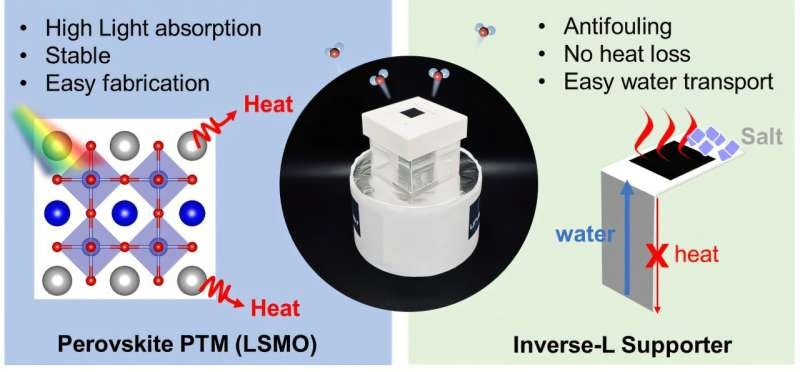
Led by Professor Ji-Hyun Jang of the School of Energy and Chemical Engineering, the team introduced a device designed to prevent salt build-up on its surface, ensuring long-term durability and reliable operation—key considerations for deployment in developing countries facing water shortages.
The core of this solar evaporator features a distinctive inverse-L-shaped paper structure. By the virtue of its water-absorbing properties, similar to litmus paper, seawater naturally wicks upward along the paper column. When the water reaches the top, it encounters a heated photothermal material that rapidly converts it into vapor under sunlight. The material employed, La₀.₇Sr₀.₃MnO₃ (LSMO), a perovskite-based semiconductor, exhibits high thermal efficiency, enabling evaporation rates that are 8 to 10 times faster than conventional methods.
Due to its unique inverse-L geometry, salt ions are driven toward the edges of the device, where they crystallise as solid deposits. This built-in salt rejection mechanism not only prevents fouling but also facilitates easy salt collection and reuse, keeping the photothermal surface clean and maintaining optimal performance over time.
The system achieves an impressive evaporation rate of 3.40 kg m⁻2 h⁻¹ (approximately 3.4 litres), vastly surpassing the typical 0.3–0.4 kg/m²/h observed under natural sunlight. Durability tests further demonstrated stable operation over two weeks in highly concentrated saline solutions with 20% salt content, exceeding the salinity of normal seawater. The inverse-L-shaped evaporator offers a sustainable approach to freshwater production and has potential applications in eco-friendly resource recovery, such as salt harvesting.
Professor Jang emphasised, “By integrating innovative structural design with a perovskite-based photothermal material, we have developed a cost-effective, electricity-free device capable of producing 3.4 kg of freshwater per hour. This breakthrough provides a practical and scalable solution to the global water scarcity crisis“.
Freshwater scarcity is an increasing global concern due to urbanization and population growth. Interfacial solar desalination offers a sustainable way to produce fresh water with minimal energy infrastructure. The process relies on photoabsorber materials that vaporize water by converting solar light into heat at the air-liquid interface. This heat is essential for desalination, a process requiring the conversion of liquid water to vapor. Various advanced photoabsorber materials have been used for solar desalination, including carbon-based, plasmonic, and semiconductor materials.
However, each of these materials presents limitations. Carbon materials, such as graphene and carbon nanotubes, have limited absorption capacity in the infrared (IR) regions of the solar spectrum, which reduces their overall efficiency. Additionally, carbon materials degrade over time when exposed to sunlight due to photo-oxidation, which further diminishes their performance. Plasmonic materials, while effective in absorbing light, have a narrow absorption range determined by localized surface plasmon resonance (LSPR). Their efficiency is also limited by the difficulty in precisely controlling their size and morphology. Semiconductor materials with high band gaps require high-energy, shorter-wavelength light for efficient photothermal conversion, making them less effective under natural sunlight. Materials with lower band gaps, which can absorb a broader solar spectrum, are more favourable for photothermal applications.
Halide perovskites (ABX₃), widely known for their optical properties, have been primarily used in solar cells and luminescent materials. However, hybrid perovskites are unstable in water environments,[31] particularly when exposed to humidity, temperature variations, and UV light, limiting their applications in solar desalination. In contrast, all-inorganic oxide perovskites offer high stability in water environments, making them more suitable for desalination.
Oxide perovskites like LaMnO₃ (A = La, B = Mn) have excellent optoelectronic properties, including tuneable band gaps and high light absorption efficiency. La0.7Sr0.3MnO3 (LSMO) is an inorganic perovskite oxide with the general formula ABO₃, known for its remarkable electrical conductivity, which was first studied by Jonker and Van Santen in the early 1950s.
LSMO gained broader attention following the discovery of the Colossal Magnetoresistance (CMR) effect, establishing it as a promising candidate for energy-related applications due to its flexible tunability via compositional modifications. In light of this, LSMO is explored as a photothermal material in this study by rationally controlling its composition, highlighting its versatility beyond conventional roles. By partially substituting La3⁺ with Sr2⁺, a black material, La0.7Sr0.3MnO3 (LSMO), is formed. This substitution narrows the band gap and enhances photothermal conversion, enabling faster recombination of energetic holes and electrons, which release heat. The black colour of LSMO further improves light absorption by reducing reflectance. Additionally, LSMO is highly stable under high temperatures and humidity due to its all-inorganic composition, making it an ideal candidate for solar desalination.
One challenge in solar desalination is salt accumulation on the photothermal material, which can reduce evaporation rates during long-term operation. Salt crystallisation occurs due to the increased concentration of salt ions, often caused by inadequate water replenishment or poor brine channel design. Effective water transport pathways are essential to mitigate this issue.
The optical properties of LSMO are critical for light harvesting. Scanning electron microscopy (SEM) revealed nano-sized, rice-shaped grains, which enhance light absorption through light trapping. The black-coloured LSMO demonstrated excellent light absorption, measured by UV–vis–NIR, with absorption reaching nearly 99% in the 250–2500 nm range. This aligns with the SEM findings, suggesting effective light trapping by nano structure.
Wettability is another key feature for efficient water transport and salt rejection. While hydrophobic materials are often used to prevent salt accumulation, our hydrophilic LSMO on GF/C membrane (GF/C was used as a substrate in this work), with a contact angle of 39˚, facilitates water transport without disruption. Moreover, no salt accumulated on the photoabsorber, demonstrating that our design mitigates salt accumulation without needing a hydrophobic surface.
Team Maverick








ISRO Successfully Tests Indigenous Ship-Borne Tracking System for Gaganyaan Mission
New Delhi, July 2026 : The Indian Space Research Organisation (ISRO) has successfully vali…

ISRO Successfully Tests Indigenous Ship-Borne Tracking System for Gaganyaan Mission
New Delhi, July 2026 : The Indian Space Research Organisation (ISRO) has successfully validated …