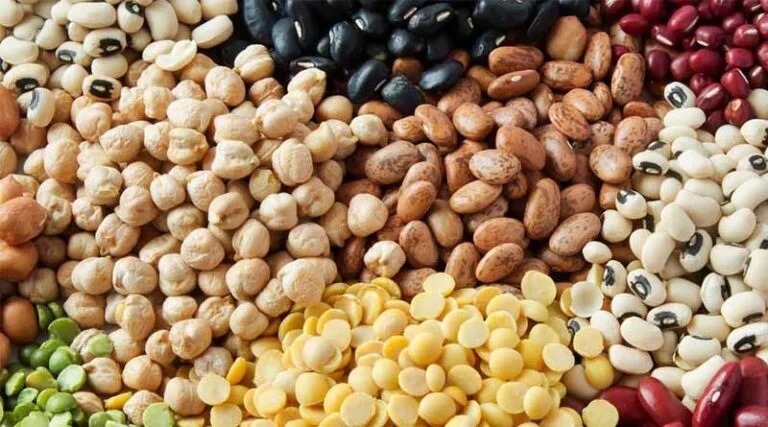
Indian Pulse sector reaching horizons.

Sept 2025 : India, the world’s largest cultivator and producer of pulses, plays a dominant role in global supply. The country accounts for 38% of the global cultivated area and 28% of output. Between 2018 and 2022, India cultivated an average of 33.46 million hectares of pulses and produced 24.76 million tons. Despite this scale, India’s productivity remains among the lowest in the world. The country’s average yield stood at 0.740 t/ha, compared to the global average of 0.969 t/ha. It is of importance that the global pulse production has expanded steadily at about 03% annually since the early 2000s, with developing countries contributing nearly three-quarters of the output. Asia alone accounts for over 44% of production. In 2022, pulses were cultivated on 97.09 million hectares worldwide, yielding 96.04 million tons at an average productivity of 0.989 tons per hectare (t/ha).
Among the top ten producers, India ranks the lowest in yield. Ethiopia leads with 1.894 t/ha, followed by Canada (1.880 t/ha), the United States (1.874 t/ha), China (1.821 t/ha), and Russia (1.707 t/ha). India’s yield is 2.5 times lower than that of Ethiopia (approximately 0.75t/ha). Experts note that if India aspires to match the global average, it should increase production by 7.66 million tons, significantly reducing import dependence.
Crop-specific data highlights the disparities. India cultivates 40.88% of the world’s dry bean area but contributes only 21.68% of production due to yields of just 0.411 t/ha, compared to the global average of 0.774 t/ha. In pigeonpea, India accounts for over 80% of global acreage and 78% of production, yet yields remain slightly below the world average. In lentils and dry peas, the country’s productivity continues to lag, missing opportunities to expand production substantially. Chickpea is the only crop where India’s yield, at 1.145 t/ha, marginally exceeds the global average of 1.106 t/ha.
What is most important at this juncture is to ascertain the challenges behind low productivity, both in structural and environmental. Limited availability of high-yielding varieties, inadequate access to quality seeds, and weak pest and disease management practices constrain improvements. The dominance of rainfed farming makes pulse cultivation vulnerable to climatic fluctuations. Historical records show that in 15 out of 27 El Niño years since 1951, India experienced a decline in both acreage and production of pulses, with output falling by as much as 30%.
Economists add that volatile market prices, lower profitability compared to cereals, and inefficient marketing systems further limit farmers’ incentives to adopt advanced practices.
Policymakers and researchers emphasise that bridging the yield gap is vital to achieving self-reliance in pulses. Strategies such as developing climate-resilient varieties, expanding irrigation coverage, and stabilizing markets are being seen as necessary steps. Despite India’s commanding role in global pulse cultivation, the country’s consistently low productivity continues to pose a challenge for domestic food security and for global supply stability.
In July, 2025 – the latest OECD-FAO Agricultural Outlook 2025–2034 was published, and the report projected an increase of nearly 08 million tons in pulse output in India by 2034. Currently, the country produces over 25.2 million tons annually, and this figure is set to rise steadily.
Team Maverick








Team Special Olympics Bharat Accorded Grand Send-Off Ahead of Special Olympics Unified Football World Cup 2026
Faridabad July 2026 : Team Special Olympics Bharat was accorded a warm send-off at Manav R…

Team Special Olympics Bharat Accorded Grand Send-Off Ahead of Special Olympics Unified Football World Cup 2026
Faridabad July 2026 : Team Special Olympics Bharat was accorded a warm send-off at …