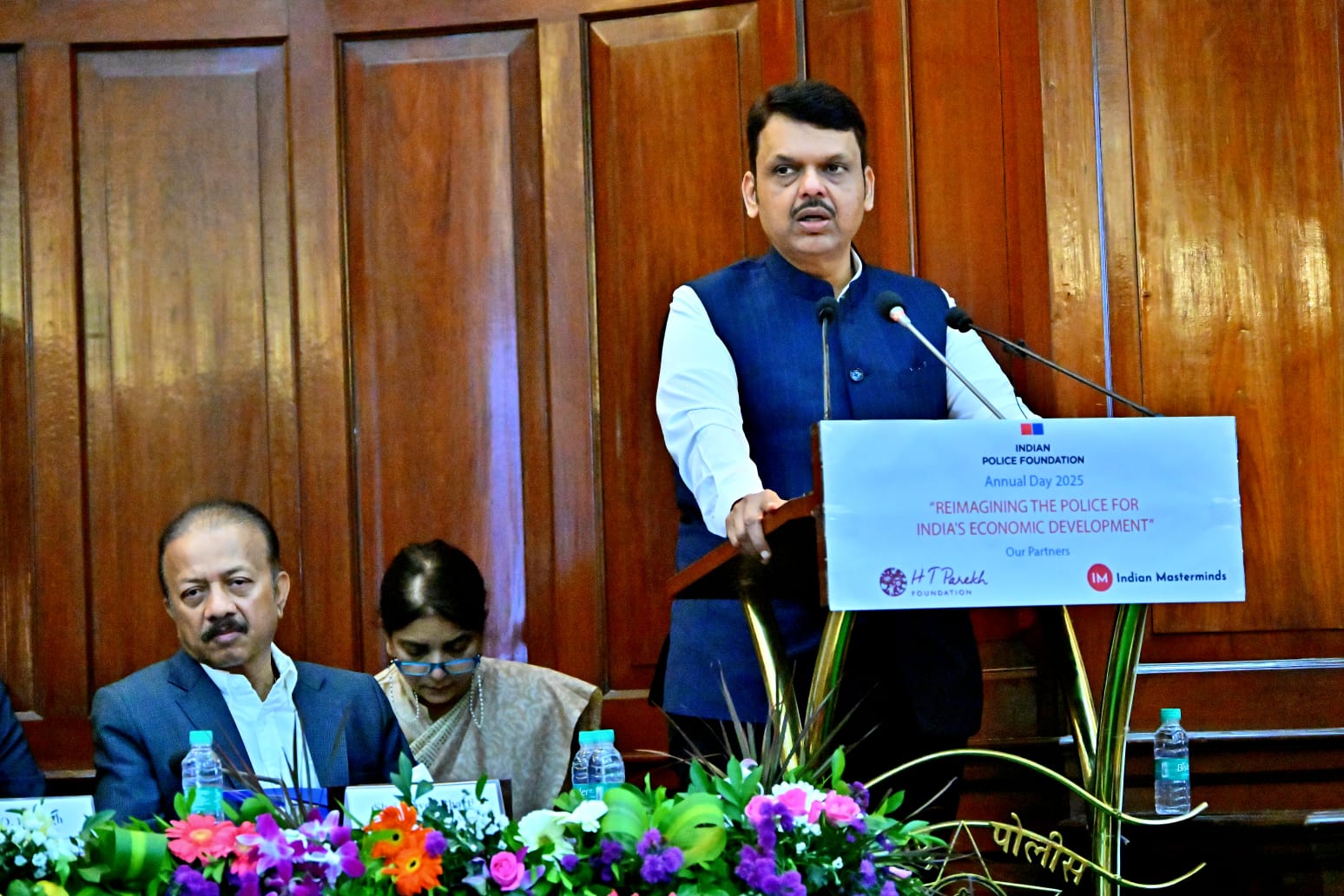
Nation’s March Toward Superpower Status Through Effective Law and Order Implementation – Chief Minister Devendra Fadnavis

Zero Tolerance Crucial in Narcotics-Related Crimes
Mumbai, Sept 2025 – Effective enforcement of law and order can pave the way for India’s journey towards becoming a superpower. While maintaining law and order, crimes related to narcotics remain a major challenge before the police force, for which the state has adopted a zero-tolerance policy. It is also essential to use modern technology to solve cybercrimes in line with changing times, stated Chief Minister Devendra Fadnavis.
The Chief Minister was speaking at a panel discussion on the theme “Reimagining the Police Force for India’s Economic Growth”, organized on the occasion of the 10th Foundation Day of the Indian Police Foundation at Police Headquarters, Colaba.
The event was attended by Asim Arun, Minister of State for Social Justice, Uttar Pradesh; R.S. Mushahary, head of the Indian Police Foundation and former Governor of Meghalaya; O.P. Singh, former DGP of Uttar Pradesh; Rashmi Shukla, DGP of Maharashtra; and Deven Bharti, Mumbai Police Commissioner, along with senior police officers from across the country.
Chief Minister Fadnavis expressed pride in the consistent high standards maintained by the Maharashtra Police and Mumbai Police. He lauded the discussion on the police force’s role in India’s economic growth and said the brainstorming in this session would be important for introducing further positive reforms. The government, he added, would consider new ideas and measures emerging from such deliberations.
The Chief Minister emphasized that unity within the police force and society is essential, as it helps reduce negativity and drives sustainable progress for both the state and the nation. While the nature of crime has changed over time, he said progress can be achieved by combining timeless values with modern technology.
Highlighting recent reforms, he noted that in 2023, a new police organizational structure was introduced. A state-of-the-art Cyber Security Lab has been set up to ensure speedy resolution of crimes, and other states have also sought to establish similar facilities. The use of Artificial Intelligence is aiding faster investigation of complex cases. However, narcotics-related crime remains a serious challenge, as drug networks not only fuel criminal activity but also weaken youth. Here, a zero-tolerance approach is critical, he stressed.
He also underlined that the Constitution provides checks and balances in policing, and many officers have used available laws to introduce progressive reforms. However, laws such as the IPC, CrPC, and the Indian Evidence Act date back to the colonial era, and are now being updated in line with democratic principles. For the police to be more effective, adoption of new technologies, digital platforms, data analytics, machine learning, and online tracking is necessary to counter rising crimes through social media and online platforms.
Fadnavis also reflected on India’s shifting economic base—from agriculture-driven to service sector–driven—pointing out that while agriculture remains vital, 55–65% of the economy now depends on services, which brings unique challenges. Hence, understanding the evolving definition of the service economy is essential. Along with modernization of the police force, it is equally important to preserve core values, he added.
During the session, participants also discussed the role of police in creating global trust in India’s investment ecosystem, digital border protection, and the need for strategic police–industry cooperation.







End of an Era: Cristiano Ronaldo Bids Farewell to the FIFA World Cup After a Record-Breaking International Career
Dallas, July 2026 : One of football’s greatest chapters came to a close on Tuesday a…

End of an Era: Cristiano Ronaldo Bids Farewell to the FIFA World Cup After a Record-Breaking International Career
Dallas, July 2026 : One of football’s greatest chapters came to a close on …