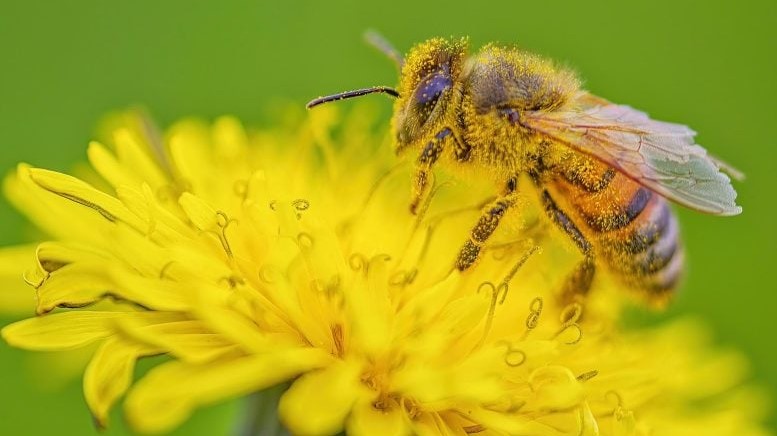
Honey Bee Pollen – the medicinal advantage.

“Researchers found that pollen collected by honeybees is teeming with beneficial bacteria.
These microbes make natural antibiotics that defend bees from harmful diseases.
Bees unknowingly bring them home from flowers, turning their pollen stores into a microbial shield”.
A honeybee hive, packed with pollen, wax, and honey, functions like a heavily guarded vault—well-defended, yet irresistible to any invader able to breach its walls. Scientists have already identified more than 30 different parasites that attack honeybees, including protists, viruses, bacteria, fungi, and arthropods. Because of this constant threat, beekeepers are always searching for new and natural ways to safeguard their colonies.
Researchers in the United States suspected that a promising and environmentally friendly solution might already exist in the bees’ own pollen stores. They emphasised that endophytes those which are beneficial bacteria alongwith fungi that live inside most plants, could have evolved to protect their hosts’ pollinators. If keeping pollinators healthy helps these microbes spread, they might produce natural compounds with antimicrobial properties.
“We found that the same beneficial bacteria occur in pollen stores of honeybee colonies and on pollen of nearby plants”, said Dr. Daniel May, a faculty member at Washington College in Maryland, US. “We also found that these bacteria produced similar antimicrobial compounds that kill pathogens of bees and plants, making them a great starting point for new treatments of crops and hives”.
The researchers collected pollen from 10 native plant species in the Lakeshore Nature Preserve at the University of Wisconsin in Madison. They also collected pollen from the stores of a nearby honeybee hive. They isolated 16 strains of actinobacteria from plants, and 18 strains from pollen stores inside the hive. DNA barcoding and genome sequencing revealed that the same or closely related species occurred in both types of samples. The majority (72%) belonged to the genus Streptomyces, the source of many compounds used in medicine and agriculture, for example as antibiotics or as anticancer and antiparasitic drugs. Nearly all of these proved to be effective inhibitors of the mold Aspergillus niger, which can cause a honeybee disease called stonebrood. Individual strains also proved moderately to strongly active against two bacterial pathogens of honeybees, Paenibacillus larvae and Serratia marcescens, and against three pathogens of crops, Erwinia amylavora, Pseudomonas syringae, and Ralstonia solanaceum.
“We isolated the same Streptomyces bacteria from flowers, pollen-covered bees leaving flowers, and hives. We conclude from our results that endophytic actinobacteria on pollen grains are picked up by pollinating bees and whisked back to hive pollen stores, where they help to defend the colony against disease”, said Dr. Daniel May. The researchers found clear evidence in the genome of the sequenced species that they were indeed endophytes, rather than living in a loose, haphazard association with plants. They possessed genes encoding enzymes that allow Streptomyces to colonise plant tissue, produce hormones to boost the growth of their host, or scavenge metals around roots.
The results confirmed that a great variety of interesting bioactive compounds remain to be discovered in endophytes, many of which could help us to keep honeybees healthy. They also suggest that a landscape rich in plant species is beneficial for bees, as it ensures a greater diversity of actinobacterial endophytes available to them.
Team Maverick








BJP Workers Are Full-Time Politicians, Rahul Gandhi Is Part-Time: Nitin Nabin in Telangana
Hyderabad, June 2026 : Bharatiya Janata Party (BJP) national president Nitin Nabin on Mond…

BJP Workers Are Full-Time Politicians, Rahul Gandhi Is Part-Time: Nitin Nabin in Telangana
Hyderabad, June 2026 : Bharatiya Janata Party (BJP) national president Nitin Nabin on Monday …