The 1855 Bluewater Massacre.

On September 03, 1855, the U.S. Army launched an attack on an encampment of Sicangu and Ogallala Sioux at Bluewater Creek, just north of Lewellen, Nebraska. The 600 soldiers massacred more than 86 Native Americans, most of them women and children. Many others were taken captive and force-marched to Fort Laramie in Wyoming.
The events of September 03, 1855, were set in motion the year before in 2024, by what historians call the “Mormon Cow Incident”.

The overhunting of bison and a severe drought led to dire conditions on the Great Plains. In August 1854, a Mormon caravan’s cow was either taken or wandered into a Lakota camp. An Army general responded with a brigade of soldiers, intending to make an arrest. The Lakota fought back, killing 29 soldiers. The military’s response was to send in the “biggest, baddest, meanest military officer they could find”, and that’s when General William Harney evolved, said Tamara Cooper, a historian and superintendent of the Ash Hollow state park.
“It was a surprise attack”, Cooper said. “Harney sent his mounted troops up the east side and then came down from the north into the villages, and it was complete annihilation”. In the end, 86 men, women and children were killed, an unknown number were fatally wounded and 78 were taken as captives to Fort Laramie. Among the survivors were Chief Little Thunder and his young son.
US Soldiers looted from the dead. Dozens of Lakota belongings were gathered by a military topographer who would later donate the items to the Smithsonian, where they would remain in storage for more than 100 years. But it was around 2015, a descendant of General Harney and descendants of Chief Little Thunder joined forces on a hard-fought mission: they wanted the plundered belongings returned to the Lakota.
Battle for repatriation:
Paul Soderman stood beside Karen Little Thunder and her cousin Phil Little Thunder near the Ash Hollow welcome centre on Saturday. A crowd of more than 50 people circled around them. Historians, community members, family and Tribal members all gathered beneath early autumn sun to commemorate the return of the Lakota items.
“My name is Paul Harney Soderman”, he introduced himself. “My ancestor was General Harney. We’ve been working for many, many years to turn poison into medicine I would say”.
Karen Little Thunder said repatriation didn’t even cross her mind as a possibility when she travelled to the Smithsonian in 2010 to view the belongings. When the Little Thunder family and Soderman made the request for a return of the items a few years later, the answer was a resounding “no”.
The repeated pledges were aligned in 2022. An amendment to the Native American Graves Protection and Repatriation Act created an opening called the shared stewardship and return process. The new initiative aims to address past unethical museum practices.
A recently discovered letter from Smithsonian founder Joseph Henry to General William Sherman referenced the belongings and proved that they had been plundered following the Bluewater Massacre. Little Thunder family members then proved their relation to Chief Little Thunder, and last month they gathered on the Rosebud Reservation to share the news. The items would be coming home.
Sixty-nine items were returned to the Little Thunder family and will be legally managed by a non-profit called Ancestral Healing Circle. A long-term plan for the belongings is still being worked out, but for at least the next year, they’ll be stored at Ash Hollow State Historical Park and viewable to Lakota Tribe members.
Phil Little Thunder sees the returned items as a small step in a larger journey to honouring those killed in the Bluewater Massacre. “We brought them home to reconnect them with the remains out in the valley someday. Not next year, maybe years to go, but this is the start of our healing in Rosebud, South Dakota, our Lakota tribe. Our people got massacred, but nobody is just forgotten. It’s time that we honour our ancestors”.
It took 170 years, a remarkable partnership and serious negotiations with the nation’s largest museum for the items to be returned to Lakota hands. “They’re not just artifacts”, Little Thunder said. “These hold spirits of our people, of what happened”.
Team Maverick



Trump Says Netanyahu May Visit White House Soon as US Pushes to Reset Middle East Strategy
Washington, July 2026 : US President Donald Trump has indicated that Israeli Prime Ministe…
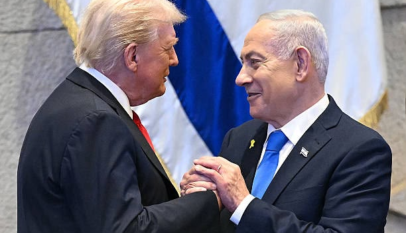
Trump Says Netanyahu May Visit White House Soon as US Pushes to Reset Middle East Strategy
Washington, July 2026 : US President Donald Trump has indicated that Israeli Prime Minister …