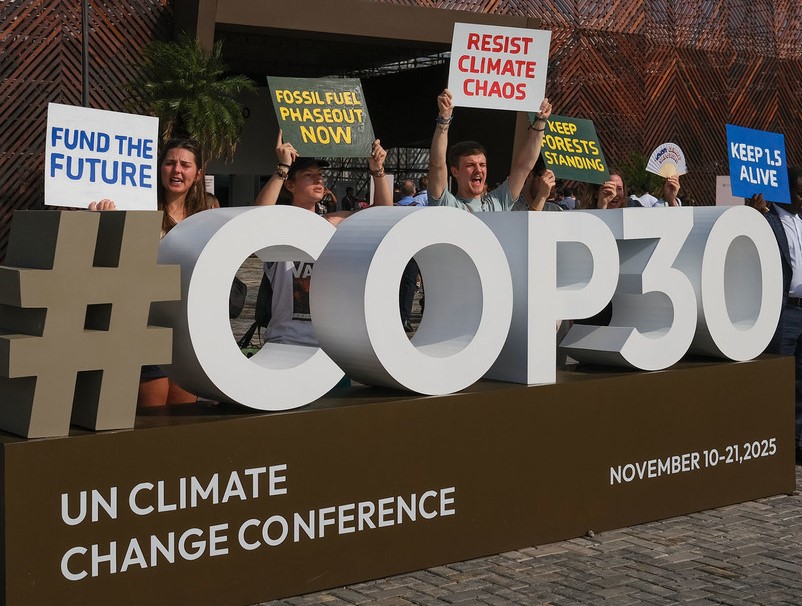
United Nation’s Climate Change Conference – Belém, 17th November 2025.

With cognizance to the Presidential consultations on NDCs, BTRs, Article 9.1, and UTMs, Túlio Andrade, COP 30/CMP 20/CMA 7 Presidency:
In the morning introduced a summary note on the consultations so far and invited comments. Many Parties supported the option of having an outcome or package in the form of a “Mutirão decision”. Australia, Kenya, Panama, and Canada, among others, supported a reinvigorated Mission 1.5°C.
On the framing, the Arab Group, Like Minded Developing States (LMDCs), African Group and others supported stronger reference to the principle of common but differentiated responsibilities and respective capabilities (CBDR-RC), and the Environmental Integrity Group (EIG) and NORWAY proposed to add “in line with national circumstances”. The Alliance Of Small Island States (AOSIS) called for accelerated action in this decade to limit the scale and duration of an overshoot and, with NORWAY and AUSTRALIA, emphasised that every fraction of a degree above 1.5°C matters. The EIG and PANAMA suggested strengthening the reference to science. GEORGIA called for reference to the Rio Conventions. MONACO and MEXICO called for reference to the Advisory Opinion of the International Court of Justice (ICJ) on obligations of states in respect of climate change.
The Least Developed Countries (LDCs) supported a call for accelerated action in this critical decade and a roadmap to 1.5°C. The AFRICAN GROUP stated that such a roadmap should include supporting countries that have not submitted their nationally determined contributions (NDCs) to do so, as well as supporting NDC implementation, strengthening the mitigation work programme, and supporting the Consultative Group of Experts. The LMDCs opposed any concept of implementing the Global Stocktake (GST) outcomes and, with the AFRICAN GROUP, opposed any dialogue on the NDC and Biennial Transparency (BTR) Synthesis Reports.
The LMDCs, ARAB GROUP, and AFRICAN GROUP opposed “targeting” particular sectors, such as the energy sector, and rejected references to sectoral approaches and long-term strategies. The AFRICAN GROUP and QATAR opposed linking ambition to decarbonization, with QATAR urging a focus instead on low-carbon development in the context of sustainable development. The Independent Association Of Latin America And the Caribbean (AILAC) supported exploring sectoral roadmaps provided they remain nationally determined and proposed a roadmap on nature, including forests.
AOSIS highlighted the importance of adaptation finance. The AFRICAN GROUP lamented an over-focus on mitigation and, with the LDCs and others, urged strengthened reference to adaptation and finance.
The European Union (EU) questioned why every reference to accelerating ambition includes reference to support, as well as why the New Collective Quantified Goal (NCQG) is only mentioned once in the text, with the EIG underscoring that not all actions are conditional on finance. The EIG further opposed references to Article 9.1 and to tripling adaptation finance, noting such references as an attempt to renegotiate the NCQG. They also opposed references to burden-sharing arrangements, noting these risk undermining the nationally-determined nature of the Paris Agreement. AUSTRALIA called for delivering on the NCQG, including its qualitative elements, such as enhancing access to finance to ensure it reaches the most vulnerable.
AILAC cautioned that only referencing support for conditional NDCs risks encouraging countries to submit mainly conditional NDCs, and underlined that all developing countries are entitled to support for their NDCs.
The EU opposed any process that requires Parties to report climate-related trade measures or trade-related climate measures:
- ARGENTINA stated that all measures, including response measures, must conform to World Trade Organization rules, with Parties striving to minimize the impact of response measures on countries, especially developing countries.
- RUSSIAN FEDERATION proposed noting trade measures could have co-benefits and trade-offs.
- CANADA supported using existing spaces to discuss the cross-border impacts of climate measures.
The Presidency will revise the note into the format of a “Mutirão decision” and expand the current bullets into detailed text. They invited written submissions from Parties to inform this revision.
Presidency information session on kick-starting the second week:
At lunchtime, COP 30/CMP 20/CMA 7 President André Corrêa do Lago reiterated the Presidency’s commitment to transparency and providing a safe space for negotiations. Noting the opportunity to send a signal to the global community of the COP’s ability to complete its work ahead of time, Corrêa do Lago urged Parties to complete their work by the evening of Tuesday, 18th November, so that the closing plenary can be held on Wednesday, 19 November, noting the possibility of continuing until Friday, 21st November. He therefore urged Parties to “shift into taskforce mode”, and stressed that each delegation should not ask what it can take away from the process but how their countries, societies, and governments can contribute to the process of implementing the Paris Agreement.
Mutirão mobilisation for the Belém package:
In the afternoon, Túlio Andrade explained that these consultations would focus on Parties’ priorities for a “Mutirão decision”, as well as key outstanding items Parties consider important for a balanced outcome from COP 30. He urged Parties to strive to conclude all work by Wednesday, 19 November, stressing this could be a legacy from Belém and “change our process forever”.
A list of items was then displayed on screen, featuring:
- the Global Goal on Adaptation (GGA);
- just transition work programme (JTWP);
- mitigation work programme;
- national adaptation plans (NAPs);
- GST;
- Article 9.5 (finance reporting);
- 2.1c (finance flow alignment);
- response measures;
- Standing Committee on Finance;
- reports of the Green Climate Fund (GCF) and Global Environment Facility;
- report of and guidance to the Fund for Responding to Loss and Damage;
- report of, and matters related to, the Adaptation Fund;
- technology implementation programme (TIP);
- Article 13 (reporting under the enhanced transparency framework).
Responding to Parties’ questions, the Presidency clarified that these consultations will not replace the technical consultations on these items, but rather seek to ensure an overall balance in the COP 30 outcome. Parties had then proceeded to provide their views on the listed items, calling for, among others:
- safeguards to ensure that the GGA indicators do not shift the burden of financing to developing countries, with the AFRICAN GROUP opposing tracking of domestic budget allocations for adaptation;
- sectoral cooperation roadmaps, with the EIG suggesting roadmaps on energy transition and forests;
- an outcome on forests, with PAPUA NEW GUINEA highlighting their intention to provide draft text on reversing global deforestation by 2030 supported with means of implementation;
- provision of fast-track funding for NAP implementation by 2030;
- mobilisation of climate finance from all sources, not only public finance;
- support for all adaptation pathways, not just transformational adaptation;
- systematic integration of health into UNFCCC processes;
- consideration of mountain priorities.
Mountains: Pedro Brancante, COP 30/CMP 20/CMA 7 Presidency, noted consultations thus far have yielded: no consensus on a dedicated agenda item; wide support for an incremental approach to highlighting the relevance of mountains in the process; and no opposition to an annual dialogue, with different proposals for its modalities.
The Mountain Group, constituting Nepal, Bhutan, Peru, and Chile and supported an annual dialogue to be jointly convened by the SBs from 2026 onwards, led by two co-facilitators tasked with preparing a report thereon. They also called for establishing a joint SB agenda item, beginning at SB 64, to consider progress, challenges, and opportunities related to mountain-related climate action, consider findings from the annual dialogue, and identify actionable next steps. NEPAL and BHUTAN further suggested a call for submissions by the end of March 2026, to be synthesized by the Secretariat, which would inform considerations under the new agenda item.
Recognising the relevance of the issue, the EU, SWITZERLAND, and JAPAN preferred to address mountains under existing workstreams, such as the research dialogue and the Nairobi work programme on adaptation, rather than a new agenda item. The EU cautioned against having an annual dialogue, noting this could open the door for calls regarding other ecosystems, but expressed support for a dialogue to be convened at SB 64. GEORGIA and LIECHTENSTEIN supported an annual dialogue to feed into the GST. On reporting, The MOUNTAIN GROUP, EU, CHILE, PERU, and NEPAL supported the development of a formal report to be presented at the next COP.
Special needs and circumstances of Africa: Pedro Brancante invited Parties’ views. AILAC lamented the regional bias this consultation raises, especially during the first Latin American COP in over a decade. With GRUPO SUR, they cautioned against reopening this sensitive issue. They pointed to UNFCCC Article 3.2 on giving full consideration of the specific needs and special circumstances of developing countries, especially those that are particularly vulnerable to the adverse effects of climate change, and recalled that the special recognition of LDCs and small island developing states (SIDS) in the Paris Agreement was the result of careful negotiation. PAKISTAN, BHUTAN, URUGAY, and ECUADOR raised similar concerns, with PAKISTAN expressing dismay at the creation of competition amongst developing countries. SAINT LUCIA underscored that weakening the special needs and circumstances of SIDS is a red line.
The AFRICAN GROUP argued that the vulnerabilities of Africa are unique and lamented the limited progress made at COP 28 and 29 on this matter. As actionable ways forward, they pointed to, among others: a CMA cover decision that recognises the special needs and circumstances of developing countries; the submission of views on the apex of climate change in developing countries, especially Africa; and for the Secretariat to compile views from African Parties for consideration at CMA 7.
Brancante noted he will report to the COP 30 President that Parties expressed diverging views and consensus does not seem within reach. He invited delegates to participate in the special event on the matter, which will convene on Friday, 21st November.
Cooperation with other international organisations: In consultations led by Luiz de Andrade Filho, COP 30/CMP 20/CMA 7 Presidency, COLOMBIA, the EU, UK, EIG, CANADA, PALAU, AUSTRALIA, PANAMA, and MONGOLIA supported developing an informal note that captures the views shared thus far. COLOMBIA underscored that the text should address: establishing an agenda item to facilitate regular meetings; moving from procedural to substantive discussions; allowing recommendations on how international cooperation can inform the implementation of the Paris Agreement; and improving communication among the Rio Conventions.
Saudi Arabia, the Russian Federation, African Group, Iraq, and China disagreed, noting limited time to capture views and the need for additional clarity regarding how cooperation between the Secretariat and international organisations takes place. Argentina cautioned that each of the Rio Conventions has its own mandate and financial resources.
After a protracted debate, the Presidency offered to report back to Parties on next steps for additional discussions during this session.
Team Maverick





Bethell, Brook Power England to Thrilling Four-Wicket Win Over India, Take Series Lead
Manchester, July 2026 : England produced a remarkable comeback with the bat as Jacob Bethe…

Bethell, Brook Power England to Thrilling Four-Wicket Win Over India, Take Series Lead
Manchester, July 2026 : England produced a remarkable comeback with the bat as Jacob …