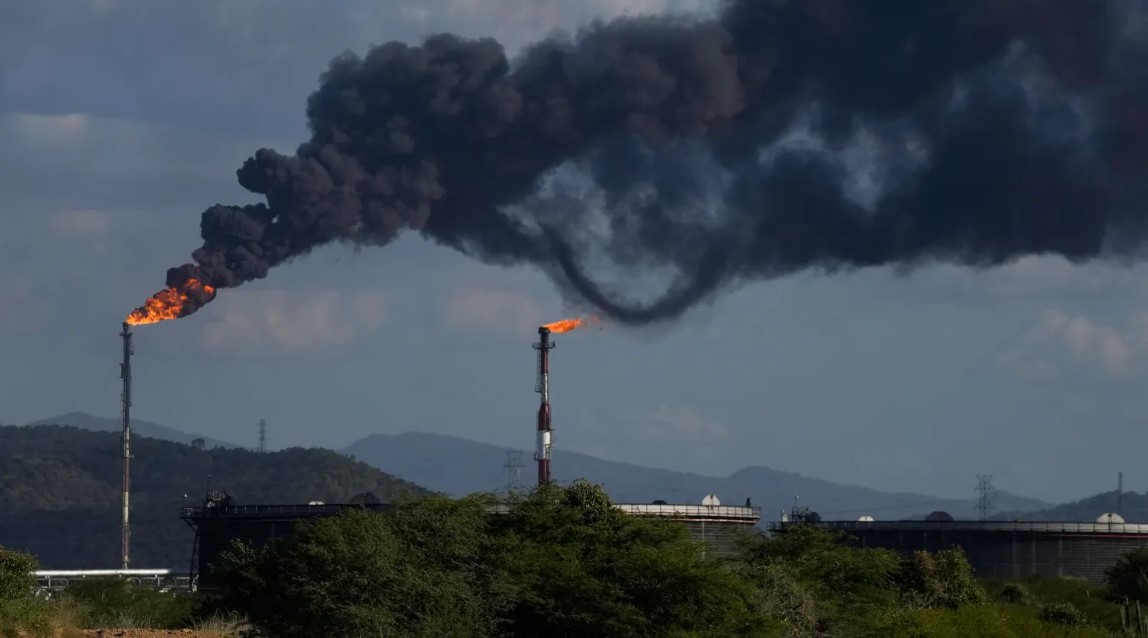
Is It The Drug Cartel or the Vast Resource of Crude Oil, which has Enticed Donald Trump?

December 2025: On 27th November 2025, the US President Donald Trump had reaffirmed that every efforts to halt Venezuelan drug trafficking “by land” would begin very soon”, intensifying tensions with Caracas at a time when Venezuela’s vast oil reserves remain a pivotal factor in global energy and political calculations.
The country holds the world’s largest proven crude deposits, and any future change in production, whether through political shifts, sanctions adjustments or new agreements could eventually boost global supply, ease U.S. inflationary pressures and strengthen Washington’s leverage in a region increasingly shaped by geopolitical competition.
It was President Nicholas Maduro, who had publicly claimed that Russian President Vladimir Putin and Chinese President Xi Jinping have voiced support for their Venezuelan President who happens to be a steadfast ally, amid escalating tensions with the United States, amidst President Trump’s accusal of Maduro’s government supporting “narco-terrorism”. Maduro has dismissed these claims, saying they are a pretext for regime change in the oil-rich nation, which has long been a vocal opponent of Washington’s moves in the region.
Coming back to what we have mentioned in the first paragraph; the U.S. military buildup in the southern Caribbean, including recent strikes on vessels allegedly carrying narcotics, signals US’ s willingness to apply pressure on Venezuela. While officially aimed at curbing drug trafficking, Caracas has portrayed the operations as an attempt to exert influence over its natural resources.
Venezuela’s vast oil reserves remain largely underexploited, constrained by political instability, infrastructure challenges, and sanctions. Any shift in access or production could have far-reaching implications for global energy markets, and the combination of political uncertainty and military tension makes the situation highly consequential for Trump’s domestic economic and political agenda.
Alex Plitsas, senior fellow at the Atlantic Council has vetted that trade and economics are at the heart of the Trump administration’s policymaking and Venezuela is no different. Removing Maduro would impact drug trafficking and commercial trade, to include oil. This strategic matrix helps in explaining the administration’s July decision to grant U.S. oil giant Chevron, a restricted license to resume limited operations.
The license allows the company to operate joint ventures and export crude while barring payments to the Maduro government, after an earlier license was revoked earlier in the year, forcing Chevron to wind down operations by April. For U.S. policymakers, the license is more than a commercial decision; it represents a tool to preserve access to Venezuela’s vast oil reserves, maintain pressure on Maduro, and support domestic energy stability amid ongoing uncertainty over production capacity. As Plitsas added, “Maduro and his predecessor have run Venezuelan economy into the ground despite it being the wealthiest country in South America”.
Venezuela’s oil production has fallen sharply from its early 2000 peak of about 3 million barrels per day to roughly 9,20,000 today. Output plummeted due to decades of mismanagement, corruption, and expropriations that began under Hugo Chávez and worsened under Maduro. Most of the crude is heavy or extra-heavy, which requires diluents and specialized refining capacity, further constraining the ability to rapidly increase exports.
Even under the best circumstances, production would likely rise only gradually, limiting any immediate impact on U.S. energy markets or global supply. Over the long term, however, a sustained increase in Venezuelan output could help ease fuel and gas costs and provide modest support for domestic inflation and economic growth. With Venezuela’s vast oil reserves, any potential U.S. control or influence over them comes with high stakes. Trump’s hints at a possible land-based campaign raise the prospect of regime change, a move that could give Washington significant geopolitical leverage.
“Removing Maduro would also take out another player in the Russia, North Korea, Iran Axis which has been used for sanctions avoidance and furthering our adversaries’ objectives”, Plitsas said, highlighting how such a shift could disrupt Russia’s regional strategy, challenge China’s influence in Latin America, and weaken Iran’s ties to Caracas. However, turning that leverage into practical control faces major political and logistical challenges. Extracting and exporting Venezuelan oil would require significant investment in production, diluents, and refining, all under a fragile regime.
Team Maverick.




India Post Invites Citizens to Design Official Mascot, Announces Rs 2 Lakh Prize Pool
New Delhi, July 2026 : The Department of Posts has launched the ‘India Post Mascot D…

India Post Invites Citizens to Design Official Mascot, Announces Rs 2 Lakh Prize Pool
New Delhi, July 2026 : The Department of Posts has launched the ‘India Post …