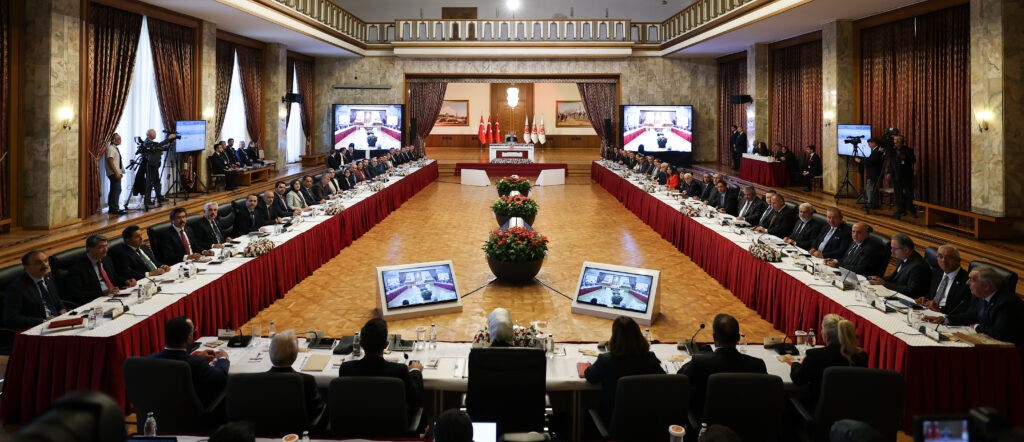
The NSBDC is Set to Convene Again on 04th December for “Türkiye Without Terror”.

“There Can Be No Peace Without Peace Conscience”
December 2025: The National Solidarity, Brotherhood and Democracy Commission (NSBDC), established in the Turkish Grand National Assembly in line with the goal of a “Türkiye Without Terror” will convene again on December 04th.
The fate of peace is often explained by the technicalities on the table, the balance of power, and the timetables. Yet, the true missing element lies elsewhere, in the inner voices of societies. The common ground which is called the conscience of peace is where justice, honour, memory, and the demand for equal citizenship meet. Without this foundation, every signature remains empty.
When the distance between the conscience of peace and politics widens, even the brightest formulas get eventually collapsed. This is precisely why the fundamental question for the Terror-Free Turkey Commission, which will hold its first meeting on Thursday following its visit to İmralı, must be this: Does this process rely on society’s conscience for peace? Does it proceed with a language that honours suffering, guarantees justice, and reinforces equal citizenship?
Victims are the Moral Compass of Peace –
The conscience of peace is proposed not as an affect, but as a faculty of public judgment. It is the capacity to judge by placing ourselves not only in our own shoes but also in the shoes of the other, as Hannah Arendt called expanded thinking. When combined with Emmanuel Levinas’s call for face-to-face responsibility, it becomes an ethical responsibility that does not retreat before the voice of the oppressed. Paul Ricoeur’s concept of just memory provides a historical framework for this judgment: a memory that contemplates truth, confession, and reparation, neither by forgetting nor by revenge.
In the field of peace studies, Johan Galtung’s positive peace approach and John Paul Lederach’s moral imagination describe the institutional equivalents of this conscience: establishing an order that repairs not only ceasefires but also structural injustices and everyday humiliations; investing in the transformation of relationships, not short-term exchanges.
In this context, the voices of the families of martyrs, the relatives of the disappeared, and everyone affected by the conflict are not always the culmination of peace, but its guiding principle. Their questions are clear:
- How will the truth emerge?
- how will reparations and justice function?
- how will memory be preserved?
The conscience of peace becomes real to the extent that institutional answers to these questions are produced: independent truth mechanisms, measurable reparations programs, inclusive of commemoration practices, and authentic victim representation in decision-making processes.
Ultimately, the conscience of peace is a normative compass that unites Arendt’s public judgment, Levinas’s ethical responsibility, Ricoeur’s just memory, and Galtung and Lederach’s transformative peace architecture. Without such a compass, every step taken remains symbolic; with it, peace becomes woven into the social fabric.
Peace Conscience Agenda for the Commission –
The conscience of peace is not an abstract wish, but a set of principles that must be translated into decision-making processes. The following sections offer a practical framework for the commission to link every step it takes with justice, dignity, memory, and equal citizenship. The goal is not merely to establish contact; it is to implement a process that restores the trust of victims, is publicly accountable, and produces measurable results.
The first principled decision: Include the conscience of peace among the official working principles of the commission, along with justice, dignity, memory, and equal citizenship. All decisions and contacts should be justified according to these principles.
Victims’ Council: Establish a gender- and regionally balanced council comprised of families of martyrs, veterans, relatives of the missing, and civilian victims. The council’s views should be included as additional justifications in reports; they should serve as an ethical compass, not a veto.
Path to truth and reparation: Create a framework that includes clarification of events, administrative redress and rehabilitation options, and standards for cemeteries and memorial sites.
Political independence and transparency: Create an online transparency dashboard for meeting schedules, delegation composition, contacts, and expenditures. The rationale for closed sessions should be publicly disclosed in writing.
Legal Guarantee Checklist: Three questions should be mandatory for each step. What is the constitutional and legal basis, what is its impact on freedom of expression and association, does it conflict with judicial decisions? If so, what are the corrective steps?
Rejection of violence and verification: Propose measurable indicators and an independent verification scheme for disarmament and rejection of violence; outline the path to follow in case of violation.
Parliamentary oversight and ombuds: Propose an independent Peace Ombudsman in addition to the Terrorism-Free Turkey Commission. The Ombuds should regularly report on citizen complaints.
The framework for visits, including İmralı: The purpose, scope, human rights safeguards, and public information plan for each visit should be announced in advance. The visit should not be a symbol, but a process that produces reportable output.
Schedule and interim report: Publish a ninety-day work plan. Include weekly activities, monthly interim reports, and a list of risks and obstacles. A mandatory format for “what we did, what we have learned, and what we’re fixing“.
Peace consciousness is strengthened when it can be measured. The commission must clearly answer four short questions in every decision:
- Whose dignity does this step protect?
- what justice does it make visible?
- how will we remember?
- what concrete arrangement does this step nourish our collective memory?
This four oversight removes the symbolism of the process and generates social trust.
Turkiye’s claim to peace gains meaning through its internal conscientiousness. If the Terror-Free Turkey Commission adopts this framework, it will not be merely a delegation of representatives, but a beacon of a new political ethos. Then, peace will become not just a headline for one day, but a daily routine.
Team Maverick.



Army Hospital (R&R) commissions modern radiotherapy technology for advanced cancer care
A Ring Gantry-based Linear Accelerator was commissioned into the Department of Radiation O…
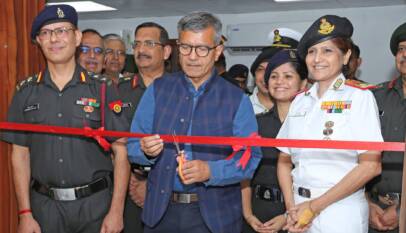
Army Hospital (R&R) commissions modern radiotherapy technology for advanced cancer care
A Ring Gantry-based Linear Accelerator was commissioned into the Department of Radiation Oncology at …