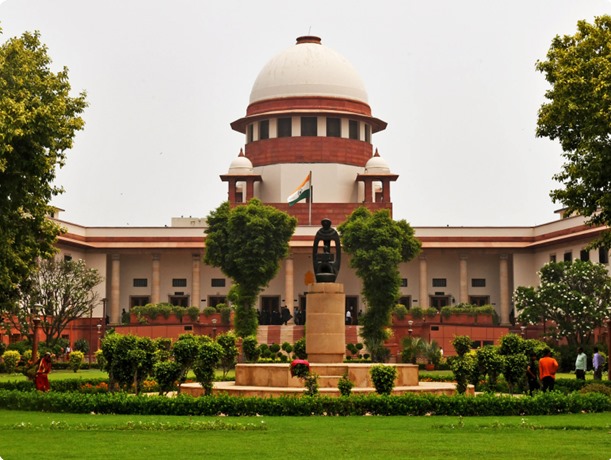
Supreme Court: Temple Money Belongs to God, Cannot Bail Out Banks

New Delhi, Dec 5: The Supreme Court on Friday strongly reaffirmed that temple funds belong exclusively to the presiding deity and cannot be diverted to support financially struggling cooperative banks. The apex court dismissed the special leave petitions (SLPs) filed by two Kerala-based cooperative banks challenging a Kerala High Court directive to immediately return the fixed deposits of Thirunelly Temple Devaswom.
A Bench headed by Chief Justice of India Surya Kant and Justice Joymalya Bagchi refused to interfere with the High Court’s ruling and made it clear that money donated by devotees must be preserved strictly for the benefit and interests of the temple. “Temple money, first of all, belongs to the deity. It must be saved, protected and utilised only for the interests of the temple and cannot be allowed to become a source of income or survival for any cooperative bank,” the Bench observed.
During the hearing, the court questioned the very premise of using temple funds to rescue financial institutions. “You want to use the temple money to save the bank?” the CJI remarked sharply, rejecting the cooperative banks’ plea to delay repayment of the matured deposits.
The cooperative banks had contended that the Kerala High Court’s two-month deadline for repayment was “abrupt” and practically difficult to comply with. However, the Supreme Court dismissed this argument, stating that public confidence is built on financial accountability. “You should establish your credibility among the people. If you are unable to attract customers and deposits, that is your problem,” the Bench stated, stressing that matured deposits must be released without delay.
While dismissing the SLPs, the apex court granted the cooperative banks limited liberty to approach the Kerala High Court seeking an extension of time for repayment, if genuinely required.
The petitions were filed by the Mananthawady Co-operative Urban Society Ltd and the Thirunelly Service Co-operative Bank Ltd after the Kerala High Court ruled that temples functioning under the Malabar Devaswom Board cannot keep their funds in cooperative banks in violation of binding regulatory circulars.
In its detailed judgment, the Kerala High Court had noted that circulars issued by the Malabar Devaswom Board clearly prohibited temples from depositing their funds in cooperative societies. After examining audit findings, the High Court held that the cooperative banks had “no right whatsoever” to deny the closure of deposits once they matured.
The High Court had further ordered that any funds deposited by temples under the Malabar Devaswom Board with cooperative banks must be withdrawn upon maturity and re-deposited only in authorised banks and financial institutions. A Bench comprising Justices Raja Vijayaraghavan V. and K.V. Jayakumar had explicitly stated that compliance with these directives was mandatory.
The Supreme Court’s ruling reinforces the legal and moral principle that temple funds are sacred trust assets meant solely for religious purposes and cannot be used as instruments for financial rescue of banks.
Team Maverick.







Solar Defence Showcases Indigenous ‘Bhargavastra’ Counter-Swarm Drone System to Indian Army
New Delhi, July 2026 : Solar Defence and Aerospace Ltd. (SDAL) on Friday showcased its ind…

Solar Defence Showcases Indigenous ‘Bhargavastra’ Counter-Swarm Drone System to Indian Army
New Delhi, July 2026 : Solar Defence and Aerospace Ltd. (SDAL) on Friday showcased …