Is Iran Drifting Toward A 1923-Style Meltdown?

Tehran; December 2025: Iran has been struggling with double-digit inflation for years, and the price of the dollar on the open market has jumped many times in recent years, to the point where it has increased 100 times compared to about ten years ago.
Although Iran’s current situation is still far from the hyperinflation of countries such as Venezuela, Argentina, or “Germany 1923”, there are signs that indicate that if the country’s economic policies and foreign policy orientation do not change quickly, hyperinflation in Iran is not out of the question; a situation that in Germany in 1923 caused the mark’s exchange rate against the dollar to fall not by tens of thousands, but by millions, billions, and even trillions daily.
Economist Hossein Abduh Tabrizi recently gave a warning speech about Iran’s economic situation: “If this year’s 60% inflation is repeated next year and the budget does not remain within the announced framework, distrust in the national currency will intensify and the country will enter a phase of dollarisation; a phase in which inflation may suddenly jump from 60% to 3,000%“.
The situation that Mr. Abdo Tabrizi describes occurred precisely in Germany in 1923, which can perhaps be found in this dialogue from one of Ernest Hemingway’s novels. The character in the novel asks, “How did you go bankrupt?” and hears the answer: “Two ways. First gradually, and then suddenly”. This is how “trust,” which is the lifeblood of any economy, disappears; gradually and then suddenly.
Meanwhile, a look at the situation in Germany in 1932, which went through terrible inflation and hyperinflation, can provide a similar historical experience for everyone, and how it was finally able to emerge from this whirlpool; although years later, due to the economic crisis of 1929, it was swallowed up by the ideology of the National Socialist German Workers’ Party, Nazism, and then destroyed in World War II.
Germany 1923 is one of the worst years in the history of the Weimar Republic, in which the people struggled with severe economic, social, political, and foreign policy crises, to the point that the experience of these crises deeply affected the collective mentality of the Germans. In addition, the Weimar Republic witnessed the occupation of the industrial Ruhr Valley by French and Belgian forces in this year due to its inability to pay the reparations determined by the victorious governments in World War I, which were implemented after the signing of the Treaty of Versailles.
On the other hand, the country’s political system suffered from a fragmented parliamentary mechanism in which parties did not have a majority and, as a result, coalition governments with moderate and right-wing parties were hasty. Indeed, cabinet crises and changes of government were part of the daily reality of Weimar. The country’s policy of “negative resistance” against the French occupation also failed and ultimately failed.
But what distinguishes this year from other years in the history of the Weimar Republic was the daily struggle of the people with horrific inflation and the many zeros on the Mark banknotes, to the point that in the fall of this year, the German Mark sank to terrifying figures of billions and even trillions against the US dollar.
Although many nationalist and right-wing circles attributed the inflation to the reparations issue, the issue was deeper than that, dating back to the time when Germany, embroiled in World War I, financed the war by issuing more and more domestic bonds. The assumption was that the country would win the war and the defeated enemies would be forced to pay the debts owed to Berlin. But the opposite happened. In other way to recoup its costs, increasingly resorted to expansionary policies and intensified money printing.
With this policy, the volume of money in circulation rose from 2.9 billion marks on August 1, 1914, to 18.6 billion marks on December 1, 1918, and by the end of the war, Germany had accumulated a debt of 156 billion marks. The interest alone on this enormous sum in the final year of the war, 1918, was equivalent to 90% of the Reich’s ordinary expenses. In practice, the value of the mark had fallen to almost half its pre-war value.
Germany resorted to rampant price increases to stimulate production, which led to rising wages and, as a result, out-of-control inflation. Instead of monetary and fiscal reform and controlling the national budget, post-war governments continued their policy of monetary expansion, aimed at preventing revolutionary unrest and radicalisation of the working class.
In fact, in Germany in the early post war years, there was a consensus among those in power that inflation was “a good thing”. Although inflation had benefits for the economy and helped boost exports at a time when other European countries were struggling with severe recessions due to the aftermath of the war, hyperinflation set in and the competitive advantage of manufacturing quickly eroded as the value of the mark fell by millions, billions, and trillions.
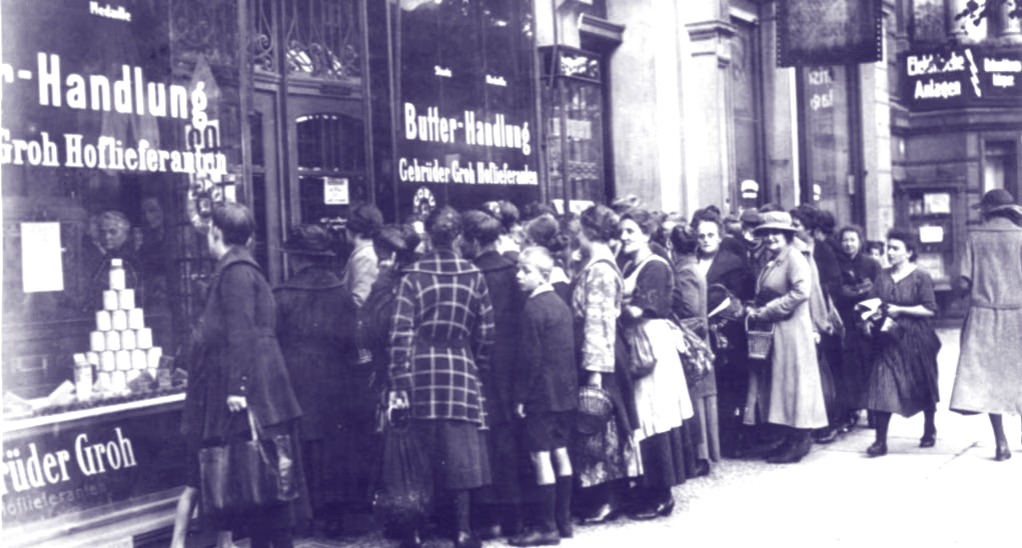
Prices rose by more than 50% each month, prompting people to rush to stores and shops to buy their necessities and stock up on groceries in a bid to turn worthless money into valuable goods, even for a short time. This exacerbated shortages and fuelled further price increases.
The Reichsbank intervened in the foreign exchange market to strengthen the national currency and was able to stabilise the mark’s value against the dollar for several months. However, due to a shortage of foreign currency, the government was forced to end this policy, and the dollar’s value suddenly plummeted.
The situation progressed to the point where the price of one dollar, which had reached 25,000 marks on April 18, 1923, jumped to 114,000 the following month and to one million marks by the end of July.
When a German diplomat, returning from vacation, ordered a coffee in the waiting room of a railway station, “the price sign said six thousand marks, but as he drank his coffee, the price disappeared. When it was time to pay, the waiter demanded twelve thousand marks. He protested, saying that the price on the sign was six thousand marks. The waiter said, ‘Oh, were you still here when the old price was? Then pay six thousand marks’”.
In early October 1923, the dollar was rising not by tens of millions but by hundreds of millions of marks every day. On October 09th, the value of one US dollar passed the one billion mark for the first time. The official exchange rate was 72 billion marks to the dollar on October 31st, 130 billion marks on November 01st, 320 billion marks on November 02nd, and 420 billion marks on November 03rd. This rate remained stable for three days, then jumped to 630 billion marks on November 07th and 840 billion marks on November 13th.
Printing presses worked around the clock to produce banknotes in ever-increasing denominations. Hundreds of printing presses, in addition to the central mint in Berlin, were employed to meet the demand for paper money.
This rampant inflation destroyed the well-being and social status of many classes and sent the moral norms of society into a downward spiral; virtues such as thrift, honesty, and collective solidarity were no longer common among the Arabs, and selfishness and bitter pessimism had taken their place. Many people longed for the “good old days” and the days of the Wilhelmine monarchy, a time that reminded them of stability and confidence in the future.
Inflation and hyperinflation had severe effects on the lives of different segments of society, crushing their livelihoods to varying degrees. Retirees, the elderly, workers, and employees who had fixed incomes suffered the most, as their savings, life insurance, and pensions became worthless. The middle class, who had bought bonds with the national debt, also had their capital wiped out. The rise in the price of food and daily necessities increasingly outpaced wage increases, to the point where many companies were forced to pay workers twice a week and eventually even daily.
“A Journalist for Berliner Illustrierte Zeitung wrote in August 1923”:
People’s nerves are being shattered every day by these crazy figures, the uncertain future, and the fact that even survival today and tomorrow has become an illusion. An epidemic of fear, the nakedness of despair. Crowded lines of consumers, which we haven’t seen for a long time, are forming again in front of the shops. The city, this huge stone city, is once again running out of purchasable goods. A kilo of rice that was 80,000 marks yesterday is 160,000 marks today and will probably double tomorrow. So tomorrow, the man behind the counter will shrug his shoulders and say: “We’re out of rice“. Well, then noodles! “We don’t have any noodles either“. Okay, then barley, bulgur, beans, lentils; the important thing is to be able to buy, buy, buy! That piece of paper, a new bill, still damp from printing and paid this morning as a weekly wage, is melting away as it heads to the grocery store. Zeros, more zeros. “Zero, zero; nothing!” With every dollar, hatred, despair, and deprivation increase.
Many people took on multiple jobs to cope with inflation. More women turned to prostitution, and the age of prostitution was even lowered to 16. More and more people sold their souvenirs and valuables. Petty crime increased. Pickpocketing was rampant. Gangs of thieves roamed Berlin and other German cities, looting anything that wasn’t secured, from brass doorknobs and bronze plaques on tombstones to works of art in churches and museums. Thieves climbed over buildings and broke into apartments to steal jewellery, furs, and silverware. Petty thefts focused mainly on everyday items, and in many places, desperate townspeople were forced to make a living by looting fruit and vegetable shops, greengrocers, and bakeries.
This economic and social unrest was only curbed when the government of Gustav Stresemann, who had become Chancellor of Germany that same year at the head of a grand coalition, adopted policies such as the establishment of the Rentenbank, for a period of currency transition, which was independent of the Reichsbank and the national government. As a result of the establishment of this bank, the currency unit “Rentenmark” was created.
Along with the introduction of the new currency, the Reichsbank stopped issuing bonds, thus closing the door on one of the main causes of inflation. At the same time, the coalition government sought to resolve the reparations crisis through negotiations with the Allied powers, with American mediation.
The next cabinet, led by Chancellor Wilhelm Marx, followed the policies of its predecessor and, as a first step, implemented the restructuring of the civil service structure that had been approved by the previous government. As a result, 400,000 civil servants, both white-collar and blue-collar, were declared redundant.
In addition, workers’ wages were cut and emergency tax increases were ordered to provide the government with immediate revenue. National support for the states to combat inflation was stopped, and compensation for those who had been hit hard by rising prices was reduced to a very limited level. Overall, the effects of spending cuts and tax increases turned out to be much more beneficial than many pessimists had predicted. By the spring of 1924, Germany had passed the first crucial stage of stabilisation.
After that, with the resolution of the issue of reparations and reaching a fair agreement for the victorious and defeated parties, foreign capital, especially from the United States, flowed into Germany, which boosted various sectors of the country’s economy; however, the global economic crisis of 1929, known as the “Great Depression”, caused severe turmoil in the country and triggered another wave of economic and political instability.
The situation in Iran and the way out –
The continuous fall in the value of Iran’s national currency in recent years, which has intensified in recent days, has led to a decrease in the purchasing power of the people, which, along with the increase in government spending and ideological institutions of the Islamic Republic, excessive printing of money, aggressive foreign policy, and ultimately the outbreak of the 12-day war with Israel, has severely lowered the living standards of society.
The unbridled increase in foreign currency prices and the escalation of inflation have led a number of experts to believe that the country’s economy is being “dollarized,” meaning a situation in which all matters will become dependent on the price of the dollar, effectively eliminating the “rial” as the national currency.
But what is the solution to this situation? What policies and solutions should be adopted to free the country from this chronic inflation and negative economic growth?
It seems that monetary and fiscal reform, a sharp reduction in government spending, administrative restructuring, distancing military institutions from economic and political affairs, and most importantly, a fundamental change in the direction of foreign policy, could be a way to escape Iran’s current eroding vortex, which is not far from economic collapse and reaching the road to hyperinflation.
Team Maverick.





India emerges as Global Leader in issuing Compliance Certificates under Nagoya Protocol
India has emerged as the global leader in issuing Internationally Recognized Certificates …

India emerges as Global Leader in issuing Compliance Certificates under Nagoya Protocol
India has emerged as the global leader in issuing Internationally Recognized Certificates of Compliance …