Refrain From Norwegian Salmon As Decompression Sickness In Fish Reveals Hidden Risks Of Hydropower Operations.

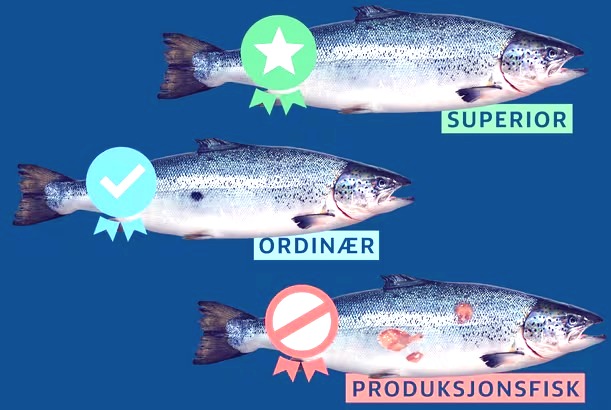
Oslo; December 2025: The Norwegian Broadcasting Corporation NRK has revealed that Norway exports salmon with wounds on the skin, which is indeed alarming. Norwegian exports of farmed salmon are among the country’s largest industries.
There are strict regulations governing exports. Salmon exported out of the country must be of the highest quality. Salmon with wounds is considered to be of insufficient quality and is therefore prohibited from being exported under Norwegian law. The revelation is therefore very serious in itself, but it also affects an industry that is already facing a great deal of criticism and scrutiny.
Healthy salmon do not have gaping wounds. Healthy salmon have intact skin. That’s why an expert on fish health advises consumers to buy whole salmon fillets with the skin on.
Robert Eriksson, CEO of the Norwegian Seafood Association, ardently suggests the wounded salmon fish should not reach the market. It should not be sold for human consumption before being corrected in Norway. But still, the sick fish becomes food after ‘correction’. But the correction does not make the fish any healthier.

When such huge quantities of salmon are ‘downgraded’ and ‘corrected’, meaning the skin is removed from the fish to hide sickness or injury before slaughter, it covers up one of the biggest animal health problems in Norwegian food production.
Institute Of Marine Research, Norway have categorically demonstrated in their latest report – Production mortality in farmed fish and environmental effects of Norwegian fish farming, that important environmental impacts from Norwegian fish farming to the risk of reduced sustainability in the thirteen production areas. In this year’s report the spotlight is on nine overall undesirable events that, if they occur, could have a range of serious consequences resulting in “Reduced sustainability with regard to poor animal welfare and negative environmental effects of fish farming” in the thirteen production areas.
The undesirable events that are included and risk assessed in the “Risk Report Norwegian Fish Farming 2025” are:
- Poor welfare of farmed salmon and rainbow trout in the sea;
- High sea lice-induced mortality of migrating post-smolt salmon;
- Negative effects of sea lice infestation on sea trout and sea char;
- Further genetic change in wild salmon as a result of inbreeding of escaped farmed salmon;
- Eutrophication of coastal waters due to discharge of nutrients from fish farming;
- Negative effects on benthic communities in the area of influence of farming;
- Negative effects on the marine environment from the use of copper in fish farming;
- Serious effects on non-target species from the use of delousing agents;
- Negative effects on the marine environment from the capture and use of wild-caught wrasse in fish farming.
The negative impact of sea lice on wild salmonids has worsened significantly in 2024. Despite the fact that the temperature did not exceed what is normal in Western Norway, the marine heat wave in 2024 resulted in much higher emissions of sea lice from PO5 to PO12, especially during the summer.
The risk of “Poor welfare of farmed salmon in the sea” is assessed as high in PO1-6 and in PO12. For PO6 there is thus a deterioration from last year’s assessment. This is mainly due to a trend towards increased production mortality in recent years and a complex risk picture with a lot of uncertainty due to vulnerability to individual events. Directorate of Fisheries’ biomass statistics for Norwegian farmed fish as of 20.1.2025 show that a total of 60 million farmed salmon were reported as dead (57 million) or were in such poor condition that they were registered as discarded (3 million) in 2024. This is a decrease from 65 million in 2023.
Professor Ole Gunnar Dahlhaug and postdoctoral fellow Wolf Ludwig Kuhn at the Norwegian University of Science and Technology (NTNU) have ascertained that, the problem lies in many hydropower plants those are in Norway for more than 100 years. The hydropower’s can threaten fish and bottom-dwelling animals that live in rivers, reservoirs or fjords downstream. When the water discharged from the hydropower plant contains too much dissolved air, fish can get gas bladder disease, which is related to decompression sickness in humans.
Gas bladder disease results when harmful, deadly air bubbles form inside the body. That’s what happened to a small trout that was found in the river Otra below one of Norway’s largest power stations a few years ago. It had all the signs of gas bladder disease: protruding eyes, bleeding, infection and wear and tear on the fins.
Supersaturation can occur when air is sucked in through the intake tunnels on the upper side of hydropower plants. The pressure becomes so high that the air dissolves in the water on the journey down to the turbines. When discharged from the lower side of the power plant, the water looks like skimmed milk due to a huge amount of gas bubbles. Gas supersaturation can also occur during floods and high water flow.
In some areas, life along long stretches of rivers downstream of power plants has almost been eliminated, such as in Otra, which is regulated by Brokke Power Plant in Agder. Calculations made by the research institute NORCE LFI (Laboratory for Freshwater Ecology and Inland Fisheries) show that many of Norway’s 1,800 power plants can be affected by the supersaturation problem. Almost 30% are in the high-risk class. The greatest risk of harm comes from the largest facilities that discharge into rivers. There are roughly 200 of these in Norway.
Team Maverick.





Parliament Paralysed for Second Day as Opposition Protests Over NEET Leak, Student Crackdown
New Delhi, July 2026 : Parliament remained deadlocked for the second consecutive day of th…

Parliament Paralysed for Second Day as Opposition Protests Over NEET Leak, Student Crackdown
New Delhi, July 2026 : Parliament remained deadlocked for the second consecutive day of …