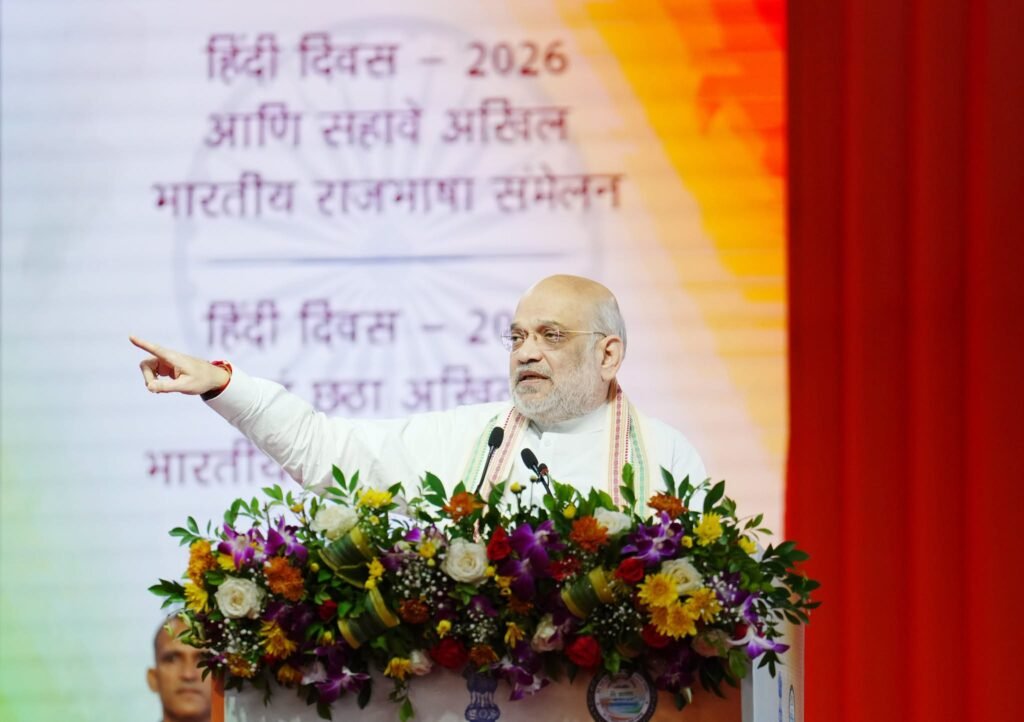
Mumbai, Sept 2026 : Union Home Minister Amit Shah on Monday highlighted the role of Hindi as an official language in strengthening national integration and enabling communication across linguistic regions while praising Maharashtra's rich multilingual heritage.
Addressing the 6th Akhil Bharatiya Rajbhasha Sammelan in Navi Mumbai on the occasion of Hindi Diwas, Shah also paid tribute to freedom fighters V.D. Savarkar and Bal Gangadhar Tilak, underlining their contributions to India's cultural and linguistic consciousness.
With Ganesh Utsav coinciding with Hindi Diwas celebrations, Shah extended his greetings to people across the country and invoked Lord Ganesha as the Vighnaharta, or remover of obstacles. He expressed hope that the blessings of Lord Ganesha would help remove hurdles in the development and promotion of Indian languages.
Sharing his personal experience, Shah said he came from Gujarat, where Gujarati is the primary language, but his knowledge of Hindi helped him discharge responsibilities at the national level without facing communication difficulties. He said the official language had provided him with an important opportunity to work and serve people across the country.
Shah described Maharashtra as the land of V.D. Savarkar and highlighted the freedom fighter's contribution not only to India's independence movement and social reform but also to the development of languages. He described Savarkar as one of the most learned linguists of his time.
The Home Minister said Savarkar had worked towards enriching Indian languages and, building on Lokmanya Tilak's call for the purification of Marathi, coined several words that were previously absent from Indian linguistic usage. Many of these words, he said, were subsequently accepted naturally in Marathi and other Indian languages.
Shah added that the Ministry of Home Affairs had sought to honour Savarkar's linguistic legacy in Hindi through the ‘Shabd Sindhu’ initiative.
He also highlighted Maharashtra's extraordinary linguistic diversity, saying few states could match its coexistence of languages and communities. Marathi, Konkani, Gujarati, Hindi, Sindhi and Warli, among other languages, coexist and flourish in the state, he noted.
Shah emphasised that Marathi deserves immense respect and recalled that Prime Minister Narendra Modi's government granted it the status of a classical language, or ‘Abhijat Bhasha’.
Referring to freedom fighter Vinoba Bhave, Shah said Hindi had helped Bhave take the message of the Bhoodan and Gramdan movements to villages across the country, including Kashmir, Assam and Kerala. He also recalled Tilak's decision to launch the public Ganesh Utsav in 1893 and celebrate Chhatrapati Shivaji Maharaj Jayanti as efforts to use cultural traditions to promote national unity.
Shah said Shivaji Maharaj viewed Swarajya not merely as a system of governance but as a broader concept incorporating Swadharma and Swabhasha. He noted that the Maratha ruler promoted the use of Marathi in administration.
The Home Minister also highlighted the historic role of ‘Vande Mataram’ in awakening national consciousness during the colonial period. He said India's linguistic traditions had played a significant role in strengthening the country's sense of identity and unity.
Shah further referred to the National Education Policy introduced under Prime Minister Modi, saying it gives priority to providing primary education in a child's mother tongue.
During the conference, the Home Minister launched training initiatives relating to Hindi language resources, shorthand and typing. He also felicitated winners of the Rajbhasha Kirti and Rajbhasha Gaurav awards, recognising their contributions to the promotion and use of Hindi in official communication.