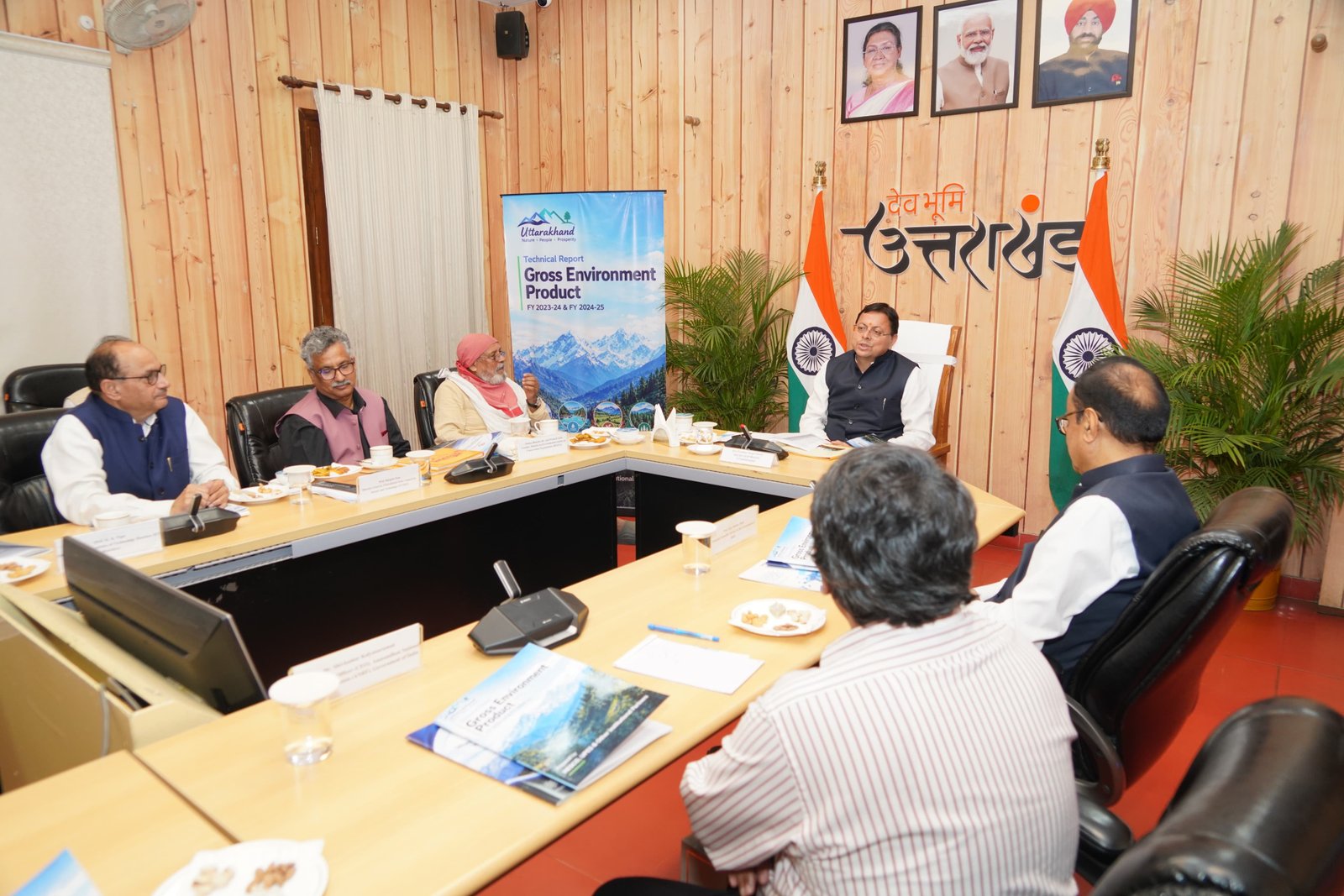
Dehradun, Sept 2026 : Chief Minister Pushkar Singh Dhami on Saturday held a meeting with Principal Scientific Adviser to the Prime Minister’s Office (PMO) Prof Ajay Sood and experts from various scientific and technical institutions.
During the meeting, CM Dhami released the Uttarakhand Science, Technology and Innovation Policy-2026, along with the Gross Environment Product (GEP) Technical Reports for 2023-24 and financial year 2024-25.
The meeting also saw detailed discussions on various aspects of the GEP technical reports. Dhami directed officials to include carbon credits in the Uttarakhand Science, Technology and Innovation Policy-2026 and make water harvesting simple and accessible for the general public.
GEP Report Focuses on Economic Valuation of Natural Resources
The meeting discussed various aspects of the economic valuation of Uttarakhand’s natural resources and environmental services through the GEP technical reports for 2023-24 and 2024-25.
Experts shared their views on the importance of forests, water, biodiversity, soil conservation, carbon absorption and other environmental services, as well as the possibilities of their scientific and economic assessment.
Dhami said GEP could facilitate the scientific and economic assessment of the contribution of the state’s natural and environmental wealth. This would help in understanding the importance of environmental resources and effectively incorporating their contribution into the state’s development plans and policies.
He said Uttarakhand has unique geographical and environmental conditions and therefore a GEP model should be developed specifically according to the state’s local circumstances, requirements and resources. He expected experts and scientific institutions to provide the necessary technical suggestions and support in this direction.
Directions to Include Carbon Credits in Policy
Dhami said effective efforts were needed in science, technology and innovation while keeping in view Uttarakhand’s distinctive geographical and environmental conditions.
He directed that carbon credits should also be incorporated into the Uttarakhand Science, Technology and Innovation Policy-2026.
He said special attention should be given to the potential of carbon absorption, forest conservation, natural resource protection and environmental services, while providing scientific and technological support to initiatives in these areas.
The Chief Minister said the Himalayas, forests, water sources, rivers, biodiversity and other natural resources were among Uttarakhand’s key strengths. Their conservation was essential not only for maintaining ecological balance but also for the local economy, livelihoods and sustainable development.
He stressed the need to develop locally relevant solutions through science and technology for the conservation and effective utilisation of natural resources.
Focus on Making Water Harvesting Accessible
Dhami directed officials to make water harvesting easier for ordinary citizens to adopt.
He said water harvesting should not remain limited to large projects or institutional initiatives. Instead, plans and technological models should be developed that people can easily implement in their homes and surrounding areas.
He emphasised promoting simple, low-cost and locally suitable technological options for water conservation. Such initiatives, he said, should be designed in a way that enables citizens to participate easily and helps expand water conservation through wider public participation.
Balance Between Development and Environmental Protection
Dhami said Uttarakhand’s natural wealth was one of its major strengths. The Himalayas, forests, water sources, rivers, biodiversity and other natural resources not only maintain ecological balance but also contribute significantly to the local economy and livelihoods.
He said it was therefore important to understand the actual value of environmental benefits and services derived from natural resources.
The Chief Minister stressed that the state’s development policies should move forward while maintaining a balance between development and environmental protection. The capacity of natural resources, environmental sensitivity and local conditions must be taken into account while planning development projects.
He said scientific assessment of environmental resources and their contribution through GEP could provide a useful basis for the state’s development plans and policies. Efforts should also be made to link conservation of natural resources with community participation and livelihood opportunities.
Experts Offer Suggestions on Scientific Basis of GEP
Experts from various scientific and technical institutions, including Principal Scientific Adviser to the Prime Minister Prof Ajay Sood, shared their views and suggestions on the scientific basis of GEP, collection and analysis of environmental data, and its potential application in a Himalayan state such as Uttarakhand.
The meeting also discussed natural resources, environmental services and sustainable development. Participants deliberated on ways to link scientific studies, technical data and research findings with the state’s policymaking process, while ensuring community participation in environmental conservation.
Uttarakhand Science, Technology and Innovation Policy-2026
Releasing the Uttarakhand Science, Technology and Innovation Policy-2026, Dhami said the state’s unique geographical and socio-economic conditions required specialised solutions for development.
He said these challenges needed to be addressed effectively through science, technology and innovation.
The policy aims to promote region-specific scientific research and development, identify emerging areas in science and technology, and encourage scientific and technological interventions for the state’s overall development.
Promoting research and development activities at the local level and effectively disseminating their outcomes would play an important role in strengthening the state’s economy and improving the quality of life, he said.
The policy seeks to establish Uttarakhand as a scientifically and technologically capable and developed state. Special emphasis will be placed on technological development in areas such as infrastructure, energy, water resources, agriculture, healthcare, education and employment, keeping in view the distinct requirements of the mountainous and plain regions.
Focus on Addressing Himalayan Challenges
The Uttarakhand Science, Technology and Innovation Policy-2026 gives priority to areas linked to the state’s specific challenges, including glaciology, natural disaster management, energy, water resources, agriculture, healthcare, educational challenges in mountainous areas, migration, skill development, entrepreneurship, intellectual property rights protection and innovation.
The policy aims to strengthen research and development institutions and innovation centres, identify priority research areas and create an effective ecosystem for scientific research.
Capacity building will also be promoted through research initiatives, outreach platforms and science communication centres to mainstream science communication and public participation.
Dhami said Uttarakhand’s scientific and technological capabilities should be linked with local needs, while self-reliance, technological efficiency, effective use of indigenous resources and environmental protection should form important pillars of the development process.
He said efforts in science, technology and innovation should ultimately aim to bring tangible and positive changes to the lives of the people of Uttarakhand.
The meeting was attended by Prof Shiv Kumar, Chief Executive Officer of the Anusandhan National Research Foundation (ANRF); senior scientist Dr Parminder Main; Himalayan Environmental Studies and Conservation Organisation (HESCO) founder Dr Anil Prakash Joshi; IIT Roorkee Director Prof K.K. Pant; Uttarakhand State Council for Science and Technology (UCOST) Director General Prof Durgesh Pant; educationist Dr Reema Pant; UCOST’s Surendra Singh Manral; and Dr Vipin Sati.