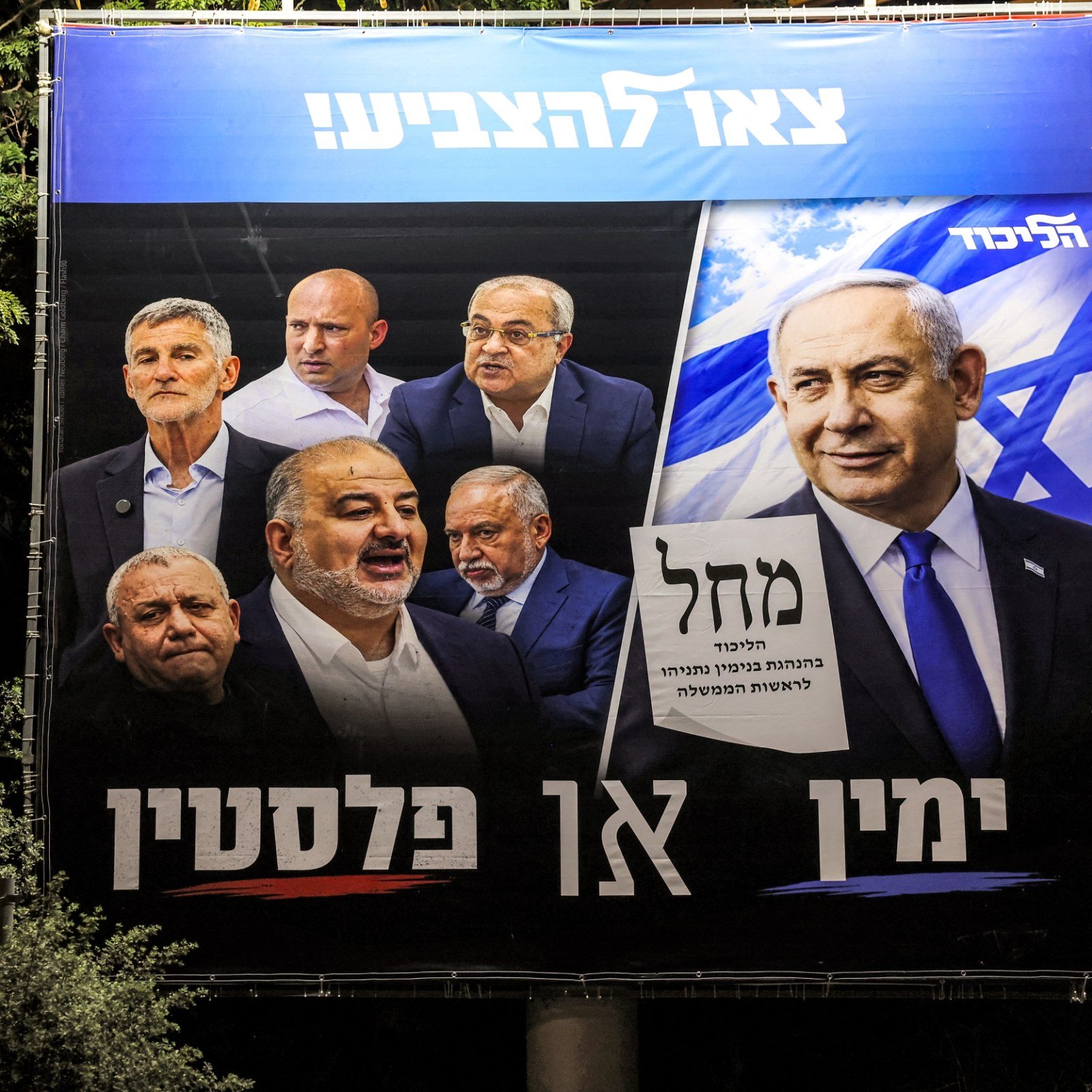
Figures released by Israel’s Central Elections Committee gave Netanyahu’s bloc 57 seats, compared with 47 for the anti-Netanyahu camp. The predominantly Arab Joint List and Ra’am factions together held the remaining 16 seats, The Times of Israel reported.
The early figures followed exit polls released by Israeli television channels 11, 12 and 13 on Tuesday night. Those projections had suggested a closely contested election, with neither Netanyahu’s supporters nor the opposition alliance seeking to replace him expected to secure the 61 seats required for a majority in the 120-member Knesset, Israel’s parliament.
However, updated projections released overnight indicated that Netanyahu’s bloc had gained an advantage over the opposition camp led by Gadi Eisenkot, a former chief of staff of the Israel Defence Forces (IDF). The difference between exit-poll estimates and partial counting results highlighted the uncertainty surrounding the final outcome.
Netanyahu calls for a strong right-wing government
Addressing supporters at the Likud election headquarters in Jerusalem after voting concluded, Netanyahu claimed that the right wing commanded a strong majority among Israel’s Zionist public and called for the formation of a national right-wing government.
The prime minister also criticised media outlets that had previously projected a weaker performance for Likud.
“Likud is the biggest party in Israel. There is no disputing it,” The Times of Israel quoted Netanyahu as saying, referring to earlier predictions that his party would win fewer seats.
He argued that the election results demonstrated broad support for his political bloc among Jewish voters and others who support Israel as a Jewish state.
Netanyahu reiterated his demand for a strong right-wing government, saying the emerging figures supported his position. His remarks came as political parties assessed their possible routes to forming a governing coalition.
Dispute over cooperation with Arab parties
Netanyahu also criticised political parties willing to cooperate with Arab factions to form a government. He described such an arrangement as a “shame” and questioned how parties could discuss military service commitments while potentially relying on groups he accused of opposing Israeli military operations.
He argued that forming a government dependent on anti-Zionist Arab parties would endanger Israel. Netanyahu further accused these groups of opposing Israel’s existence, describing Hamas as a charitable organisation and referring to Israeli soldiers as war criminals.
These remarks reflected the continuing divisions within Israeli politics over the role of Arab parties, national security and the composition of any future coalition government.
Election held amid security and political tensions
The parliamentary election was the first electoral contest since the Hamas-led attack on Israel on October 7, 2023. The attack and the subsequent conflicts have significantly shaped Israel’s political debate, security priorities and public assessment of its leadership.
During his address, Netanyahu highlighted what he described as Israel’s achievements in the conflicts that followed the October 7 attack. He claimed that Iran had been substantially weakened and that Israel had emerged stronger.
The election also took place against the backdrop of changing political alignments since the previous parliamentary elections in 2022. Voters faced questions concerning national security, the war’s consequences, relations with Arab political groups and the country’s future leadership.
Coalition formation remains crucial
Although the partial results placed Netanyahu’s bloc ahead, securing a parliamentary majority remains central to forming the next Israeli government. Under Israel’s electoral system, parties must negotiate coalition agreements to command the support of at least 61 members of the Knesset.
The final seat distribution and subsequent coalition negotiations will determine whether Netanyahu can continue leading the government or whether opposition parties can assemble an alternative alliance.
With counting continuing, the early figures offered an indication of the political balance but did not, by themselves, settle the question of who would ultimately form Israel’s next government.
(Disclaimer :The content of this article is sourced from a news agency and has not been edited by the Mavericknews30 team.)