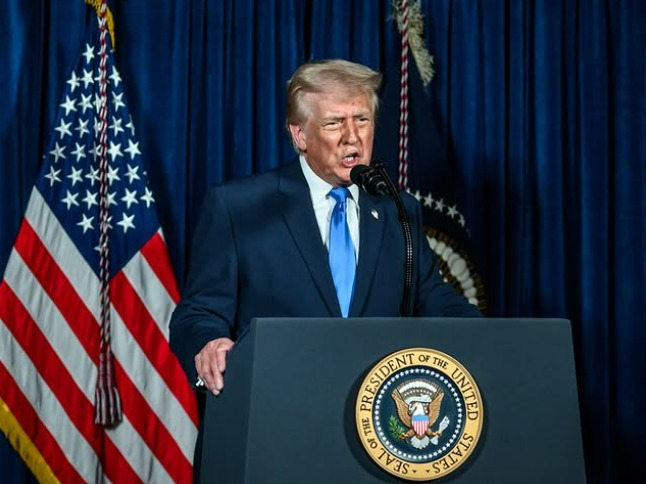
Trump Dismisses Reports of Military Dissent on Iran, Faces Growing Congressional Scrutiny Over War Risks

Washington, Feb 2026 : US President Donald Trump on Monday strongly rejected media reports suggesting that America’s top military leadership opposes potential military action against Iran, asserting that any such operation, if ordered, would be “easily won.” His remarks came amid mounting concern among senior Democratic lawmakers, who warned against what they described as a dangerous drift toward another prolonged conflict in the Middle East.
Taking to Truth Social, President Trump dismissed reports claiming that General Daniel Caine, Chairman of the Joint Chiefs of Staff, was against military action targeting Iran. Trump labelled these reports as “100% incorrect,” accusing what he called the “Fake News Media” of misrepresenting the general’s position. He insisted that while military leaders naturally prefer to avoid war, they are fully prepared to act decisively if civilian leadership authorises force.
The controversy followed a report by the Wall Street Journal, which stated that Pentagon officials have cautioned the President about the potential risks of a sustained military campaign against Iran. According to the report, the Defense Department raised concerns that such plans could lead to significant US and allied casualties, depletion of air defence systems, and excessive strain on already stretched American forces. The report added that these warnings were communicated during internal Pentagon discussions and meetings of the National Security Council.
Trump countered this narrative by stating that General Caine, like others in the military establishment, would prefer to avoid war but is confident of victory if action is deemed necessary. “If a decision is made on going against Iran at a military level, it is his opinion that it will be something easily won,” Trump wrote. He further emphasised that the general has not opposed military options but remains focused on preparedness and success if tasked with executing an operation.
The President also sought to underline his authority in such matters, stating that ultimate decisions rest with him alone. At the same time, he reiterated his preference for diplomacy over conflict. Trump said he would rather strike a deal with Iran but warned that failure to reach an agreement could have dire consequences. “If we don’t make a deal, it will be a very bad day for that country and, very sadly, its people,” he said, adding that the Iranian people deserved a better outcome.
In a pointed reference to earlier US military actions, Trump said that General Caine had previously overseen “Midnight Hammer,” a strike aimed at Iran’s nuclear infrastructure. He claimed that the operation had effectively destroyed Iran’s nuclear development capabilities, asserting that facilities were “blown to smithereens” by American B-2 bombers. The statement appeared intended to reinforce the administration’s narrative of military superiority and deterrence.
However, Trump’s comments triggered sharp reactions on Capitol Hill, where lawmakers expressed alarm at the prospect of renewed military escalation. Senator Chris Coons, the Ranking Member of the Senate Appropriations Subcommittee on Defense, warned that the administration’s actions risked dragging the United States into another open-ended conflict. He noted that less than a year after US strikes on Iran’s nuclear program, the President had again deployed substantial air and naval assets within striking distance of Iranian territory.
Coons questioned the administration’s objectives and demanded greater transparency. He said Congress and the American public needed clear answers about the goals of any potential military engagement with Iran, how such action would enhance US security, and what an endgame might look like. While acknowledging bipartisan agreement that Iran should not be allowed to develop nuclear weapons, Coons argued that repeated bombing campaigns were not a viable long-term strategy.
Echoing these concerns, Congressman Seth Moulton warned that the President appeared to be steering the country toward what he described as “Iraq War 2.0.” Moulton questioned what the administration hoped to achieve through military force and at what human and strategic cost. He also argued that diplomatic avenues had been undermined when Trump withdrew from the earlier nuclear agreement during his first term.
Moulton went further, saying that it was now incumbent upon Congress to demonstrate stronger oversight than it had during the run-up to the Iraq War under George W. Bush. He cautioned that failure to scrutinise executive decisions could once again leave the United States entangled in a costly and destabilising conflict.
As tensions persist, the debate underscores a widening divide between the White House’s assertive posture and lawmakers’ calls for restraint, clarity and renewed diplomatic engagement.
(The content of this article is sourced from a news agency and has not been edited by the Mavericknews30 team.)
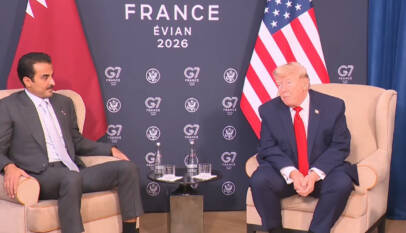



Trump Hails UAE and Qatar for Backing Iran Deal, Says Agreement Will Bar Tehran from Nuclear Weapons
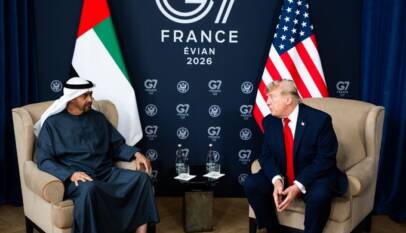
Evian, June 2026: U.S. President Donald Trump on Monday praised the United Arab Emirates (…
Trump Hails UAE and Qatar for Backing Iran Deal, Says Agreement Will Bar Tehran from Nuclear Weapons
Evian, June 2026: U.S. President Donald Trump on Monday praised the United Arab Emirates …