Updated Ukraine Recovery and Reconstruction Needs Assessment Released.

Kyiv, Ukraine; February 2026: Four years into Russia’s invasion of Ukraine, an updated joint Rapid Damage and Needs Assessment (RDNA5) released today by the Government of Ukraine, the World Bank Group, the European Commission, and the United Nations currently estimates that as of 31st December 2025, the total cost of reconstruction and recovery in Ukraine is almost $588 billion (over €500 billion) over the next decade, which is nearly 3X the estimated nominal GDP of Ukraine for 2025.
With the support of development partners, the Government of Ukraine is taking significant steps to meet recovery and reconstruction priorities for 2026, including public investment projects and essential recovery support programs such as funding for destroyed housing, demining, and multisector economic support programs, totalling more than $15 billion. In addition, per the available information collected under the RDNA assessment, at least $20 billion in needs have already been met since February 2022 through urgent repairs and early recovery activities in housing, energy, education, transport, and other essential sectors.
“Four years into Russia’s full-scale invasion, the total cost of Ukraine’s reconstruction and recovery is now estimated at nearly $588 billion over the next decade, which is nearly three times the country’s projected nominal GDP for 2025”, noted Prime Minister of Ukraine Yulia Svyrydenko. “Amid unprecedented Russian attacks on energy infrastructure and homes across Ukraine this winter, our people show resilience, our entrepreneurs keep working. We still manage to recover fast and develop further. I thank the World Bank, EU, and UN teams for supporting our efforts to stand against the challenges. The assistance helps us urgently repair our critical infrastructure to keep the country running as well as continue systematic recovery activities focusing on energy projects and housing for our people”.
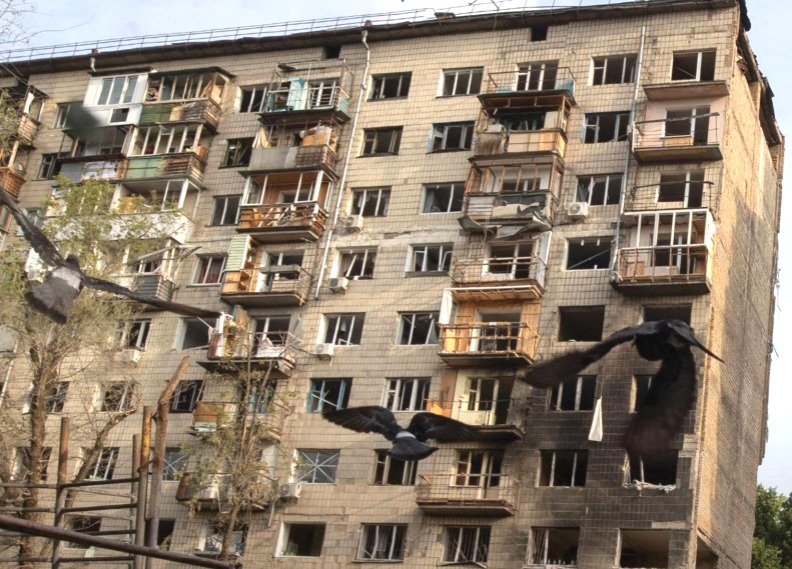
The latest update presents an overview of nearly four years of impact, covering 46 months between February 2022 and December 2025. It finds that direct damage in Ukraine has now reached over $195 billion (€166 billion), up from $176 billion (€150 billion) in the RDNA4 of February 2025, with housing, transport, and energy sectors being most affected. Damage, losses, and needs remain concentrated in frontline oblasts and major metropolitan areas.
In the energy sector, which has been subject to increased attacks as Ukraine endures a winter of record intensity, there has been an approximately 21% increase in damaged or destroyed assets since the RDNA4, including power generation, transmission, distribution infrastructure, and district heating. In the transport sector, needs have increased by around 24% since RDNA4 and are the result of intensified attacks on rail and ports during 2025. As of December 31, 2025, 14% of housing has been damaged or destroyed, impacting over three million households.
“Despite the widespread damage that continues to mount against Ukraine’s people, economy and infrastructure, the entire country continues to press on with remarkable strength and resolve”, said Anna Bjerde, World Bank Managing Director of Operations. “The World Bank Group stands firmly committed to supporting Ukraine’s recovery and reconstruction and helping to advance the people of Ukraine with jobs, opportunities and hope in a resilient, modern, and competitive economy”.
Ukraine’s private sector has demonstrated remarkable resilience in the face of unprecedented disruption and will play a critical role in recovery and reconstruction. The RDNA5 underscores that unlocking the full potential of private investment, both domestic and international, will depend on sustained reforms to improve the business environment, strengthen competition, expand access to finance, address labour constraints, and align production with EU green and digital standards.
Promoting sustainable and inclusive development and job creation, and integrated approaches to resilient recovery at the local level, such as through the Government’s pilot Comprehensive Restoration program will also be essential. The RDNA5 findings complement the reform and investment agenda of the Ukraine Facility, grounded in the EU accession process, for the next two years.
“Russia’s war of aggression continues to have a devastating impact on Ukraine”, said EU Commissioner for Enlargement Marta Kos. “The EU will continue to play a key role in supporting Ukraine’s reconstruction and recovery by mobilising more private investments through the Ukraine Investment Framework, and by encouraging key reforms through the Ukraine Plan that will attract investment and bring Ukraine closer to EU membership”.
Of the total long-term needs, reconstruction and recovery needs are the highest in the transport sector (over $96 billion = €82 billion). This is followed by the energy sector (nearly $91 billion = €77 billion), the housing sector (almost $90 billion = €77 billion), commerce and industry sector (over $63 billion = €54 billion), and agriculture sector (over $55 billion = €47 billion). The cost of explosives hazard management and debris clearance is almost $28 billion = €24 billion, despite some progress in surveying and demining that helped to contain losses in this sector.
“People are central to recovery”, said Matthias Schmale, the UN Resident and Humanitarian Coordinator in Ukraine. “Ukraine’s most critical asset is its people. Refugee return, veteran reintegration, and women’s labour force participation will shape economic recovery as much as capital flows and rebuilding infrastructure. Recovery must be human-centered and community-based”.
The RDNA5 acknowledges the Government of Ukraine’s efforts to build a forward looking, inclusive, and resilient economic model anchored in post-war recovery planning and long-term growth and underscores the pivotal role played by EU accession and reforms under the Ukraine Plan, International Monetary Fund, and World Bank Group supported programs. The Government’s emerging post-war economic strategy, the Ukraine Economy of the Future (UEF) which focuses on macro-fiscal stability, governance and rule of law reforms, private sector dynamism, infrastructure rebuilding, and investments in human capital and social sustainability. These efforts will help to strengthen confidence among citizens, investors, and partners and position Ukraine for accelerated EU convergence and long-term prosperity.
Damages –
The direct damage is immense and increasing continuously. As of December 31st, 2025, total damage
to Ukraine’s buildings and infrastructure was estimated at US$195.1 billion. Total damage in RDNA5
reflects a US$19 billion (10.8%) increase since RDNA4, and a doubling of damage since RDNA1.
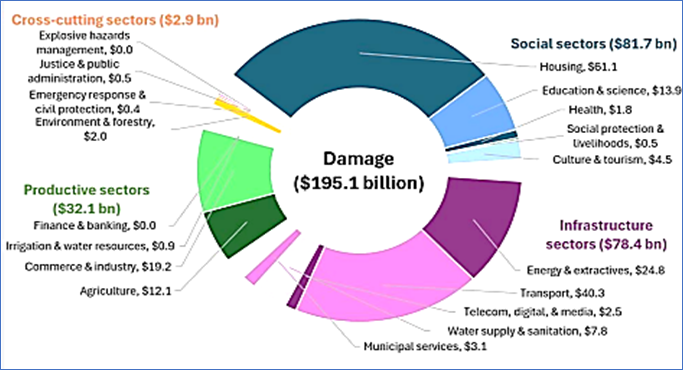
Damage remains highly concentrated in several key sectors. About 14% of the national housing stock is estimated to be damaged or destroyed, and more than 03 million households affected. The housing sector has sustained US$ 61.1 billion in damage (31.3% of total damage), followed by transport with US$40.3 billion in damage (20.6%), energy and extractives with US$ 24.8 billion (12.7%), and commerce and industry with US$19.2 billion (9.8% percent).
Other sectors with substantial damage burdens include education and science (7.1% of total damage),
agriculture (6.2%), and water supply and sanitation (04%), each reflecting the widespread destruction of public facilities and service delivery assets. The increase relative to RDNA4 is primarily driven by continued attacks on critical infrastructure, but also reflects improved data availability, refined assessment methodologies, and exchange rate adjustments.
Losses –
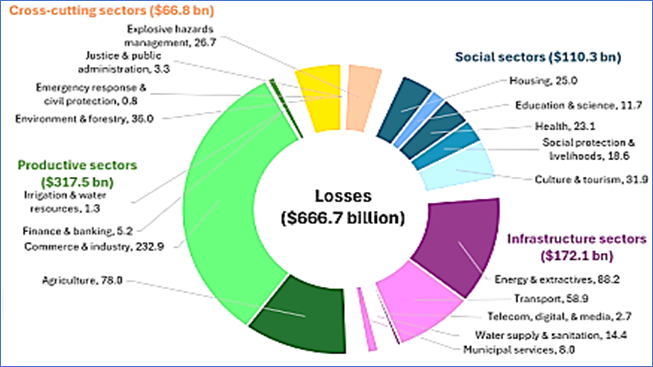
Socioeconomic losses are estimated at US$666.7 billion in RDNA5, a 13.2% increase since RDNA4 that reflects the extensive and prolonged disruption to economic activity, public services, and livelihoods nationwide. Losses continue to be dominated by the commerce and industry sector, where they amount to US$232.9 billion, equivalent to 34.9% of total losses.
Other sectors with large losses are the energy and extractives sector, with losses of US$88.2 billion (13.2% of total losses); agriculture, with losses of US$78.0 billion (11.7%); and transport, with losses of US$58.9 billion (8.8%). These losses capture the cascading effects of damaged infrastructure, the high cost of maintaining critical services under challenging conditions, and the contraction of productive capacity across the economy.
Total losses of US$ 34.6 billion (04%) in explosive hazards management reflect persistent clearance needs, area denial, and associated economic effects, though this sector is the only one to record a decrease in losses (-10.5%). This decrease is due to progress in unexploded ordnance (UXO) surveying and major demining efforts that contribute to a reduction in residual contamination.
Team Maverick.






Congress Lines Up Rahul, Priyanka for Key Lok Sabha Debate on Anti-Paper Leak Bill
New Delhi, July 2026 : The Congress has fielded some of its top leaders, including Leader …

Congress Lines Up Rahul, Priyanka for Key Lok Sabha Debate on Anti-Paper Leak Bill
New Delhi, July 2026 : The Congress has fielded some of its top leaders, …