
Artemis II Astronauts Return Safely After Historic Lunar Mission

Washington, April 2026 : In a landmark achievement for modern space exploration, NASA’s Artemis II astronauts safely returned to Earth after completing a 10-day mission around the Moon, marking humanity’s first deep space journey in more than five decades since the Apollo 17 mission. The crew’s successful splashdown in the Pacific Ocean off the coast of San Diego at 8:07 p.m. Eastern Time on Friday signals a major step forward in the United States’ ambitious lunar exploration programme.
The mission featured four astronauts aboard NASA’s Orion spacecraft—Reid Wiseman, Victor Glover, Christina Koch, and Canadian Space Agency astronaut Jeremy Hansen. Their journey, launched atop NASA’s powerful Space Launch System rocket, marked the first crewed test flight of the Orion spacecraft, designed to carry humans beyond low Earth orbit.
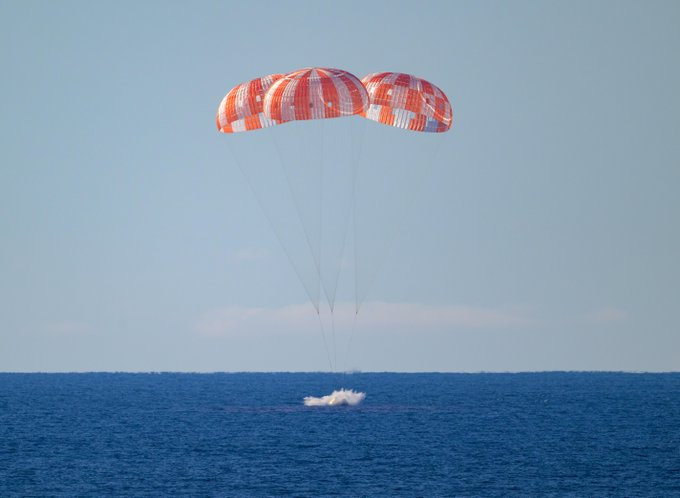
As the spacecraft re-entered Earth’s atmosphere at speeds nearing 25,000 miles per hour, it endured extreme conditions, including temperatures approaching 5,000 degrees Fahrenheit. A blazing plasma sheath formed around the capsule during descent, one of the most critical phases of the mission. Orion successfully deployed its drogue and main parachutes in sequence, ensuring a smooth and controlled splashdown in the Pacific.
Moments after landing, mission commander Wiseman confirmed the crew’s safety during a live broadcast, saying, “What a journey. We are stable—four green crewmembers.” NASA officials quickly followed with a jubilant “Splashdown!” announcement, confirming the mission’s successful conclusion.
Recovery operations were swiftly initiated, with teams approaching the capsule by boat before airlifting the astronauts via helicopter to the USS John P. Murtha for initial medical evaluations and debriefing. NASA later confirmed that all crew members were in good health.
The Artemis II mission achieved several historic milestones. It marked the first time humans traveled to the Moon’s vicinity in over 50 years, surpassing even the achievements of Apollo 13 mission in terms of distance. The astronauts reached a maximum distance of 252,756 miles from Earth, setting a new record for human spaceflight.
The mission also broke barriers in representation. Victor Glover became the first Black astronaut to journey to the Moon’s vicinity, Christina Koch the first woman to do so, and Jeremy Hansen the first Canadian to participate in such a mission—underscoring the global and inclusive nature of modern space exploration.
Throughout the mission, the crew conducted observations of the Moon’s far side, capturing images and data of ancient basins, craters, and geological formations. These insights are expected to play a crucial role in planning future lunar landings and long-term habitation.
Despite its success, the journey was not entirely without challenges. Minor technical issues, including irregularities in the spacecraft’s toilet system and unusual cabin odours, were reported during the mission. However, NASA confirmed that these did not impact the safety or overall objectives of the mission.
NASA Administrator Jared Isaacman praised the mission as a testament to years of dedication and innovation. “I couldn’t be more proud of the entire workforce—the effort, the perseverance, and the collaboration that made this moment possible,” he said.
The successful mission also drew praise from across the United States. President Donald Trump described the journey as “spectacular” and the landing as “perfect,” expressing eagerness to host the astronauts at the White House. The U.S. State Department also lauded the mission, stating it demonstrated what humanity can achieve through determination and technological excellence.
Artemis II serves as a crucial stepping stone in NASA’s broader Artemis Program, which aims to return humans to the Moon and establish a sustainable presence there. The upcoming Artemis III mission is expected to test advanced capabilities, including lunar orbit docking, and ultimately pave the way for a crewed landing on the Moon’s surface later this decade.
With Artemis II’s success, a new era of deep space exploration has begun, reigniting global interest in lunar missions and setting the stage for humanity’s long-term presence beyond Earth.







AAIB Interim Statement on the Progress of Investigation into the Accident Involving Air India Flight AI-171
Today marks one year since the tragic accident involving Air India Flight AI-171, a Boeing…

AAIB Interim Statement on the Progress of Investigation into the Accident Involving Air India Flight AI-171
Today marks one year since the tragic accident involving Air India Flight AI-171, a …