Trump Says ‘Freedom for Iranians’ Is Core Aim as US Launches High-Risk Military Campaign Against Iran

Washington, Feb 28: US President Donald Trump on Saturday asserted that securing “freedom” for the Iranian people is the central objective behind a major new American military campaign against Iran, as the United States launched what officials described as a multiday operation that has dramatically escalated tensions across the Middle East. The strikes, which began in the early hours of Saturday, have been portrayed by leading US media as a bold attempt to force political change in Tehran and a high-stakes “war of choice” with far-reaching consequences.
Speaking briefly to The Washington Post shortly after 4 a.m. Eastern Time, Trump said his motivations were rooted in both security and ideology. “All I want is freedom for the people,” he said, adding that the United States was acting to ensure long-term safety. “I want a safe nation, and that’s what we’re going to have.”
According to senior US officials, the military operation began around 1 a.m. Eastern Time with ship-launched Tomahawk cruise missiles, complemented by air-launched munitions fired from US Air Force and Navy aircraft. The administration has named the campaign “Operation Epic Fury,” signalling that the strikes are expected to continue over several days rather than being limited to a single round of attacks.
Iran responded swiftly, launching counterstrikes against multiple US military installations in the region. Among the reported targets was the support facility for America’s 5th Fleet in Bahrain. While the situation remains fluid and operations are ongoing, US officials said no American service members have been injured so far. Israel also confirmed that it carried out its own strikes against Iranian targets on Saturday, reinforcing the sense of a coordinated escalation.
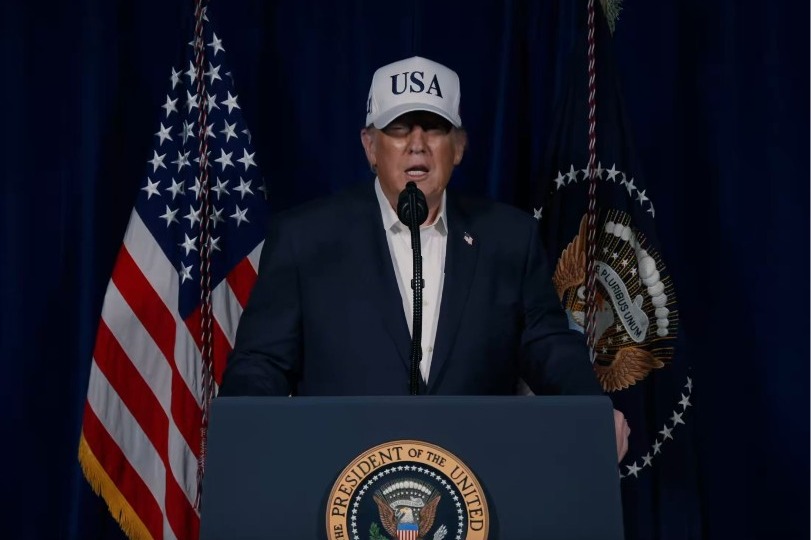
In a prerecorded video address released around 2:30 a.m., Trump formally announced the start of what he described as “major combat operations.” In unusually direct language aimed at the Iranian population, he urged citizens to seize the moment once the strikes subside. “Take over your government,” he said, calling the moment a rare opportunity and warning that “this will probably be your only chance for generations.”
Trump acknowledged the dangers inherent in the operation, conceding that American casualties were possible. “The lives of courageous American heroes may be lost, and we may have casualties,” he said. “That often happens in war. But we’re doing this, not for now. We’re doing this for the future, and it is a noble mission.” He added pointedly, “No president was willing to do what I am willing to do tonight.”
The president framed the strikes as a defensive necessity, arguing that the Iranian leadership posed an imminent threat to American security. He accused Tehran of pursuing a decades-long campaign of “mass terror” against the United States and its allies, referencing events such as the 1979 hostage crisis and the 1983 bombing of US Marine barracks in Beirut. Trump also suggested Iran was “probably involved” in the 2000 al-Qaeda attack on the USS Cole, though that claim has long been disputed by analysts.
Highlighting military preparedness, Trump said the US armed forces were unmatched in capability. “I built and rebuilt our military in my first administration,” he said. “There is no military on Earth even close to its power, strength or sophistication.” He insisted that overwhelming force would back his message to the Iranian people, declaring that America stood ready to support them.
American media reaction underscored the controversy surrounding the decision. An editorial published by The Wall Street Journal before the strikes argued that Iran’s leadership had effectively chosen confrontation by refusing to compromise on its missile and nuclear programmes. Under the headline “The Ayatollah Is Choosing War,” the editorial cited stalled nuclear talks in Geneva and said negotiations had collapsed with both sides “far apart on key issues.” It noted that Iran had rejected proposals to transfer uranium stockpiles abroad, end enrichment, dismantle facilities or accept permanent restrictions.
In contrast, The New York Times offered a sharply critical assessment, describing the action as “the ultimate war of choice.” In a detailed news analysis, the paper argued that there was no immediate threat from Iran and no evidence of a rush toward a nuclear weapon. “With his broad attack on Iran early Saturday morning and his call to the Iranian people to overthrow their government, President Trump has embarked on the ultimate war of choice,” the analysis said.
Quoting former Council on Foreign Relations president Richard N. Haass, the Times drew parallels with the 2003 Iraq war. “As in the second Iraq war, there wasn’t a necessity to attack Iran, there was an opportunity,” Haass said, suggesting the decision was driven more by strategic calculation than urgent danger.
The move also appears to contradict Trump’s earlier political rhetoric. On election night in November 2024, he had emphasised his record of avoiding new conflicts. “They said he will start a war. I’m not going to start a war. I’m going to stop wars,” he had said. Vice President JD Vance echoed that sentiment days before the strikes, telling The Washington Post that there was “no chance” the US would become trapped in a prolonged Middle Eastern war.
The United States and Iran have been adversaries since the 1979 Islamic Revolution, with relations collapsing after the 444-day hostage crisis. Tensions have repeatedly flared over Iran’s nuclear ambitions, missile development and regional influence. Washington withdrew from the 2015 nuclear deal during Trump’s first term and reimposed sweeping sanctions, a decision that many analysts say laid the groundwork for the current confrontation.
(The content of this article is sourced from a news agency and has not been edited by the Mavericknews30 team.)



Amarnath Yatra Resumes After Six-Day Rain Halt, Pilgrims Hail Safety Arrangements and Renew Their Journey of Faith
Jammu, July 2026 : The annual Shri Amarnath Yatra resumed on Saturday after remaining susp…
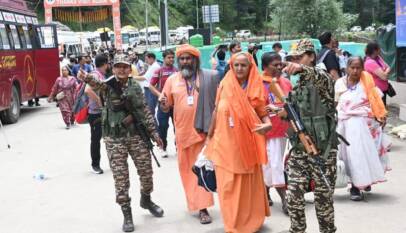
Amarnath Yatra Resumes After Six-Day Rain Halt, Pilgrims Hail Safety Arrangements and Renew Their Journey of Faith
Jammu, July 2026 : The annual Shri Amarnath Yatra resumed on Saturday after remaining …