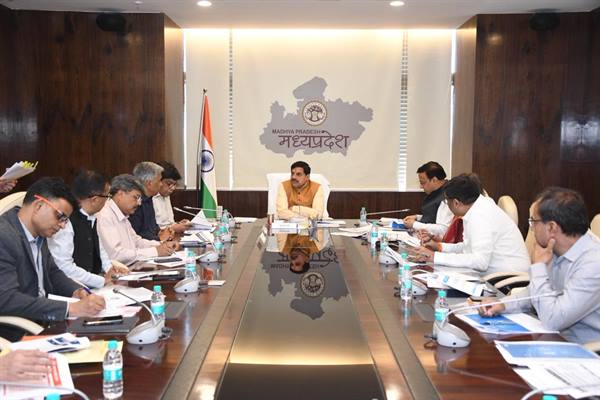
‘Jal Ganga Samwardhan’ is Foundation of Development and Security for Future Generations: CM Dr. Yadav

Chief Minister Dr. Mohan Yadav stated that the Jal Ganga Samvardhan Abhiyan is not only related to environmental protection but also a foundation for development. It is an effort to secure the future of generations. He emphasised that public participation from the state level to the village level must be encouraged in every activity undertaken under the Abhiyan.
Chief Minister Dr. Yadav said that the impact of excessive exploitation of groundwater sources, declining groundwater levels, deterioration of ancient water conservation structures and the decreasing flow of rivers is being felt by everyone. Collective efforts are required to improve this situation. He stated that the previous Jal Ganga Samvardhan Abhiyan in the state yielded encouraging results, and in the 2026 Abhiyan, efforts must be made to ensure the participation of every citizen so that the Abhiyan becomes effective and result-oriented.
Chief Minister Dr. Yadav addressed a meeting held at the Mantralaya on Thursday. Additional Chief Secretary Dr. Rajesh Rajoura, Shri Ashok Barnwal, Shri Sanjay Dubey, Shri Neeraj Mandloi, Smt. Deepali Rastogi, Shri Shivshekhar Shukla and other officials were present at the meeting. All District Collectors joined the meeting virtually. During the meeting, discussions were held on the major achievements of the Jal Ganga Samvardhan Abhiyan 2025 and the action plan for 2026.
Chief Minister Dr. Yadav directed officials to take action against encroachments in the catchment areas of water structures and emphasised the need for continuous monitoring of such activities. He also instructed that the origins of rivers emerging from the state be systematically developed and that intensive plantation be carried out around these areas.
Chief Minister Dr. Yadav emphasised encouraging both individual initiatives and community participation for installing public drinking water kiosks (pyau) in rural and urban areas. He also directed officials to discourage the use of plastic bottles. The Chief Minister said that ensuring easy access to clean and cool drinking water at public places should be established in society as a social responsibility.
Chief Minister Dr. Yadav further stated that districts where innovative practices have been successfully implemented under the Abhiyan should share their experiences with other districts so that such innovations can be replicated.
The Chief Minister said that Ministers in charge of districts should provide leadership to the Jal Ganga Samvardhan Abhiyan at the district level. Members of Parliament, Members of the Legislative Assembly, and representatives of Panchayats and Urban Local Bodies should actively participate in the Abhiyan. Voluntary organisations and CSR institutions working at the grassroots level should also be associated with activities related to public participation. District Collectors will act as nodal officers to ensure effective monitoring of the works.
Under the Abhiyan, the Panchayat and Rural Development Department will act as the nodal department, and the Urban Administration and Development Department will serve as the co-nodal department. Other participating departments include Revenue, Water Resources, Horticulture, Public Health Engineering, Narmada Valley Development, Forest, Jan Abhiyan Parishad, Industry and MSME, Environment, Sanskrit, Women and Child Development, School Education, and Agriculture Development and Farmers Welfare. A presentation on the major achievements of the 2025 Abhiyan was also made during the meeting.
State-Level Abhiyan to Begin from March 19
It was informed in the meeting that the Jal Ganga Samvardhan Abhiyan will commence across the state on March 19 (Vikram Samvat New Year – Varsh Pratipada). Activities related to Vikram Samvat, environmental conservation, and protection and promotion of water structures will be organised in all districts of the state.
Under the Abhiyan, an International Water Conference will be organised in Bhopal from May 23 to 24, followed by the Shipra Parikrama Yatra from May 25 to 26. On May 26, on the occasion of Ganga Dussehra, the Mahadev River Katha will be held on the banks of the Shipra River in Ujjain. From May 30 to June 7, the Sadanira Samagam will be organised at Bharat Bhavan in Bhopal. During this event, the satellite mapping of the state’s agricultural land will also be launched.
Various departments have proposed activities under the Abhiyan.
- The Panchayat and Rural Development Department will implement 2,200 works worth ₹170 crore related to water conservation and augmentation under the Pradhan Mantri Krishi Sinchai Yojana – Watershed Development 2.0. It will also complete 86,360 farm ponds and 553 Amrit Sarovars worth ₹2,500 crore initiated in 2025. The department will also undertake groundwater augmentation works and restoration of traditional water harvesting structures in areas covered under the Jal Jeevan Mission Single Village Scheme.
- Activities will also be carried out under the Maa Narmada Parikrama Path, Gangotri Harit Project, and Ek Bagia Maa Ke Naam Project.
- Plans will be prepared for the rejuvenation of the Betwa, Kshipra, and Gambhir rivers.
- The Urban Development Department will strengthen 120 water harvesting structures and develop 50 green areas in urban local bodies. To ensure youth participation, they will be registered as Amrit Mitras on the My Bharat Portal. The Abhiyan aims to install 4,130 rainwater harvesting systems and implement treatment processes for 20 drains flowing into rivers.
- Urban local bodies will also undertake conservation of rivers, ponds, and stepwells, cleaning of drains, and large-scale plantation drives. Awareness rallies, competitions, and IEC activities in schools will also be organised.
- The Public Health Engineering Department will conduct activities for recharging groundwater sources under single-village tap water schemes and ensure cleanliness and maintenance around drinking water sources.
- The Forest Department will undertake groundwater augmentation works under the Aviral Nirmal Narmada initiative and plans to plant 28 lakh saplings during the monsoon season.
- To ensure water availability for wildlife, more than 400 water conservation structures will be constructed at a cost of ₹25.10 crore, and 189 ponds will be deepened.
- The Women and Child Development Department will undertake activities such as installing rainwater harvesting systems in Anganwadi centres, presenting exemplary models of water conservation at the village level, and developing Anganwadi centres as Water and Nutrition Model Centres to inspire communities. Each Anganwadi centre has been sanctioned ₹16,000 for rainwater harvesting and ₹10,000 for nutrition gardens.





Australia Calls India a Top-Tier Security Partner, Unveils Landmark Defence and Energy Agreements
Canberra, July 2026 : Australia on Thursday described India as one of its most important s…

Australia Calls India a Top-Tier Security Partner, Unveils Landmark Defence and Energy Agreements
Canberra, July 2026 : Australia on Thursday described India as one of its most …