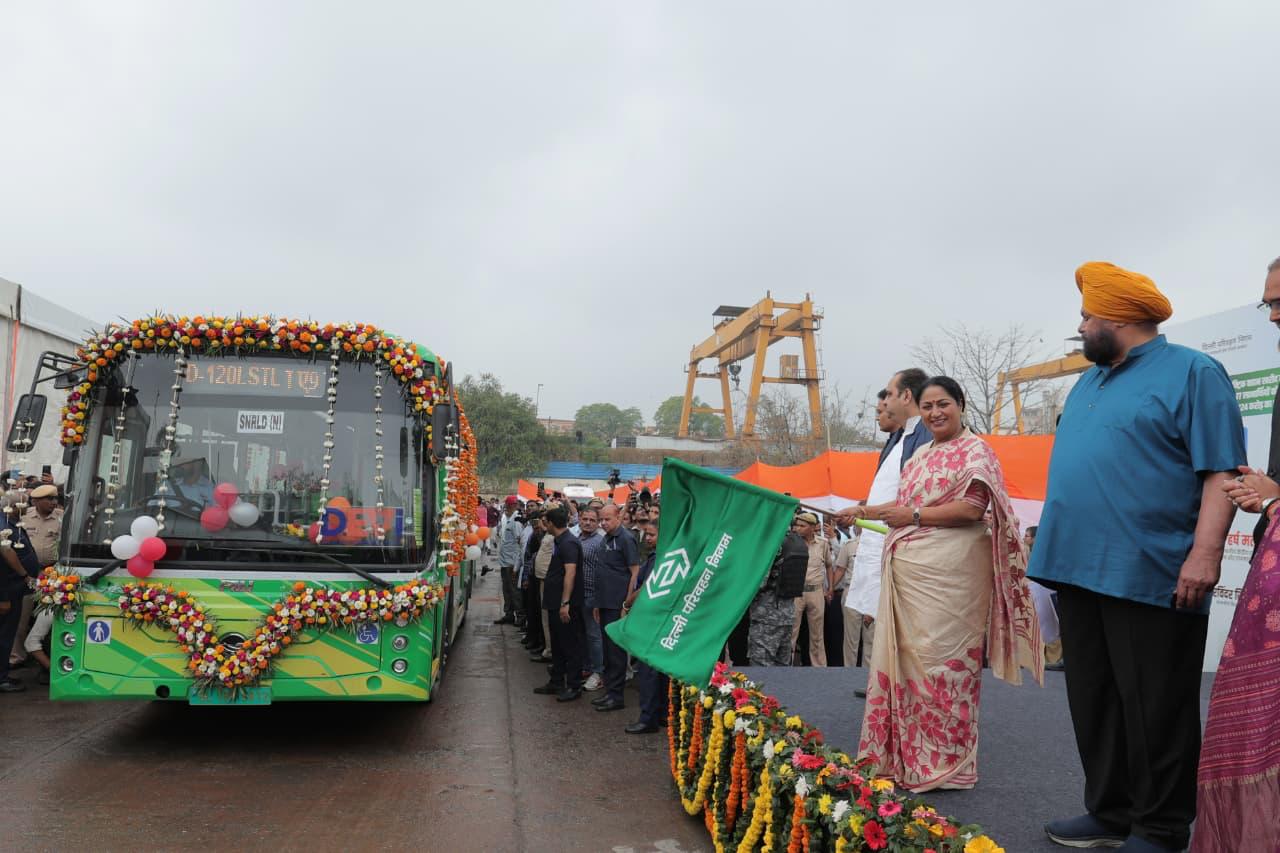
Chief Minister Rekha Gupta Flags Off 300 new EV Buses to Boost Public Transport

• Major Boost for EV Buyers: Subsidies Exceeding ₹24 Crore Credited to the Accounts of 12,877 Beneficiaries
• Travel from Nanaksar to Ghaziabad Set to Become Easier as New E-Bus Service Launches
• We Are Clearing the Financial Liabilities of Previous Governments; DTC Is Moving Towards Financial Stability: CM Rekha Gupta
• Our Goal Is Clean, Safe, and Future-Ready Transportation for Delhi: CM Rekha Gupta
• Under the Guidance of the PM and the Leadership of the CM, Development Projects Are Taking Shape on the Ground: Transport Minister Pankaj Singh
New Delhi, March 2026 : Delhi Chief Minister Smt. Rekha Gupta on Friday launched and laid the foundation for several key transport initiatives from the Indraprastha Bus Depot, marking a major step towards cleaner and more modern public mobility in the capital. She flagged off 300 new electric buses, launched a new inter-state e-bus service connecting Nanaksar (Delhi) to Ghaziabad, and laid the foundation stone for a multi-storey office building of the Delhi Transport Corporation (DTC). The Chief Minister also launched the EV incentive portal and oversaw the disbursal of more than ₹24 crore in subsidies to 12,877 beneficiaries through Direct Benefit Transfer (DBT). These initiatives, she said, are aimed at strengthening Delhi’s transition to a green, clean and modern transport system.
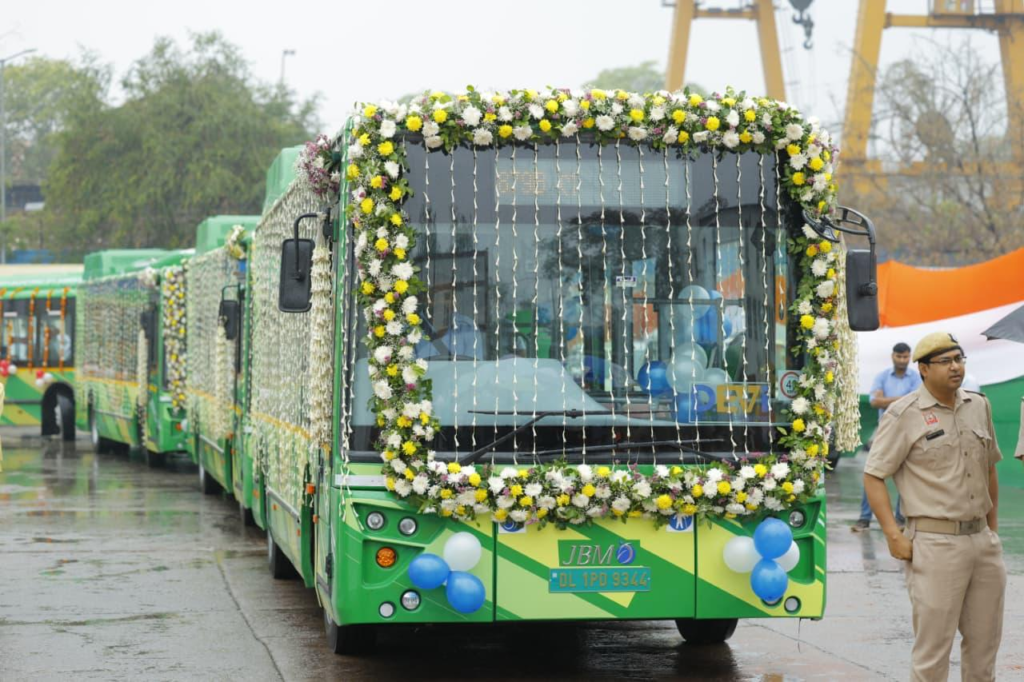
Delhi Transport Minister Dr. Pankaj Kumar Singh, Jangpura MLA Tarvinder Singh Marwah, along with other dignitaries and senior officials, were present on the occasion. Addressing the gathering, the Chief Minister said these initiatives are important steps towards building a public transport system that is clean, affordable, safe and future-ready. Green transport, she noted, will not only help reduce pollution but also make daily commuting more convenient for residents.
Highlighting recent progress, Chief Minister said DTC has seen significant improvements over the past year. Once running in heavy losses, the corporation is now gradually moving towards financial stability due to sustained efforts by the government. She added that under previous governments, DTC had weakened due to operational irregularities and poor resource utilisation, but her administration has worked to address these systemic gaps while ensuring transparency and accountability.
She also outlined key measures taken by the government, including the modernisation of bus depots, redevelopment of ISBTs, construction of DTC offices, establishment of automated testing stations and strengthening of the Pollution Under Control Certificate (PUCC) system. Financial liabilities inherited from previous governments, she said, are also being cleared in a responsible manner.
On EV subsidies, the Chief Minister said that despite earlier announcements, beneficiaries had not received payments on time. The current government has corrected this by introducing a transparent system and transferring more than ₹24 crore directly into the accounts of 12,877 beneficiaries. The aim is to ensure that citizens receive their entitled benefits on time and without any hurdles.
Reiterating her government’s vision, Gupta said the goal is to build a public transport system that is safe, convenient and environmentally sustainable. She also welcomed the launch of new inter-state bus services in the Delhi-NCR region, noting that these will ease daily commuting for thousands of passengers and strengthen regional connectivity.
Transport Minister Dr. Pankaj Kumar Singh said the rollout of 300 zero-emission electric buses, the launch of the Nanaksar–Ghaziabad e-bus service and the foundation of the new DTC office mark significant progress in making Delhi’s public transport modern and environment-friendly.
He said that under the guidance of the Prime Minister and leadership of Chief Minister Rekha Gupta, the government is delivering on its commitments. With the addition of these buses, Delhi’s total bus fleet has crossed 6,100, and the city is moving rapidly towards its target of 5,000 electric buses by March. The new buses are equipped with CCTV cameras, panic buttons, real-time tracking and facilities for persons with disabilities.
The newly launched e-bus service between Nanaksar and Ghaziabad will cover a distance of around 21 km, providing an affordable and convenient commuting option for thousands of daily passengers across Delhi-NCR. Meanwhile, the upcoming DTC office, spread across approximately 1,800 square metres, will serve as a modern and energy-efficient administrative hub.
The Minister added that long-pending EV subsidies are now being released through DBT, with more than ₹24 crore being transferred directly to 12,877 beneficiaries. He reiterated that the government is continuously working to make DTC stronger, self-reliant and future-ready.
Detailed Overview of Projects
- The Delhi government has taken several major steps to make public transport more modern, clean and convenient. As part of this effort, the Chief Minister flagged off 300 new zero-emission electric buses. These buses are low-floor and air-conditioned, and come equipped with CCTV cameras, panic buttons, real-time tracking and facilities for persons with disabilities. With their induction, Delhi has become the city with the largest electric bus fleet in the country, and the government aims to scale this up to around 14,000 buses by 2028–29.
- To further strengthen connectivity across the Delhi-NCR region, a new inter-state EV bus service has been launched between Nanaksar in Delhi and the Old Bus Stand in Ghaziabad. Covering a distance of about 21 kilometres, the route connects key locations including Bhajanpura, Loni Road, the UP border, Pasonda, Hindon Airport and Mohan Nagar. Initially, three electric buses will operate on a pilot basis, running 12 trips daily in both directions. The service will be available from 7:15 am to 10:10 pm, with a maximum fare capped at ₹53, offering an affordable and convenient travel option for thousands of daily commuters.
- The Chief Minister also laid the foundation stone for a new multi-storey office building of the Delhi Transport Corporation (DTC), which will be developed over an area of approximately 1,800 square metres with modern administrative facilities. The building will include a contemporary entrance lobby, waiting lounge, conference room, offices for officials, staff workstations, an IP-PBX-based communication system, energy-efficient design and fire safety features. To ensure that administrative work continues without disruption during construction, a temporary office facility is also being put in place.
- In addition, the government has relaunched the EV incentive portal with several improvements, making the subsidy distribution process more transparent and efficient. Under the Delhi Electric Vehicle Policy 2020, financial incentives are provided for electric two-wheelers, three-wheelers and e-rickshaws. However, the subsidy disbursement had been halted in June 2023 under the previous government, causing inconvenience to beneficiaries. The current government has reviewed and streamlined the process by integrating PFMS and implementing the DBT system, ensuring that subsidies are directly transferred to beneficiaries’ bank accounts. In the first phase, more than ₹24.04 crore is being disbursed to 12,877 beneficiaries, while pending cases will be cleared in a phased manner. The portal has also been reopened for new applications. This initiative reflects the government’s commitment to clean mobility, improved air quality and sustainable urban development.





Australia Calls India a Top-Tier Security Partner, Unveils Landmark Defence and Energy Agreements
Canberra, July 2026 : Australia on Thursday described India as one of its most important s…
Australia Calls India a Top-Tier Security Partner, Unveils Landmark Defence and Energy Agreements
Canberra, July 2026 : Australia on Thursday described India as one of its most …