US Deploys USS Gerald R Ford Aircraft Carrier To Red Sea For Strike Operations Amid Iran Threat.

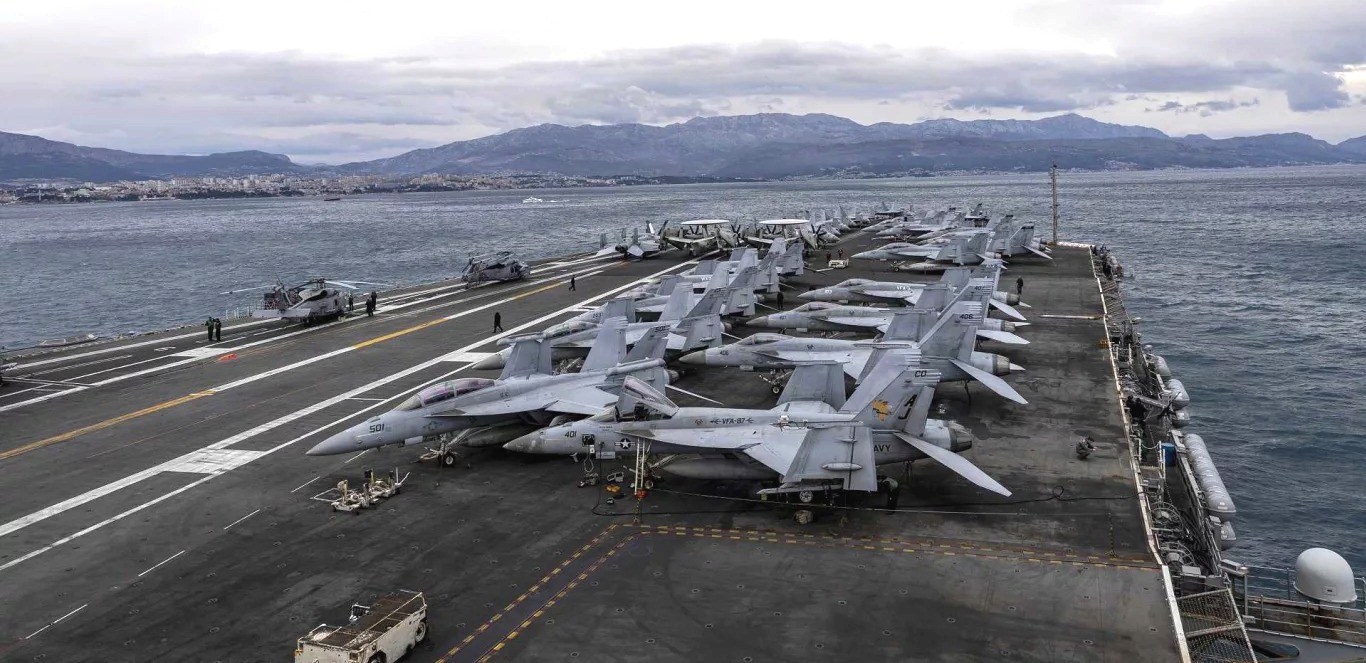
Washington DC; April 2026: The US Navy USS Gerald R. Ford aircraft carrier has returned to the Red Sea, restoring a high-end US naval strike capability at a time of rising tensions with Iran. Its presence strengthens deterrence and enables sustained airpower projection in a contested maritime environment.
Backed by guided-missile destroyers, the carrier strike group can launch continuous air and precision strike operations while defending against air and missile threats. This deployment reinforces US capacity for power projection, sea control, and rapid response across a volatile regional battlespace.
Earlier, on 02nd April, 2026 US Navy USS Gerald R. Ford (CVN 78), the world’s largest aircraft carrier, had departed Split, Croatia, during a scheduled deployment in the US 6th Fleet area of operations to enhance warfighting readiness and support US, allied, and partner interests across Europe and Africa.
The redeployment of the US Navy US Navy USS Gerald R. Ford aircraft carrier follows more than a month at Souda Bay, Greece, where the Ford underwent repairs after an onboard fire outbreak on March 12th, 2026, in a laundry space. The incident, which caused injuries and internal damage but did not affect propulsion or combat systems, temporarily forced the carrier out of the operational area, highlighting the importance of resilience and rapid repair cycles for forward-deployed naval forces.
07 berthing compartments affected by the fire have undergone rehabilitation, with support from onboard personnel and external technical teams. The ship remains assigned to Carrier Strike Group Twelve, which continues its deployment despite the temporary removal of its flagship. According to the US Navy, the port call is part of a controlled maintenance cycle rather than a full operational reset. The fire that triggered the Ford redeployment began on March 12, 2026, in the aft laundry system, specifically within a dryer vent connected to the ship’s ventilation network. The fire spread through adjacent compartments via airflow ducts and required more than 30 hours of firefighting and damage control efforts to fully extinguish.
More than 200 sailors were treated for smoke inhalation, and at least 03 sustained injuries during response operations. The fire damaged more than 100 berthing racks, displacing several hundred sailors and forcing temporary living arrangements across the ship. Estimates indicate that up to 600 personnel were required to sleep on floors or improvised bedding following the incident. Laundry systems were largely disabled, requiring the distribution of additional clothing to maintain operational readiness. The incident also affected internal airflow, sanitation, and support systems, increasing maintenance demands. The cause remains under investigation, with a focus on mechanical failure within the ventilation or dryer assembly.
The return of the Ford to the Red Sea re-establishes a central node of US naval airpower under US Central Command. As the lead ship of its class, the nuclear-powered carrier displaces over 100,000 tons and operates an air wing of more than 75 aircraft, including F-18 Super Hornet strike fighters, EA-18G electronic warfare aircraft, and E-2D airborne early warning platforms. This combination delivers a full-spectrum capability ranging from precision strike and suppression of enemy air defences to maritime interdiction and persistent surveillance across critical sea lanes.
Operationally, positioning the Ford in the Red Sea places its carrier air wing within immediate range of strategic chokepoints such as the Bab el Mandeb Strait and the southern approaches to the Suez Canal. This enables rapid sortie generation against land-based targets while ensuring protection of commercial shipping routes exposed to missile and drone threats from regional actors. The carrier’s embarked air wing can sustain high-tempo operations, providing both offensive strike capacity and defensive counter-air coverage for US and allied forces.
Ford’s current deployment is part of a broader, increasingly demanding operational cycle that has stretched US naval forces across multiple regions. Since departing Naval Station Norfolk in June 2025, the carrier has been redirected several times, supporting operations in the Caribbean linked to Venezuela before shifting to the Middle East for combat missions tied to the confrontation with Iran. This extended deployment has now surpassed 295 days, marking the longest US carrier deployment in the post-Cold War era and reflecting sustained demand for high-end naval power projection.
From a capability perspective, the Ford-class introduces advanced systems designed to increase sortie generation rates and reduce crew workload compared to Nimitz-class carriers. Its Electromagnetic Aircraft Launch System and Advanced Arresting Gear improve aircraft launch efficiency and enable a broader range of aircraft operations. The ship also integrates advanced radar and command systems that enhance situational awareness and battle management, critical for operating in a high-threat environment characterised by anti-ship missiles and unmanned systems.
The presence of accompanying destroyers further strengthens the strike group’s layered defense architecture. Equipped with the Aegis Combat System and Standard Missile family, these escorts provide ballistic missile defense, air defense, and anti-submarine warfare capabilities, ensuring the carrier can operate in contested waters while maintaining freedom of manoeuvre. This integrated naval formation enables the United States to project power while mitigating the risks posed by increasingly sophisticated regional threats.
In the context of ongoing US maritime pressure operations targeting Iranian-linked shipping networks, the USS Gerald R. Ford is not primarily configured as an interception platform but plays a critical enabling role. The enforcement of maritime control measures relies mainly on surface combatants, patrol ships, and surveillance assets operating across key waterways, including the Gulf of Oman and Arabian Sea. However, the presence of a carrier strike group significantly enhances escalation dominance by providing immediate access to sustained airpower, intelligence, surveillance, and reconnaissance, and precision strike capabilities in support of maritime interdiction operations.
This means the Ford can directly support such operations by providing air cover for US naval units, conducting long-range precision strikes against coastal or naval targets if required, and deterring attempts to challenge maritime control through asymmetric means such as fast-attack craft, drones, or missile systems. Its air wing also enables rapid response options across a wide operational area, reducing reliance on land-based airfields and increasing operational flexibility.
Strategically, US Navy aircraft carrier Ford’s return to the Red Sea signals a sustained US commitment to maintaining maritime security and economic pressure while preserving freedom of navigation for global shipping. The integration of a high-end carrier strike group into this operational framework elevates the mission from a maritime control task to a broader joint force posture capable of transitioning rapidly from containment to high-intensity conflict if escalation occurs.
Team Maverick.







US told Israel That Ceasefire With Iran Will Expire On Sunday.
Washington DC; April 2026: The United States told Israel that the recently extended ceasef…

US told Israel That Ceasefire With Iran Will Expire On Sunday.
Washington DC; April 2026: The United States told Israel that the recently extended ceasefire …