Maharashtra: BMC Announced 10% Water Cut Across Mumbai From May 15; Jalyukt Shivar 2.0 In Big Question.

Mumbai; May 2026: Brihanmumbai Municipal Corporation (BMC) has announced a 10% water cut across Mumbai from May 15 onwards, a press release stated. According to the BMC PRO, yesterday on 11th May 2026, the municipal body issued an advisory for discretionary use of water, stating that the water level in supply lakes is quite low. The authorities appealed to the citizens of Mumbai not to panic and advised judicious use of water.
“This decision has been taken in accordance with the directives of the Water Resources Department, Government of Maharashtra, and in light of the Indian Meteorological Department’s (IMD) forecast regarding a potentially weaker monsoon next year, influenced by the anticipated El Nino and IOD (Indian Ocean Dipole) phenomena. There is absolutely no reason for the citizens of Mumbai to panic. However, on behalf of the BMC administration, a humble appeal is being made to all citizens to use water judiciously and sparingly”, BMC said in the release.
Providing the statistics, the BMC stated that a combined total of 340,399 Million Litres of water is currently available across the reservoirs supplying Mumbai as of Monday. Compared to the annual requirement of 1,447,363 Million Litres, the currently available usable water stock stands at only 23.52%. The Municipal Administration is monitoring the water levels with extreme vigilance, and water supply is being distributed daily in a planned and systematic manner.
According to the press release, Mumbai will receive an additional water supply of 147,092 Million Litres from the maintenance reserve of the Bhatsa Dam, and another 90,000 Million Litres from the maintenance reserve of the Upper Vaitarna Dam. The 10% water cut comes as a “precautionary measure”. This 10% water cut will also apply to the water supplied by the Brihanmumbai Municipal Corporation to the Thane and Bhiwandi-Nizampur Municipal Corporations, as well as to other villages, effective Friday, May 15.
This water cut will remain in force until satisfactory rainfall occurs and the usable water levels in the reservoirs show improvement, BMC stated. Earlier, the municipal body had announced a planned 30-hour water supply shutdown across several parts of the city between May 05th and May 06th, to facilitate critical water tunnel connection and related maintenance works under its Water Supply Project.
Yesterday (11th May)’s press conference has raised several questions pertinent to the much propagated Jalyukt Shivar 2.0, which had largely claimed to redefine Maharashtra’s water future. Anchored by a formal MoU between The Art of Living Social Projects and the Government of Maharashtra, the initiative is driving large scale desilting, groundwater recharge and community-led
execution across drought-prone regions. With groundwater declining and monsoons often turning
rogue, the response is bold, structured, ambitious, and practical building resilience, restoring water bodies, and securing long-term water stability for the state.
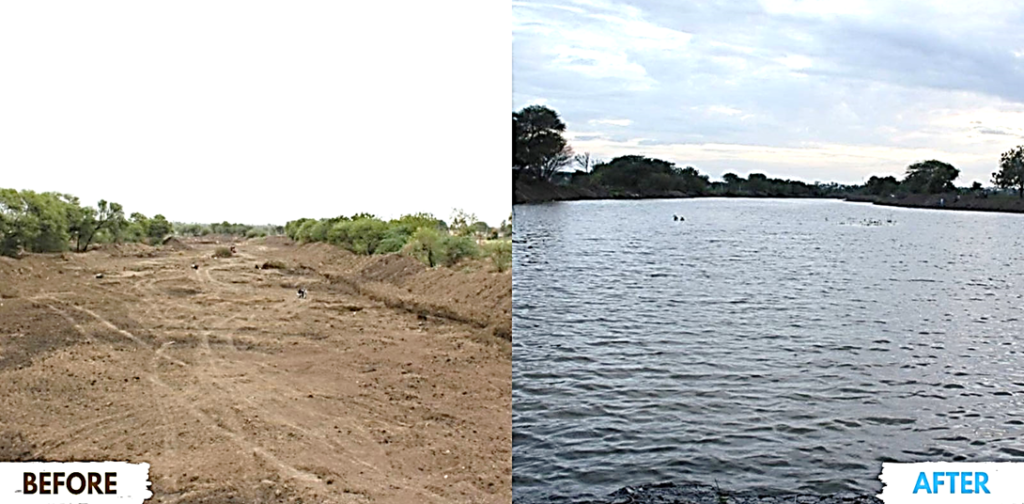
The Jalyukt Shivar 2.0 had stressed on the following since its conceptualisation in order to make Maharashtra a drought free state by the year 2019:
A Nation Running on Empty: India’s water crisis is no longer a distant warning – it’s an everyday challenge. Nearly 80% of the country’s agricultural and domestic water needs rely on groundwater, while only about 20% come from rainfall and surface sources like rivers, lakes, and reservoirs. For more than two decades, extraction has outpaced natural recharge, causing water tables to fall.
Disruptions in the hydrological cycle and increasingly erratic rainfall have intensified stress.
Furthermore, as they have assessed, there is a stark imbalance, as an estimated 239 trillion litres of
groundwater is extracted each year, yet only around 06% of rainfall is effectively stored, while nearly 78% flows into rivers and eventually the sea. Aquifers remain under severe strain, highlighting the urgent need for structured conservation, storage, and recharge systems.
Between Drought and Flood: For years, large parts of Maharashtra have swung between extremes – drought and flood. Failed or uneven monsoons bring acute scarcity, while heavy rainfall rushes away
unchecked, causing damage instead of relief. Streams and rivers that once held water longer are now shallow and silted, reducing storage and weakening groundwater recharge. Increasing reliance on borewells and deeper wells further lowers water tables.
Communities face frequent droughts, declining agricultural productivity, crop losses, flood damage, and dependence on tanker water. This cycle: scarcity, over-extraction, runoff, and loss, reveals that the problem is not rainfall alone, but how water is managed. Structured, long-term conservation became not just necessary, but urgent.
Jalyukt Shivar 2.0: Turning Rain into Security – The initiative is driven by a single, practical goal: make Maharashtra drought-resilient through systematic water management. Its core objectives: –
- Capture and store rainwater efficiently,
- Strengthen groundwater recharge,
- Stabilise and improve agricultural productivity.
By rebuilding natural water-holding systems, Jalyukt Shivar 2.0 converts short-lived monsoons into year-round security benefiting farmers, villages, and future generations.
Reviving Maharashtra’s Waterways – Jalyukt Shivar 2.0 revitalises rivers, streams, ponds, and lakes by desilting, deepening, and widening channels. Pond and lake silt is reused on marginal farms, improving soil fertility. Maharashtra faces a challenging reality: 80-90% of rainfall falls within just a few months, and most of it runs off without recharging groundwater. Jalyukt Shivar 2.0 changes this,
raising infiltration from 06% to 25-35% through scientific, phased interventions: –
- Phase I (2013 – 2019): Focused on drought-prone regions, desilting, stream deepening, and water storage;
- Phase II (2024 – 2026): Expands coverage, consolidates long term water security
Scale & Impact –
- 2,90,64,668 cubic metres of silt removed from rivers, including Gharni, Tavarja, Jana, Mudgul, and more;
- 16,716 million litres of water conserved since 2013;
- 12,38,175 total beneficiaries.
Farm-Level Benefits:
- Higher yields: Consistent water and soil moisture support better cultivation and crop rotation.
- Stronger incomes: Multiple crop cycles and diversified farming reduce risk and stabilise earnings.
- Flood resilience: Wider, desilted streams prevent waterlogging, erosion, and crop loss.
- Lower drought risk: Recharged aquifers provide water even during dry spells.
National Recognition – In November 2025, The Art of Living Social Projects was honoured by the Ministry of Jal Shakti with two national awards – Best Civil Society at the 6th National Water Awards
2024 (for the second consecutive year) and Best NGO award under Jal Sanchay Jan Bhagidari (JSJB 1.0).
These accolades recognise the scale, innovation, and measurable impact of Jalyukt Shivar 2.0 – a model for science driven, community-led, long-term water resilience across India. As Gurudev Sri Sri Ravi Shankar had said, “Our survival depends on water; it is the basis of our life force. We need to
protect and nurture the sources of water”. This insight underlines the very ethos of Jalyukt Shivar 2.0: protecting water is protecting life.
Team Maverick.





Wimbledon Final Locked at One Set Each as Sinner Fights Back Against Zverev
London, July 2026 : World No. 1 Jannik Sinner displayed remarkable resilience to fight bac…

Wimbledon Final Locked at One Set Each as Sinner Fights Back Against Zverev
London, July 2026 : World No. 1 Jannik Sinner displayed remarkable resilience to fight …