Maharashtra poised to lead nuclear energy sector; US companies urged to invest in Maharashtra – Chief Minister Devendra Fadnavis

Mumbai, May 2026 : The demand for stable and uninterrupted electricity is set to rise significantly in the coming years due to artificial intelligence, data centres, semiconductors, green hydrogen, electric mobility, and advanced manufacturing sectors. Chief Minister Devendra Fadnavis said that long-term industrial growth cannot rely solely on solar and wind energy, and that nuclear power will become a key component of the future industrial economy. He stated that Maharashtra is ready to lead the transformation in the nuclear energy sector and urged American companies to invest in the state.
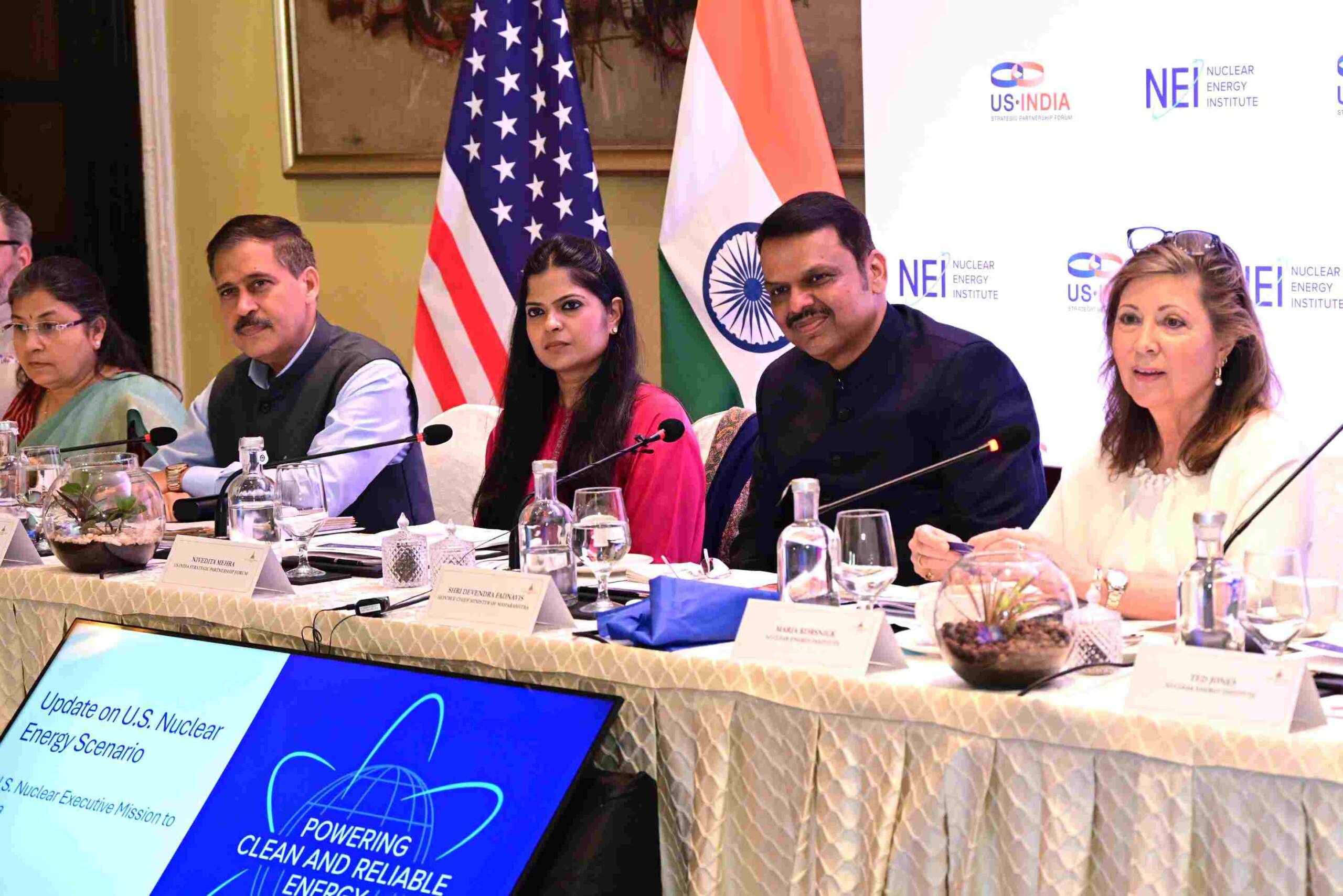
Chief Minister Fadnavis was speaking at a meeting of the Nuclear Energy Institute and the US-India Strategic Partnership Forum held under the US Nuclear Executive Mission in India.
The meeting was attended by Additional Chief Secretary (Energy) Abha Shukla, Additional Chief Secretary to the Chief Minister Lokesh Chandra, Principal Secretary (Industries) P. Anbalagan, Mahanagenco CEO Radhakrishnan B., Investment Advisor to the Chief Minister Kaustubh Dhavse, Secretary (Protocol) Rajesh Gawande, along with Maria Korsnick, President and CEO of the Nuclear Energy Institute (USA), Dan Listik of Centrus Energy, Mehul Shah, CEO of Clean Core Thorium Energy, Gary Wolski, Vice President of Nuclear at Curtiss-Wright Corporation, Nivedita Mehra, Managing Director of the US-India Strategic Partnership Forum, Jack Edlow, President of Edlow International, and Anant Jain, CEO and Head of Strategic Partnerships at Holtec Asia, along with senior officials from various US companies.
Chief Minister Fadnavis said that major changes are taking place globally in the energy transition process. For many years, solar and wind energy were considered sufficient to solve future energy challenges. However, with increasing industrialisation and the growth of the digital economy, the need for stable and continuous power generation is being strongly felt. While Maharashtra is investing heavily in solar and wind energy, nuclear power will be essential for carbon-free, industrial-scale baseload power supply.
He noted that Maharashtra is a leading industrial state with a $660 billion economy, attracting more than 40% of India’s total foreign direct investment. Around 60% of the country’s data centre capacity is concentrated in Mumbai and Navi Mumbai. In the coming years, demand for electricity will increase manifold due to sectors such as semiconductors, artificial intelligence, logistics, and advanced manufacturing.
Significant positive developments have taken place in India-US civil nuclear cooperation in recent years, including increased private sector participation, reforms under the “Shanti” framework, technology transfer, and industrial collaboration, creating new opportunities. India is expected to witness rapidly growing electricity demand over the coming decades, with Maharashtra becoming its largest industrial contributor.
The Chief Minister said Maharashtra will play a central role in India’s nuclear energy journey and aims to evolve not merely as an importer of nuclear reactors but as a hub for nuclear manufacturing, technology partnerships, and global exports. He highlighted that the state possesses strong industrial infrastructure, world-class ports, logistics facilities, skilled manpower, engineering capability, and industry-friendly policies.
He assured that if US companies take the initiative to establish nuclear manufacturing and projects in Maharashtra, the state government will provide support in terms of industrial land, infrastructure, skill development, research collaboration, and manufacturing clusters. He also indicated readiness to offer subsidies and special incentives for early-stage industries.
Fadnavis said Maharashtra is also keen to become an early hub for Small Modular Reactors (SMRs). He noted that SMR technology aligns with the future needs of the industrial economy and that Maharashtra could serve as an ideal testbed for next-generation nuclear energy solutions.
He added that India-US relations are becoming stronger in areas such as technology, defence, artificial intelligence, and supply chains. Civil nuclear cooperation could be a defining pillar of the next phase of this partnership. Nuclear energy, he said, is not just about power generation but is linked to industrial competitiveness, technological leadership, energy sovereignty, climate responsibility, and long-term trust.
Maria Korsnick noted that India presents a major opportunity in the nuclear energy sector. She added that Maharashtra, with its skilled workforce, industrial technology base, and supply chain ecosystem, offers significant investment potential.
Additional Chief Secretary (Energy) Abha Shukla, in a presentation, outlined the state’s rising energy demand, current generation capacity, and future nuclear energy requirements. She said Maharashtra’s current power demand is 31 GW and is expected to rise to 42 GW by 2030. The state is implementing large-scale projects in solar energy, battery storage, green hydrogen, and energy transition. Maharashtra has made significant progress in renewable energy and aims to meet 65% of its energy needs from renewable sources by 2035. Given future demand, nuclear energy has been identified as a key objective, and preparations have already begun.
Mahanagenco Managing Director Radhakrishnan B. presented an overview of ongoing energy projects. He stated that the company has set a target of generating 7,000 MW of nuclear power over the next two decades. Currently, it operates with 14.5 GW capacity as the country’s largest state-owned power generation company. In line with the energy transition, emphasis is shifting from coal-based generation to nuclear power. SMR technology is also being considered for industrial clusters, with potential applications for steel, cement, fertiliser industries, and data centres.
Nivedita Mehra, Managing Director of the US-India Strategic Partnership Forum, provided the background of the meeting in her introductory remarks. Participants also shared their views on Maharashtra’s nuclear energy ecosystem, infrastructure, and investment opportunities.

You’re using a less powerful model until your limit resets after 8:09 PM. Upgrad



Naresh Pal Gangwar Appointed Higher Education Secretary Amid Push for Exam Reforms
Jaipur, July 2026 : In a major bureaucratic reshuffle at a time when the Centre is under p…
Naresh Pal Gangwar Appointed Higher Education Secretary Amid Push for Exam Reforms
Jaipur, July 2026 : In a major bureaucratic reshuffle at a time when the …