Complete Jalyukt Shivar Works at the Earliest: Chief Minister Devendra Fadnavis

Special emphasis on digitisation in agriculture sector at State-level Kharif Season Review Meeting
Mumbai, May 2026 : This year’s Kharif season is likely to be challenging due to El Nino, changing climatic conditions and the global fertiliser situation. However, by ensuring timely crop loans to farmers, proper fertiliser management and the use of modern technology, the state will successfully overcome these challenges and conduct the Kharif season effectively. Against the backdrop of the upcoming Kharif season, adequate stock of seeds is available in the state, and special emphasis should be laid on timely credit supply to farmers, water conservation works and digitisation in the agriculture sector, directed Chief Minister Devendra Fadnavis.
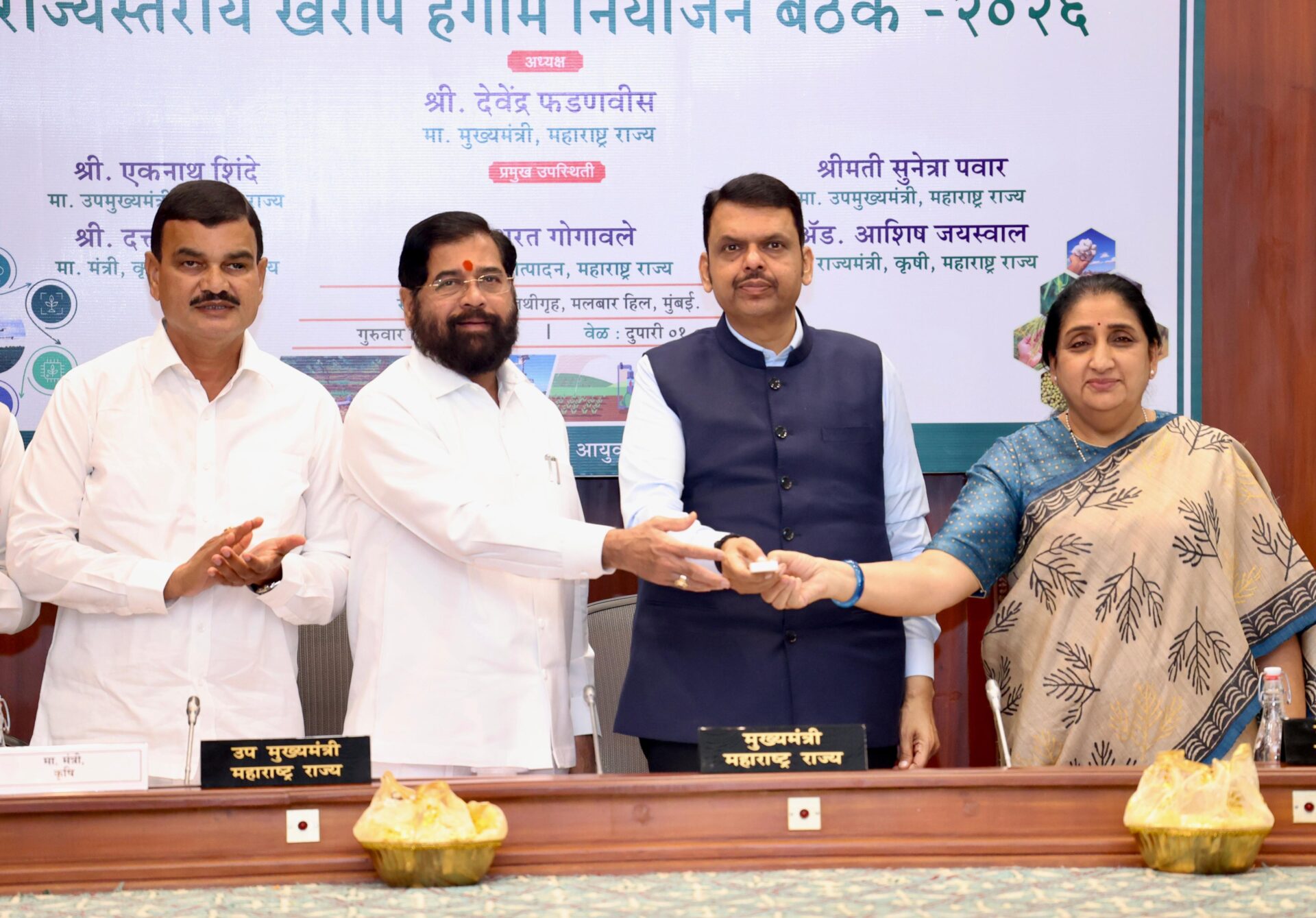
Chief Minister Devendra Fadnavis was speaking at the State-level Kharif Season Review Meeting 2026 held at Sahyadri Guest House under his chairmanship. Deputy Chief Minister Eknath Shinde, Deputy Chief Minister Sunetra Ajit Pawar, Revenue Minister Chandrashekhar Bawankule, Other Backward Bahujan Welfare Minister Atul Save, Agriculture Minister Dattatray Bharne, Marketing Minister Jaykumar Rawal, Relief and Rehabilitation Minister Makarand Jadhav-Patil, Tribal Development Minister Dr Ashok Uike, Cooperation Minister Babasaheb Patil, Employment Guarantee Scheme, Horticulture and Saline Land Development Minister Bharat Gogawale, Minister of State for Agriculture Adv Ashish Jaiswal and Minister of State Pankaj Bhoyar were present.
Chief Secretary Rajesh Agrawal, Agriculture Secretary Parimal Singh, Agriculture Commissioner Suraj Mandhare, along with ministers of various departments, all guardian ministers of the state, vice-chancellors of agricultural universities, senior officials, divisional commissioners, district collectors and senior officials of the Agriculture Department attended through video conferencing.
Various innovative initiatives in the agriculture sector were inaugurated at the hands of dignitaries. A blueprint for population-level food traceability through the Open Agri Traceability Stack (OATS), developed in partnership between the World Bank and the Maharashtra Government, was also released. A press conference under the chairmanship of the Chief Minister was held after the Kharif season meeting.
Chief Minister Devendra Fadnavis said the Agriculture Department has made planned preparations keeping in mind climate change and the possible impact of El Nino during this year’s Kharif season. According to the Meteorological Department forecast, satisfactory rainfall is expected in June, but rainfall may remain below normal during July, August and September. Instructions have been issued to undertake crop planning based on weather advisories issued by the Meteorological Department. There is no shortage of seeds in the state and adequate stock is available. Due to the increase in cotton prices, cotton cultivation is likely to increase this year and accordingly instructions have been issued to the Agriculture Department for necessary planning.
Chief Minister Fadnavis said banks should play a positive role in ensuring timely and smooth crop loans to farmers. Discussions have been held in the State Level Bankers Committee (SLBC) meeting regarding making more crop loans available to farmers. Many times, banks reject loans citing CIBIL score conditions. To avoid such difficulties, every bank should issue clear instructions to its branches. Efforts are being made to bring more farmers into the formal credit system. Currently, around 25 per cent old stock of fertilisers is available in the state and new stock will also arrive. However, due to the international situation, pressure on fertiliser supply may arise. Therefore, strict district-level planning is necessary to prevent misuse, hoarding and diversion of fertilisers.
Chief Minister Fadnavis directed that works under the Jalyukt Shivar campaign should be expedited. Considering the possibility of dry spells during the monsoon, water availability for protective irrigation is essential and hence water conservation works should be completed immediately. Due to digitisation in agriculture, technologies such as the Mahavistar App, AgriStat, DCS App and Crop Safe will provide accurate information and services to farmers. The digital system will also increase transparency in crop insurance, subsidies and various schemes, making it easier to ensure benefits reach eligible farmers.
The Chief Minister said agriculture in the state will no longer remain dependent only on water, but is moving towards modern farming based on the three “Ds” — data, drones and digital technology. Maharashtra has become the first state in the country to implement Artificial Intelligence (AI), Generative AI, drones and AgriStack policy in agriculture. Through the “Mahavistar AI” system, information related to weather, market prices, fertiliser dosage, crop advisory and pest-disease management is currently being made available to 40 lakh farmers. The use of AI will reduce production costs by 25 per cent.
Chief Minister Fadnavis said that out of 1.71 crore farmers in the state, Farmer ID registration of 1.32 crore farmers has been completed, including 1.95 lakh forest rights holders. This will make PM-Kisan, crop insurance, loans and compensation facilities easier to access. Assistance worth Rs 4,746.72 crore has been approved for 1.42 lakh hectares affected by natural disasters in 2026. Panchnamas for damage to more than one lakh hectares during April and May are underway. Through the MahaDBT portal, Rs 91,649 crore has been distributed to farmers under various schemes during 2025-26. In addition, the farm loan waiver process will be completed before June 30. Under the PM-Kisan and Namo Shetkari Mahasanman schemes, Rs 55,897 crore has been distributed so far. Registration of 80,912 farmers has also been completed for the Rs 3,000 pension scheme.
Chief Minister Fadnavis said Maharashtra has a major share in the country’s agricultural exports, contributing 94 per cent in grapes, 73 per cent in mangoes, 85 per cent in pomegranates, 86 per cent in bananas and 85 per cent in onion exports. Maharashtra also contributes 33 per cent to mango pulp exports. Due to AI, blockchain and QR code-based traceability, Maharashtra’s agricultural products will gain global identity and branding. The state has received a total of 200 GI tags, including 37 agricultural products and 29 horticultural crops.
Chief Minister Fadnavis said the total geographical area of the state is 307.58 lakh hectares, while the combined Kharif, Rabi and summer cropped area is 210.45 lakh hectares. Of this, Kharif area is 152.97 lakh hectares and excluding sugarcane, the area is 145.14 lakh hectares. Soybean and cotton, the major crops, will be cultivated over 88.75 lakh hectares, while other Kharif crops will cover 64.22 lakh hectares. Since 2022, 41 projects have been completed in the state, creating 105 TMC water storage. Through 225 revised administrative approval projects, irrigation potential for 33.45 lakh hectares will be created. Under the “More Crop Per Drop” scheme, nine lakh hectares have been brought under micro-irrigation in the last six years.



TN CM Vijay Likely to Launch New Ration Card Distribution on Birthday
Chennai, June 2026 : Tamil Nadu Chief Minister C. Joseph Vijay is expected to launch the d…

TN CM Vijay Likely to Launch New Ration Card Distribution on Birthday
Chennai, June 2026 : Tamil Nadu Chief Minister C. Joseph Vijay is expected to …