Solar Defence Showcases Indigenous ‘Bhargavastra’ Counter-Swarm Drone System to Indian Army

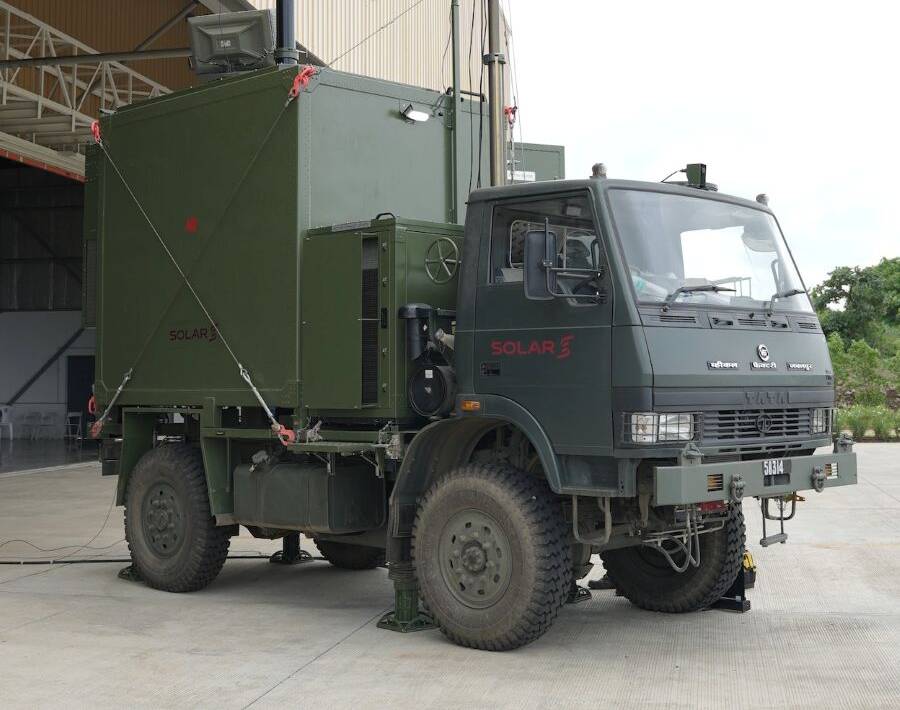
New Delhi, July 2026 : Solar Defence and Aerospace Ltd. (SDAL) on Friday showcased its indigenous “Bhargavastra” vehicle-mounted counter-swarm drone system to the Indian Army, marking a significant milestone in India’s efforts to strengthen its indigenous air defence capabilities against the rapidly evolving threat of weaponised drones and loitering munitions.
The demonstration took place at the company’s Nagpur facility as part of a status review under the Indian Army’s Make-II programme. Designed as a layered hard-kill solution, Bhargavastra is capable of detecting, tracking and neutralising hostile drones, autonomous aerial systems and coordinated drone swarms using a combination of advanced sensors, rockets and precision micro-missiles.
The complete weapon system demonstrated to Army officials comprised a Command and Control Vehicle integrated with radar, electro-optical/infrared (EO/IR) sensors, passive radio-frequency (RF) detection systems and an advanced C4I (Command, Control, Communications, Computers and Intelligence) network. The setup was supported by a launcher vehicle equipped with multiple launch tubes capable of engaging aerial threats.
During the live demonstration, SDAL deployed a swarm of drones to simulate an enemy attack. The system successfully detected and tracked the targets using its integrated radar, EO/IR and RF sensors, generated a real-time aerial picture, issued automated threat alerts and assigned targets to the launcher vehicle before executing the complete firing sequence.
Speaking after the demonstration, Satyanarayan Nuwal, Chairman of Solar Defence and Aerospace Ltd., said the company has already completed several critical milestones in the programme.
He stated that the integrated system, including the radar, electro-optical tracking system and missile components, has undergone extensive testing, while the company expects to complete internal trials within the next two to three months. He also noted that officers from the Indian Navy had recently reviewed the system, followed by the Army’s evaluation.
According to Nuwal, the system’s radar can detect aerial targets at distances of up to 10 kilometres, while the electro-optical tracking system has a range of approximately six kilometres. Although the Army’s current operational requirement is around 2.5 kilometres, SDAL has already initiated the development of a six-kilometre interceptor missile to enhance future capabilities.
Bhargavastra has been developed as a cost-effective response to the growing use of drones in modern warfare. Unlike traditional electronic warfare systems that rely on jamming or spoofing signals, the system employs a hard-kill approach capable of physically destroying drones, including autonomous platforms that are resistant to electronic countermeasures.
The weapon system uses indigenously developed unguided rockets for area defence and precision-guided micro-missiles for engaging high-value or manoeuvring targets, creating a multi-layered engagement capability against both individual drones and coordinated swarms.
SDAL said the system has been designed for seamless integration with the Indian Armed Forces’ existing command and control infrastructure and can be deployed across diverse operational environments, including deserts, plains and high-altitude mountainous regions.
The company also highlighted the economic advantage of the system, noting that it offers a far more cost-effective alternative to employing expensive surface-to-air missiles against comparatively inexpensive drones. This significantly improves the cost-exchange ratio in counter-drone operations.
The development of Bhargavastra began several years ago in anticipation of the growing role of unmanned aerial systems in warfare—a trend that has become increasingly evident in conflicts such as those in Ukraine and West Asia, where drones have emerged as decisive battlefield assets.
According to SDAL, Bhargavastra is among the first fully integrated, vehicle-mounted indigenous systems specifically designed to defeat drone swarms using a combination of unguided rockets and precision micro-missiles. The company said the visiting Army officials appreciated the technological progress achieved under the programme and expressed satisfaction with its potential to strengthen India’s indigenous counter-drone and air defence capabilities. Further user evaluation is expected after the completion of the next phase of development.
(The content of this article is sourced from a news agency and has not been edited by the Mavericknews30 team.)






South Korea Tests AI-Powered Humanoid Robot to Steer Warships Amid Growing Manpower Crunch
Seoul, July 2026 : South Korea has taken a significant step towards integrating artificial…
Solar Defence Showcases Indigenous ‘Bhargavastra’ Counter-Swarm Drone System to Indian Army
New Delhi, July 2026 : Solar Defence and Aerospace Ltd. (SDAL) on Friday showcased …