Marine Fish Landings in India.

The marine fisheries sector in India has witnessed a phenomenal growth during the last five decades both quantitatively and qualitatively. The subsistence fisheries during the early 50’s which produced about 0.5 million tonnes annually has presently grown into a full-grown industry producing currently about 2.7 million tons annually with a landing site value of about Rs. 13,000 crores. This increase is not only as a result of improvements in the harvesting methods, increase in the fishing effort and extension of fishing into relatively deeper regions but also increased demand resulting from trade in export of marine products as well as the ever growing domestic market demand.
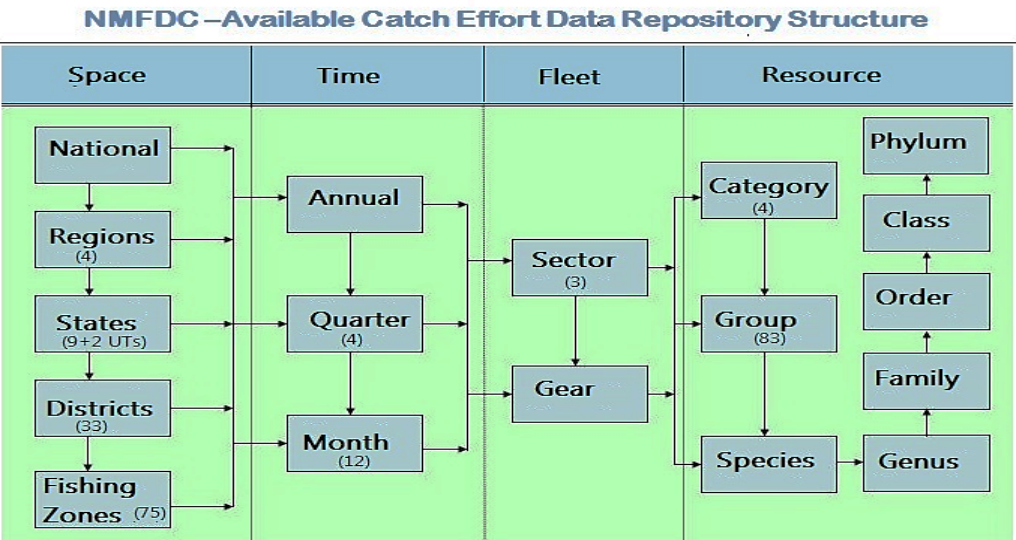
A comprehensive centralised survey paradigm for the estimation of marine fish landings, has been in practice since 1950. The statistical methodology adopted has been recognised by FAO. The procedure adopted, is unique in respect of conceptualisation, planning, implementation and analysis. All the 1511 landing centres both major and minor distributed along nine maritime states (West Bengal, Odisha, Andhra Pradesh, Tamil Nadu, Kerala, Karnataka, Goa, Maharashtra and Gujarat) and two union territories (Puducherry, Daman & Diu) are covered by qualified and trained field staff. The technically trained field staff are stationed at 25 locations across all maritime states of which 10 are research stations with full scientific and infrastructure backup. The overall operation of this uninterrupted exercise is coordinated by the Fishery Resources Assessment Division (FRAD). Equal importance is given for the inclusion of both landings and effort data with clear delineation of various crafts and gears. Information about more than 1200 marine fish species landed along the Indian coast are collected through the data collection scheme.
This methodology which is in practice since 1950, was validated in 1973, by a team of scientists under the leadership of Dr. M. Krishnan Kutty from the National Institute of Oceanography. They examined:
- to what extent the catch statistics at the all India and states levels are accurate;
- whether any improvement in the sampling procedure is possible;
- whether the present sampling fraction, which depends on the number of survey staff should be increased.
The methodology envisages the four different categories, namely: Pelagic, Demersal, Crustacean and Molluscs.
Pelagic – fish can be categorised as coastal and oceanic fish, based on the depth of the water they inhabit. Coastal pelagic fish inhabit sunlit waters up to about 655 feet deep, typically above the continental shelf. Examples of species include forage fish such as anchovies, sardines, shad, and menhaden and the predatory fish that feed on them. Oceanic pelagic fish typically inhabit waters below the continental shelf. Examples include larger fish such as swordfish, tuna, mackerel, and even sharks.
Demersal – The benthic biomass is one of the most valid parameters for projecting productivity of demersal fishery yield. Demersal fish groups such as sharks, groupers, threadfins, pomfret and Indian halibut are commercially valuable and contribute substantially to the economy of Indian halibut are commercially valuable and contribute substantially to the economy of Indian marine fisheries. Other groups includes rays, eels, catfishes, lizard fishes, pigface bream, perches, goatfishes, sciaenid’s, silver bellies, white fish, mullets, unicorn cod, flounders and soles are also contributed considerably. Compared with the pelagic, the demersal fishes are less affected by the environmental changes namely, temperature, currents and so on. Hence, the biological characteristics of the demersal are relatively stable.
Crustacean – a large, diverse group of mainly aquatic arthropods including decapods (shrimps, prawns, crabs, lobsters and crayfish), seed shrimp, branchiopods, fish lice, krill, remipedes, isopods, barnacles, copepods, opossum shrimps, amphipods and mantis shrimp. Most crustaceans are aquatic, living in either marine or freshwater environments, but a few groups have adapted to life on land, such as terrestrial crabs, terrestrial hermit crabs, and woodlice.
Molluscs – Mollusca includes such well-known delicacies as scallops and oysters, as well as slugs, squid, cone shells, and several types of octopus. Cone shell snails of the genus Conus produce a painful puncture wound if handled carelessly, followed by systemic toxic symptoms which are sometimes fatal. Another highly venomous mollusc is the blue- ringed octopus (Hapalochlaena maculosa).
The landing figures constitutes the estimates of quantities of different fishery resources (in Kilogram) brought to the respective fisheries harbours during a 24 hours period starting from 12:00 noon of the first calendar day to 12:00 noon of the subsequent day.
Team Maverick





Mission Shakti 6.0: Over 37,000 Girls Learn Practical Banking and Health Skills
Lucknow, March 2026 : Under the ‘Mission Shakti’ campaign, a total of 37,685 girls across …
Mission Shakti 6.0: Over 37,000 Girls Learn Practical Banking and Health Skills
Lucknow, March 2026 : Under the ‘Mission Shakti’ campaign, a total of 37,685 girls …