Jaishankar : Modi Government Corrected Nehru’s ‘Appeasement’ by Suspending Indus Water Treaty with Pakistan

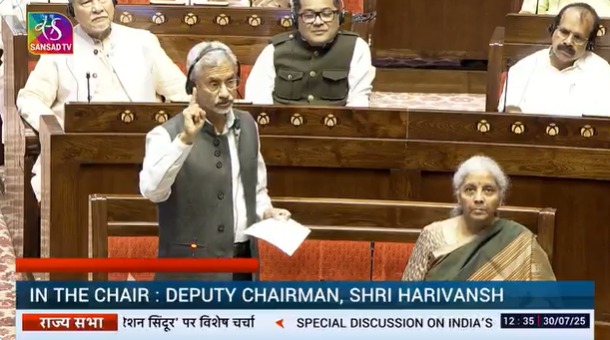
New Delhi : External Affairs Minister (EAM) S. Jaishankar on Wednesday asserted in the Rajya Sabha that the Modi government had “corrected historical mistakes” made by former Prime Minister Jawaharlal Nehru by placing the Indus Water Treaty (IWT) with Pakistan in abeyance. He stated that the treaty would remain suspended until Pakistan permanently ends its support for cross-border terrorism.
Speaking during the debate on Operation Sindoor, Jaishankar began by expressing “deep gratitude” to the Indian Armed Forces for their decisive response following the April 22 Pahalgam terror attack.
“A shocking and unacceptable attack”
“The Pahalgam attack shocked the nation for multiple reasons — the victims were murdered in front of their families, their religion was asked before they were killed, and it was a clear attempt to destroy Jammu and Kashmir’s growing prosperity and normalcy after the abrogation of Article 370,” Jaishankar said. “There was grief and anger across the country, and solidarity from the world.”
He emphasised that the attack had crossed India’s “red lines” and demanded severe consequences. “There had to be accountability for the perpetrators and their supporters. Justice had to be served,” he said.
Cabinet Committee sent a ‘clear message’
Jaishankar recalled that the Cabinet Committee on Security (CCS) had met on April 23 and decided on several strong measures as India’s “first clear message of anger, resolve and determination”. These included:
- Cancelling Pakistani visas under SAARC,
- Reducing the strength of Pakistan’s diplomatic mission in India,
- Expelling Pakistani military advisors, and
- Placing the Indus Water Treaty in abeyance.
Why the Indus Water Treaty matters
The EAM highlighted the extraordinary nature of the 1960 treaty. “I cannot think of another agreement in the world where a country allows its major rivers to flow into another country without retaining rights over them. It was an exceptional arrangement,” he said.
Recalling the parliamentary proceedings of the 1960s, Jaishankar noted that the then Prime Minister had admitted that the treaty was framed keeping in mind the interests of West Punjab in Pakistan rather than those of Indian farmers.
“Not a single word was spoken about the rights of farmers in Kashmir, Punjab, Rajasthan or Himachal Pradesh,” he said. “He claimed India was ‘purchasing peace’, but within a year, that same Prime Minister acknowledged there was no peace with Pakistan. What we purchased was not peace, but appeasement.”
Treaty had lost relevance
Jaishankar argued that the spirit of goodwill in which the treaty was originally signed had long since dissipated. “Since 1960, we have received no goodwill or friendship from Pakistan — only terrorism, attacks and wars,” he said.
“Such a treaty had to be dealt with decisively, and this government has done so,” he added, drawing a sharp contrast with Nehru’s approach.
‘Blood and water will not flow together’
The EAM reiterated the Modi government’s firm stance, declaring that India would no longer separate terrorism from diplomatic engagement.
“This was not a price of peace, but a price of appeasement,” Jaishankar said. “The Modi government has corrected the mistakes of Pandit Nehru’s policies by suspending the Indus Water Treaty. The treaty will remain in abeyance until Pakistan irrevocably gives up its support for terrorism. Blood and water will not flow together.”
Jaishankar’s remarks drew widespread applause from the treasury benches and set the tone for a heated debate in the House over India’s evolving Pakistan policy.


Gill, Rahul Power India to Seven-Wicket Win Over Afghanistan in Rain-Hit ODI
India beat Afghanistan by 7 wicketsAfghanistan 194 all out in 24.5 overs (Rahmanullah Gurb…

Gill, Rahul Power India to Seven-Wicket Win Over Afghanistan in Rain-Hit ODI
India beat Afghanistan by 7 wicketsAfghanistan 194 all out in 24.5 overs (Rahmanullah Gurbaz …