Dhaka University Votes in Historic DUCSU Election, First Since July Uprising Redefined Politics

Dhaka, Sept 2025: For the first time in six years, students of Dhaka University are casting their ballots to elect representatives to the Dhaka University Central Students’ Union (DUCSU) and its 18 affiliated hall unions. The elections, which began at 8 a.m. on Tuesday across 810 booths at eight polling centres, mark not only a long-awaited revival of student democracy but also the first DUCSU polls since the July Uprising shook Bangladesh’s political order last year.

Nearly 40,000 students are eligible to vote for a total of 471 candidates competing for 28 posts in the central union and over 1,000 candidates vying for 234 positions in the hall unions. Polling will continue uninterrupted until 4 p.m., with assurances that students still in line at closing time will be allowed to cast their votes.
A New Political Reality on Campus
The campus atmosphere this year is unlike any seen in decades. Unlike previous elections, when the ruling party’s student wing often dominated, the absence of a hegemonic force has created an unusually competitive environment.
“Two things are remarkable,” said Prof. Zobaida Nasreen, a political analyst at Dhaka University. “First, Islami Chhatra Shibir is participating actively, though under a different banner. In my 25 years, I have never seen Shibir so visible on this campus. Second, there is no longer the singular dominance of a ruling party’s student wing. Although the [National Citizen Party’s] student wing is in the race, it is no longer hegemonic. BNP’s Chhatra Dal, leftist groups, and independents are all present.”
The diversity of candidates and panels reflects the political shifts since the July Uprising of 2024, when mass protests led by young people, students, and opposition groups forced the resignation of Sheikh Hasina’s government.
Security and New Safeguards
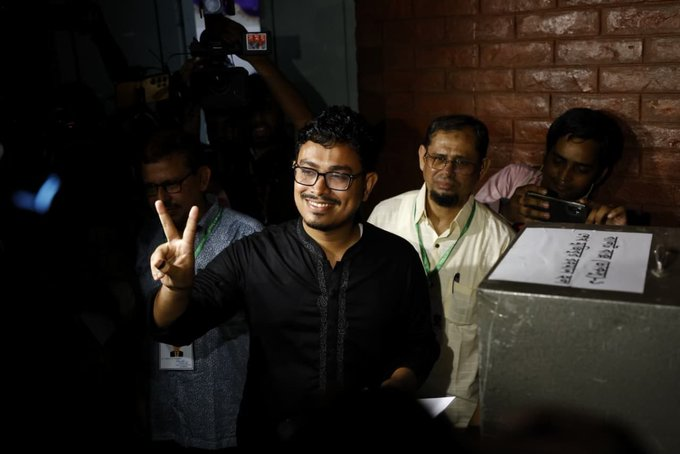
Authorities have introduced several measures to ensure transparency. Polling centres were moved outside residential halls to reduce clashes, ballot boxes are being sealed in front of the media, and results will be displayed live on LED screens.
Voting is being conducted with Optical Mark Recognition (OMR) ballot sheets, which include candidate names and ballot numbers. For the first time in Bangladesh’s history, Braille ballots are being used to enable visually impaired students to participate.
Security has been tightened with 2,000 police officers, Border Guard Bangladesh personnel, armoured vehicles, and water cannons deployed. A control room at TSC monitors proceedings, and police officials have promised to maintain vigilance until Wednesday evening.
Chief Returning Officer Prof. Md Jasim Uddin reassured students: “Law and order is very good. We see no cause for concern. This will be a model election that students of other universities can follow.”
Wider Political Significance
Though these are campus elections, the stakes are viewed as national. Analysts believe the DUCSU results will provide clues to the political climate ahead of the general election in February 2026.
Author and political analyst Mohiuddin Ahmed described the election as a “rehearsal for the national polls.” He told reporters: “Panels from affiliate organisations of various political parties are participating. So the results will give us an idea of the balance of power and how parties are resonating with young people.”
Yet others caution against overstating its importance. Prof. Kazi Mahbobor Rahman of the Political Science Department argued: “While Dhaka University has played pivotal roles in Bangladesh’s history, I don’t believe these polls will reshape national politics. This is primarily an election among students. Interest is high because of DUCSU’s symbolic weight, not because of direct influence.”
Contesting Panels and Key Candidates
At least 10 formal panels are competing, alongside many independents. The banned Bangladesh Chhatra League (BCL) is absent, leaving the field open to groups that were central to last year’s uprising.
- Jatiyatabadi Chhatra Dal (JCD) has nominated Abidul Islam Khan for Vice President (VP), Shaikh Tanvir Baree Hamim for General Secretary (GS), and Thanbir Al Hadi Mayod for Assistant General Secretary (AGS).
- Bangladesh Ganatantrik Chhatra Sangshad (BGCS), born out of the July Uprising, has fielded Abdul Kader for VP and Abu Baker Mojumder for AGS. Its spokesperson, Ashrefa Khatun, active in the uprising, is also contesting. Internal disputes, however, have pushed some BGCS members to run as independents.
- The Protirodh Parishad, a coalition of seven left groups, nominated Sheikh Tasnim Afroz Emi for VP. Emi, a key July Uprising figure, was elected VP of Shamsun Nahar Hall in 2019. Their GS candidate is Meghmallar Bosu of Chhatra Union, while AGS candidate Jabir Ahmed Jubel represents Biplobi Chhatra Moitree.
- Independent Students Unity, led by uprising leader Umama Fatema, has assembled candidates from among unaffiliated students. Its GS candidate Al Sadi Bhuiyan, a campus journalist, was active in both the July movement and earlier quota reform protests.
- Islami Chhatra Shibir, more visible than ever, has fielded Abu Shadik Kayem for VP. Shadik’s candidacy stunned many when his Shibir affiliation became public after he had played a major role in the uprising. Shibir’s GS candidate SM Farhad is also a prominent debater.
- The “Aparajeyo 71, Adommo 24” panel unites three leftist groups, fielding Nayem Hasan Hridoy (VP), Anamul Hasan Onoy (GS), and Adite Islam (AGS).
- Chhatra Odhikar Parishad, which finished second in the 2019 DUCSU elections, has nominated its central president Bin Yamin Mollah for VP, alongside Sabina Yasmin for GS and Rakibul Islam for AGS.
The Historical Weight of DUCSU
Founded in 1922, DUCSU has been at the heart of Bangladesh’s student politics. Movements for the Language Movement of 1952, the uprisings of 1969, and the Liberation War of 1971 all had deep roots in Dhaka University’s activism. Even after independence, DUCSU served as a breeding ground for national leaders.
But irregular polls and dominance of ruling party student wings eroded its credibility. The last DUCSU election, held in 2019 after a 28-year hiatus, was marred by allegations of rigging. This year’s election thus represents both a revival and a test of student democracy in a post-uprising Bangladesh.
Student Voices
Many students see the election as their first opportunity to shape campus governance without heavy political interference.
“This is our chance to decide our own leadership,” said Shamsun Nahar Hall resident Priyanka Das, a first-year student. “For once, it doesn’t feel like everything is controlled by a single party.”
Others expressed caution. Rakibul Hasan, a third-year law student, said: “The presence of Shibir makes me uneasy. But at least this election feels more competitive than before. Whoever wins, I hope they will focus on student welfare, not just national politics.”
Analysts Weigh In
Mushtuq Husain, a former DUCSU general secretary and now a senior member of Bangladesh JaSaD, believes the election is significant beyond campus.
“A democratic atmosphere has prevailed so far,” he said. “Whoever wins should have the courage to question those in power. This is the essence of student politics. If the process remains transparent, it will send a positive signal to the country.”
Looking Ahead
The results, to be announced after counting concludes Tuesday evening, will be scrutinised not only by students but also by political parties, the media, and civil society.
For many, the DUCSU election is a mirror of Bangladesh’s shifting political landscape. Whether it proves a rehearsal for the national polls or merely a student exercise in democracy, it has already rekindled the spirit of political engagement at Dhaka University.
As ballots are cast and anticipation builds, one thing is clear: Dhaka University remains a barometer of Bangladesh’s democratic future.
(The content of this article is sourced from a news agency and has not been edited by the Mavericknews30 team.)

Viren Rasquinha Questions India Hockey Team’s New Saffron Jersey
New Delhi, July 2026 : Former India hockey captain Viren Rasquinha has criticised Hockey I…

Viren Rasquinha Questions India Hockey Team’s New Saffron Jersey
New Delhi, July 2026 : Former India hockey captain Viren Rasquinha has criticised Hockey …