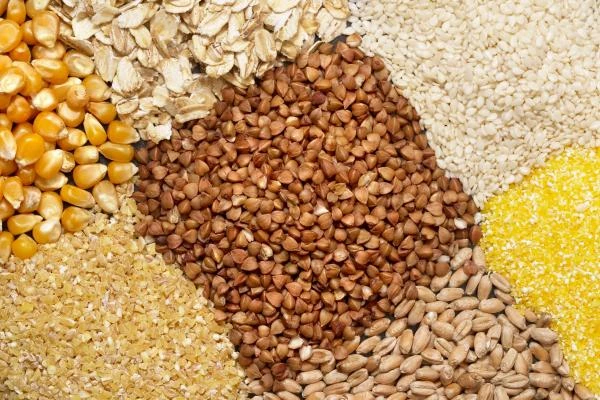
FAO Cereal Supply and Demand Brief.

“Cereal markets remain well supplied, with a positive outlook for the short term”.
Global Cereal Production:
Oct 2025 : Food and Agricultural Organization’s (FAO’s) latest forecast for global cereal production in 2025 has been raised by 10.1 million tons (0.3%) this month, putting the total at 2971 million tons. The increase reflects upward revisions to production forecasts across all crops, led by wheat, maize and rice (in order of magnitude). At this level, world cereal production is 3.8% higher year on year, marking the largest annual growth since 2013.
World wheat production is forecast at 809.7 million tons in 2025, up 0.6% compared to the previous month and now 1.3% above the 2024 output. Most of this month’s increase is linked to Australia, where favourable July-August rains, following a dry start of the season in parts, boosted yield expectations and lifted the 2025 production forecast to a level now on par with the five-year average.
Forecasts for the European Union and the Russian Federation are also raised on stronger yields. Global coarse grains production in 2025 is forecast at 1 605 million tons, up 0.3% from last month’s figure and now 91.7 million tons higher than the 2024 outturn. The latest upward revision is principally driven by a higher forecast in Brazil, linked to better-than-expected yields.
Maize production has also been raised for China (mainland), on newly released official data, and for the United States of America, tied to a larger area that outweighed a concurrent small cut to yields. At 427.1 million tons, the United States of America’s maize output would reach an all-time high and account for one-third of the global output, the highest share of global maize production since 2016. These increases offset cuts to production forecasts in the European Union, where dry and hot weather curtailed yield expectations, and in Mexico, where recent official figures point to a smaller-than-expected area.
The forecasts for global barley and sorghum production in 2025 have also been raised marginally this month, largely reflecting improved prospects in Australia.
As for rice, FAO has provisionally lowered its production forecast for Pakistan by 0.6 million tons (milled basis), owing to severe floods in Punjab, the country’s leading rice producing province. However, this downgrade is outweighed by 1.6 million tons increase in production expectations for India, where a strong pace of Kharif crop plantings is reported, despite some challenges posed by deficient rains in some eastern and northeastern states and by floods in northwestern areas. As a result of these changes and various other smaller amendments, world rice production is now forecast to reach a record high of 556.4 million tons (milled basis) in 2025/26, up 1.0 million tons from September expectations and implying a 1.2% annual expansion.
World Cereal Utilisation:
FAO’s forecast for world cereal utilisation in the 2025/26 season is now expected to reach a record level of 2930 million tons following an upward revision of 8.1 million tons since September. At 1575 million tons, the forecast for total utilisation of coarse grains in 2025/26 is up 7.2 million tons since the previous report and 33.8 million tons (2.2%) higher than the 2024/25 level. This month’s upward revision mostly reflects higher use of maize and barley in feed rations and for industrial purposes.
Plentiful supplies of maize are forecast be directed to animal feed in the leading producers Brazil and the United States of America, and in importing countries such as Egypt and Mexico. Wheat use in 2025/26 is also seen at a record level of 804.2 million tons with both feed use and human consumption expected to rise, the latter in line with population growth with per-capita food consumption broadly unchanged year on year. World rice utilisation is forecast at a historical peak of 550.8 million tons in 2025/26, little changed from September expectations and up 2.0% from 2024/25.
World Cereal Stocks:
The forecast for world cereal stocks by the close of seasons in 2026 has been revised upwards by 1.6 million tons since the previous month to 900.2 million tons, with upward revisions made to wheat and rice, while forecasts for coarse grains are scaled back slightly.
Stocks of wheat are expected to grow by 2.4 million tons from their opening levels with some build-up in major producers such as Canada and the Russian Federation after large harvests.
Stocks of maize are expected to rebound largely due to accumulations in major producers Brazil and the United States of America while stocks in the European Union could decline as production forecasts are scaled back, while feed use is expected to grow.
Among other coarse grains, stocks of barley, sorghum and rye are expected to remain stable. The global cereal stocks-to-use ratio in 2025/26 is expected to remain nearly unchanged from last season at 30.6%, continuing to indicate comfortable supply prospects in the new season.
Following a 1.1 million tons upgrade to 215.6 million tons, FAO’s forecast of world rice stocks at the close of 2025/26 marketing years continues to suggest that world rice reserves could strike a record high, sustained by accumulations in rice exporting and importing countries.
World Trade in Cereals:
FAO’s latest forecast for world trade in cereals in 2025/26 has been raised by 3.7 million tons to 497.1 million tons this month, pointing to an increase of 2.5% (12.0 million tons) from the 2024/25 level.
World trade in wheat (July/June) is forecast to grow by 4.9% (9.5 million tons) in 2025/26 to 202.1 million tons, up 1.2 million tons from last month’s forecast. Lower export prospects in the European Union reflecting slow pace observed in the first quarter are outweighed by upward revisions to exports from Australia, on abundant supplies following a bumper harvest, and the United States of America on competitive prices and continuing strong demand from Iraq and Türkiye.
Trade in coarse grains is also lifted by 2.9 million tons on upward revisions to barley and sorghum while global maize trade, at 189.9 million tons, is now expected to be near to the level of the 2024/25 season as importing countries take advantage of abundant supplies and low prices. The start of the 2025/26 season has seen strong demand for coarse grains from the European Union, Mexico and Türkiye while purchases by China remain subdued.
International rice trade is forecast at 60.1 million tons in 2026 (January-December), down from a revised forecast of 61.2 million tons for 2025. The 1.8% annual reduction is expected to be demand driven, as ample availabilities from good local harvests and large purchases in 2025, could drive a second annual cut in Asian imports, while also easing purchases by African countries somewhat.
Team Maverick








Top 10 Monsoon Destinations in India That Come Alive During the Rainy Season
Hyderabad, July 2026 : The arrival of the southwest monsoon transforms India into a specta…

Top 10 Monsoon Destinations in India That Come Alive During the Rainy Season
Hyderabad, July 2026 : The arrival of the southwest monsoon transforms India into a …