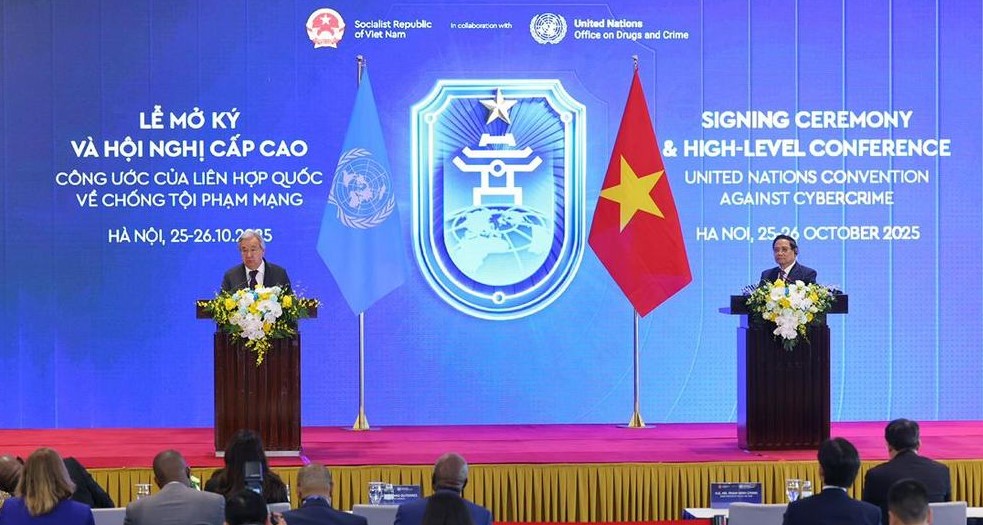
United Nations First Treaty to mitigate Cyber Crime, a milestone in digital cooperation.

Oct 2025 : Adopted by the General Assembly in December 2024 after five years of negotiation, the Convention against Cybercrime establishes the first universal framework for investigating and prosecuting offences committed online ranging from ransomware and financial fraud to the non-consensual sharing of intimate images.
“The UN Cybercrime Convention is a powerful, legally binding instrument to strengthen our collective defences against cybercrime”, said Mr. Guterres at the signing ceremony on Saturday, 25th October, 2025. “It is a testament to the continued power of multilateralism to deliver solutions. And it is a vow that no country, no matter their level of development, will be left defenceless against cybercrime”.
The signing ceremony was hosted by Vietnam in collaboration with the UN Office on Drugs and Crime (UNODC), drawing senior officials, diplomats and experts from across regions.
The new treaty criminalises a range of cyber-dependent and cyber-enabled offences, facilitates the sharing of electronic evidence across borders and establishes a 24/7 cooperation network among States. It also makes history as the first international treaty to recognise the non-consensual dissemination of intimate images as an offence, which is a significant victory for victims of online abuse. It will enter into force 90 days after the 40th State deposits its ratification.
In his remarks, Mr. Guterres warned that while technology has brought “extraordinary progress”, it has also created new vulnerabilities. “Every day, sophisticated scams defraud families, steal livelihoods and drain billions of dollars from our economies. In cyberspace, nobody is safe until everybody is safe. One vulnerability anywhere can expose people and institutions everywhere”.
The Secretary-General emphasised the Convention represents “a victory for victims of online abuse” and “a clear pathway for investigators and prosecutors” to overcome barriers to justice when crimes and evidence cross multiple borders. By providing a global standard for electronic evidence, the treaty aims to improve cooperation between law enforcement agencies while safeguarding privacy, dignity and fundamental human rights.
The signing ceremony formed part of Mr. Guterres’ official visit to Vietnam, where he also met with President Lương Cường, Prime Minister Pham Minh Chinh and other top officials. At a joint press conference with the Prime Minister, Mr. Guterres highlighted Viet Nam’s vital role in the global digital supply chain.
“It is fitting that the signing ceremony takes place here in a nation that has embraced technology, powered innovation and become an essential part of the world’s digital supply chains”, he said, urging States to swiftly ratify and implement the treaty. “Now we must turn signatures into action. The Convention must be ratified quickly, implemented fully, and supported with funding, training and technology especially for developing countries”.
The new convention is expected to reshape how countries tackle cybercrime at a time when digital threats are rising sharply. Global cybercrime costs are projected to reach $10.5 trillion annually by 2025, according to industry experts. For many governments, particularly in the Global South, the treaty represents an opportunity to access training, technical assistance and real-time cooperation channels.
“Let us seize this moment”, Mr. Guterres said. “Let us build a cyberspace that respects everyone’s dignity and human rights, and ensure that the digital age delivers peace, security and prosperity for all”.
Why the Convention against Cybercrime matters.
In 2023, 67.4% of the world’s population accessed the Internet, according to the World Bank. People rely on connectivity for tasks ranging from communication and shopping to advanced research and innovation. However, this connectivity also exposes more than two-thirds of the global population to the dangers of cybercrime. For those on the wrong side of the digital divide, the lack of resilience further increases vulnerability once they get online.
Cybercriminals exploit digital systems using malware, ransomware, and hacking to steal money, data, and other valuable information. Information and communications technology (ICT) are also used to facilitate crimes such as drug trafficking, arms smuggling, human trafficking, money laundering and fraud.
Regions like Southeast Asia have been described as “ground zero” for organized cybercrime operations, which are often highly sophisticated and coordinated. The threat is escalating, undermining economies, disrupting critical infrastructure, and eroding trust in digital systems.
Until now, there has been no globally negotiated convention on cybercrime. The new Convention against Cybercrime will enable faster, better-coordinated, and more effective responses, making both digital and physical worlds safer. Investigating transnational crimes, whether online or offline, depends heavily on electronic evidence, which poses unique challenges for law enforcement.
One major challenge is the decentralised nature of data, networks, and service providers, with potential evidence often scattered across multiple jurisdictions. Additionally, electronic evidence must frequently be accessed quickly to prevent tampering or deletion through normal processes.
The Convention focuses on frameworks for accessing and exchanging electronic evidence, facilitating investigations and prosecutions. States Parties will also benefit from a 24/7 network to boost international cooperation, enabling assistance with investigations, prosecutions, crime proceeds recovery, mutual legal assistance, and extradition.
Online platforms such as social media, chat apps and games offer anonymity that predators can exploit to groom, manipulate, or harm children. The Convention is the first global treaty to specifically address sexual violence against children committed with information and communication technologies (ICT).
By criminalising these offenses, the Convention equips governments with stronger tools to protect children and bring perpetrators to justice.
Team Maverick








Maharashtra Shuts Schools Across Several Districts as Heavy Rain Alert Triggers Safety Measures
Mumbai, July 2026: Authorities across several districts in Maharashtra have declared a hol…

Maharashtra Shuts Schools Across Several Districts as Heavy Rain Alert Triggers Safety Measures
Mumbai, July 2026: Authorities across several districts in Maharashtra have declared a holiday for …