Lac Cultivation Becomes the Foundation of Rural Prosperity, Farmers See Revolutionary Income Growth

Palash Trees Turn into a Pillar of Livelihood Through Forest Division’s Initiative; 400 Farmers from 37 Villages Join Campaign
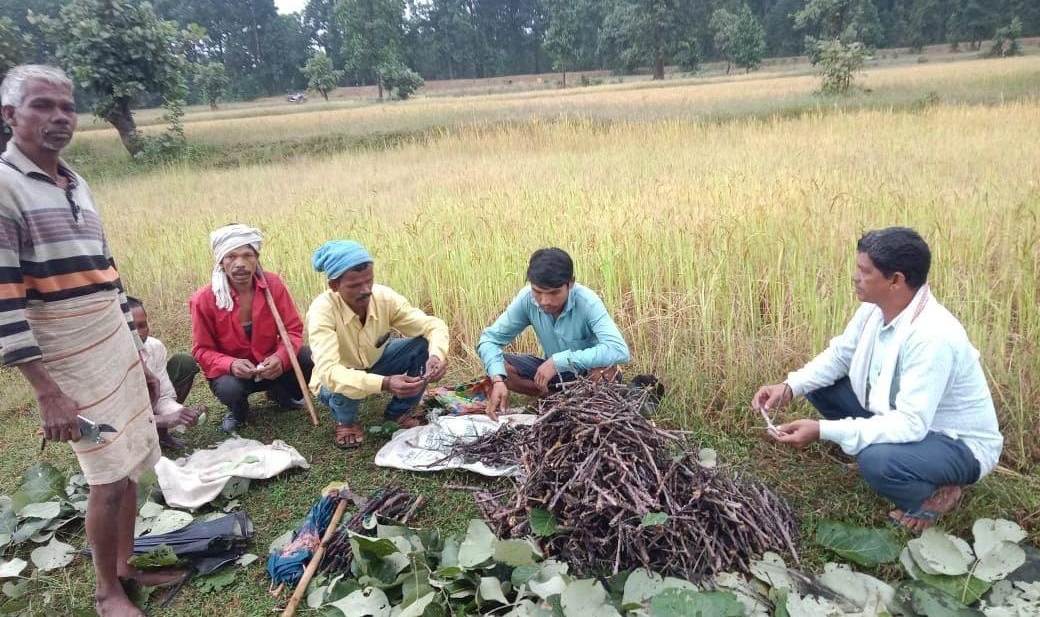
Raipur, Nov 2025 : Lac cultivation is emerging as a major driver of rural prosperity in Chhattisgarh, bringing a transformative rise in farmers’ incomes. The state is rich in Palash trees—locally known as Parsa—which are commonly found along field boundaries. Despite their abundance, the trees had no significant commercial use until recently.
Now, the Manendragarh Forest Division has launched an innovative initiative recognizing that Palash trees are highly suitable for Rangini lac cultivation. When utilized scientifically, these trees can provide farmers with an additional income source apart from agriculture.
Reviving Rural Economy Through Lac Cultivation
Manendragarh district has abundant Palash trees, and lac cultivation was practiced earlier. However, owing to unfavorable weather conditions and lack of scientific techniques, the practice dwindled over time.
During discussions with villagers, farmers from Bhauta, Narayanpur, Chipchipi, and Bundeli expressed strong interest in reviving lac cultivation. Responding to their enthusiasm, 2.54 quintals of lac seed (brood lac) were distributed to 34 farmers during October–November 2023–24, which were inoculated on 276 trees in these villages and in nearby areas of Chanti and Jardol under Janakpur.
Later, in June–July 2024–25, an additional 0.74 quintals of brood lac were inoculated on 80 trees belonging to four farmers in villages under Bhauta and Belbahara committees.
Lac Cultivation Expands to Every Village
In October 2024–25, five Primary Forest Produce Cooperative Societies operating under Bhauta, Belbahara, Madisarai, Janakpur, and Januva facilitated lac inoculation on 3,117 Palash trees by 126 farmers across nine villages.
By July 2025, the initiative expanded further—205 farmers from 27 villages under 10 cooperative societies inoculated 25.50 quintals of brood lac on 2,037 trees. Notably, 20.45 quintals of this brood lac were produced locally within Manendragarh district, while 4.05 quintals were brought from Balrampur.
By October 2025, the initiative had grown significantly:
✅ 400 farmers from 37 villages
✅ 60 quintals of brood lac
✅ Inoculated on 6,000 Palash trees
A remarkable point is that all brood lac used this year was produced by farmers of Manendragarh itself.
Manendragarh Set to Become Chhattisgarh’s Lac Hub
The mission aims to triple production every year, ensuring that lac cultivation spreads across the entire district in the coming year.
The biggest challenge in lac cultivation is the availability of brood lac since sourcing it from other regions is difficult. However, with Manendragarh rapidly emerging as a production leader, it is expected to become the main supplier of brood lac for the entire state.
Currently, Jharkhand ranks first in lac production and Chhattisgarh second—within Chhattisgarh, Manendragarh stands at the top.
Higher Profits and Self-Reliant Farmers
Cost-benefit analysis shows that lac production is highly profitable. Farmers typically obtain 2.5 times the amount of brood lac inoculated, resulting in about 1.5 times net profit. Many farmers are already earning ₹30,000 to ₹40,000 in additional income through this initiative.
Success Stories: Real-Life Case Studies
1. Sarvjeet Singh – Village Chipchipi, Bhauta Committee
- In Oct–Nov 2023: Inoculated 40 kg brood lac on 45 trees at a cost of ₹10,000
- In Oct–Nov 2024: Sold 150 kg brood lac for ₹37,500
- In July 2025: Sold 125 kg brood lac for ₹31,250
✅ Net profit in two years: ₹58,000
2. Udaynarayan – Village Narayanpur, Bhauta Committee
- In Oct–Nov 2024: Inoculated 60 kg brood lac on 70 trees at a cost of ₹15,000
- In July 2025: Sold 150 kg brood lac for ₹37,500
✅ Net profit in one year: ₹22,500



US-Led Israel-Lebanon Peace Talks to Resume in Rome from August 4
Washington, July 2026 : The United States will host the next round of negotiations between…

US-Led Israel-Lebanon Peace Talks to Resume in Rome from August 4
Washington, July 2026 : The United States will host the next round of negotiations …