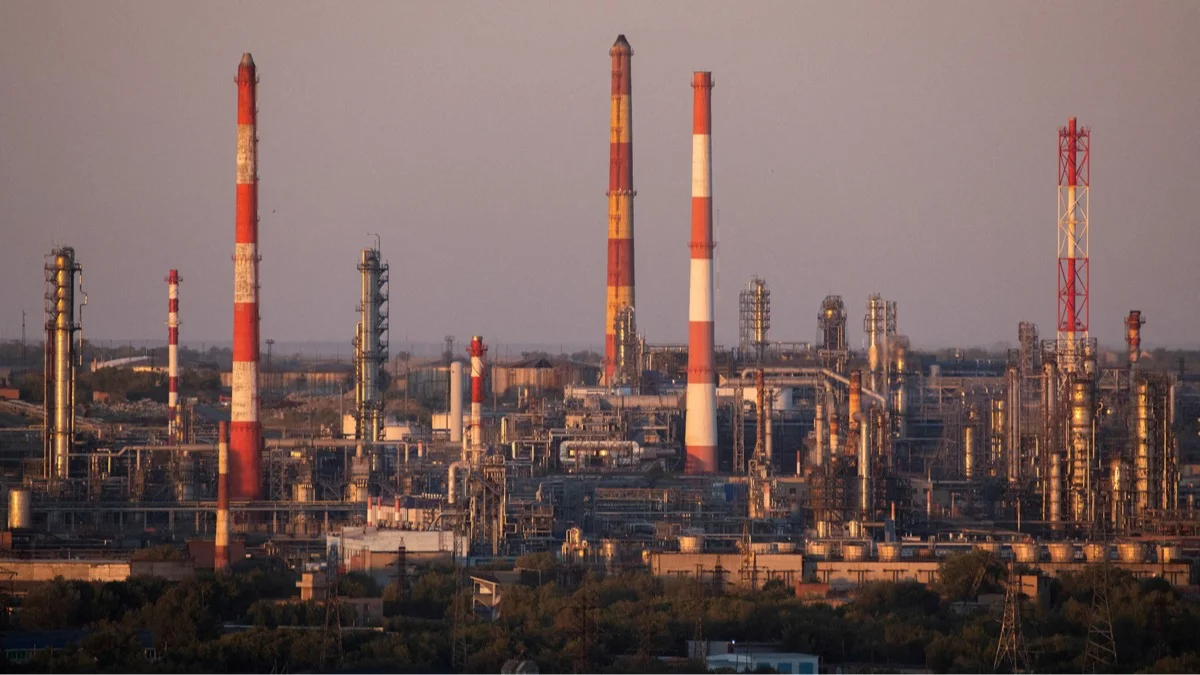
Russian oil companies will be hit twice as hard by US sanctions and Ukraine’s ongoing strikes on refineries.

US sanctions have already reduced Russian seaborne oil exports by approximately 20%. This has become eventual, after the Donald Trump administration added two of Russia’s largest oil producers, Rosneft and Lukoil, to the Specially Designated Nationals (SDN) list in late October.
Although they will formally be cut off from dollar trading only on November 21, buyers are already rejecting their crude: while approximately 3.6 million barrels of oil were shipped from Russian ports daily in October, however these volumes dropped to approximately 3 million barrels per day in the first week of November after the sanctions were announced.
Things would get worse, as 05 Indian refineries, which collectively accounted for approximately 65% of seaborne imports from Russia, have already suspended oil purchases planned for December. They have been joined by two Chinese state-owned oil companies, Sinopec and PetroChina, which are canceling approximately 45% of shipments from the Russian Far Eastern port of Kozmino. If these temporary pauses turn into a strategic refusal of Russian oil, then its seaborne exports, according to calculations by international oil experts could fall not by 20%, but by 40–45%, to just over 2 million barrels per day.
Pipeline exports to China will add another 0.8–0.9 barrels per day to this figure. Pipeline shipments are unlikely to decline because, unlike tanker shipments, they are less transparent to those imposing sanctions, and are likely settled in yuan and rubles.
It turns out that sanctions could reduce exports to approximately 2.8 million barrels per day, compared to 4.8-5 million barrels per day in 2021-2022. Shipments are falling this year also because, in early 2025, the Joe Biden administration imposed “farewell” blocking sanctions against two other major exporters, Gazpromneft and Surgutneftegaz. Furthermore, this is due to bans on the use of Russian shadow fleet tankers, regularly imposed by the EU, the UK, and, until January 2025, by the US.
At the same time, oil cannot be sold on the global market, and within Russia there is no place to refine it due to the fact that Ukrainian Armed Forces drones bombed the largest oil refineries. While in July 2025, before the massive bombings, the country was refining approximately 5.4 million barrels of oil per day, by the end of October this volume had fallen by approximately 10%.
According to more pessimistic estimates, after the airstrikes in late October and early November, when the largest refineries Volgograd, Tuapse, and Nizhny Novgorod, were shut down, the decline could reach 15%. Or approximately 0.8 million barrels per day of oil with nowhere to go.
And things will only get worse; despite the growing gasoline shortage on the Russian market, along with rising prices, domestic demand for crude oil is not increasing due to the refining shortage. As Tatyana Mitrova, an expert at the Center for Global Energy Policy at Columbia University, and Sergei Vakulenko, an expert at the Carnegie Russia Eurasia Center, asserts, “No single strike can destroy the entire system, but regular, accelerating attacks increase the likelihood of cascading outages of plants, increasingly lengthy repairs, and cumulative power losses”.
Experts cite the example of Lukoil’s Volgograd refinery, one of the largest in Russia with a refining capacity of 300,000 barrels per day. “It was hit at least five times in two months, the last time just a few days after it was restarted following maintenance. While such repeated attacks cannot destroy the refinery, it requires constant repairs. And the supply chain for spare parts is already seriously hampered by sanctions“, Mitrova and Vakulenko have quoted.
The current crisis will hurt oil companies and, as an inevitable consequence, the federal budget, 40% of which the Kremlin spends on defense and security. Oil and gas revenues have already plummeted by 21% between January and October compared to the same period last year. The reasons include falling oil prices in the spring, Western countries banning hundreds of illegal tankers from shipping, and the US imposing blocking sanctions against Surgutneftegaz and Gazpromneft in January.
In absolute terms, the federal treasury lost 2 trillion rubles in the first ten months. This is one of the reasons the government is increasing taxes: spending is almost double pre-war levels, and the money needs to come from somewhere.
An important caveat is in order here: the fact is that budget revenues from oil and gas depend not on export volumes (the Russian government has waived the oil export duty), but on the volume of oil production. The treasury is primarily filled by the mineral extraction tax (MET), which is calculated based on the average dollar export price of Urals crude oil, the ruble exchange rate, and a number of adjustment factors.
Therefore, if oil producers have nowhere to “sell” their crude, budget revenues will fall due to declining production. If the decline in exports persists for longer than 04-06 weeks, and pipeline shipping and storage capacity including the ‘shadow fleet’ and floating storage reach their limits, then yes, forced balancing through production begins by shutting down high-cost wells.
Therefore, the key question now is how long the pause in Russian crude purchases will last. German economist Janis Kluge, a research fellow at the Berlin based Foundation for Science and Politics (SWP), believes the decline in exports will be temporary, and Russian oil will find its way onto the global market after some time. “But Lukoil and Rosneft will have to restructure part of their supply chains, possibly finding new partners or markets, which will result in a drop in revenue”, he said.
But beyond the potential decline in production, there are two other reasons why the budget will lose taxes:
First, mineral extraction tax collections will fall because sanctions will increase the cost of oil transportation. As Kluge noted, there are almost no “clean” (i.e., non-sanctioned) Urals barrels left on the market. To transport liquid “sanctioned” crude by sea, Russia needs to increase “shadow” shipping, which is becoming increasingly expensive.
Second, sanctions are increasing the discount on Russian oil relative to Brent. This year, this discount fluctuated between $5 and $7. According to Kluge, it’s possible this discount could increase by an additional $10 per barrel.
This means Russian oil could be $15-$17 cheaper than the benchmark Brent crude, which was trading at $64 per barrel on Friday. This could be a significant blow to Russia’s “war budget”. As an economist at a global bank has calculated, the treasury currently earns $1.7-$1.8 billion annually for every dollar of average annual oil prices.
At this juncture, it is impossible to say definitively how much the budget will lose, how much export revenue will dry up, and how much the ruble will depreciate, and here’s why. If Russia starts plugging its wells, this could lead to a rise in global oil prices. If, for example, Russian production were to decline by 1 million barrels per day, the Brent price would typically respond to such a supply reduction by rising by $8-10 per barrel, but only if other suppliers don’t compensate for this decline.
“Saudi Arabia and the UAE could technically offset approximately 1 million barrels per day over four to six weeks, but the question is whether they will do so, as if prices rise, they benefit from a short-term boost“, the expert says. However, the US, which doesn’t want expensive gasoline and the accompanying rise in inflation, could put pressure on producers, and then they would likely quickly increase production, Mitrova notes.
On the other hand, there’s the demand factor for raw materials, which could put pressure on prices. For example, the International Energy Agency predicts that the oil surplus will reach 4 million barrels per day next year, meaning a possible supply cut from Russia is unlikely to push up the price of Brent.
The main consumers of hydrocarbons are China and the United States, and if Trump’s trade wars hit their economies, this will reduce the demand for oil. As Mitrova says, China is currently maintaining global demand by pumping massive amounts of gas into its strategic reserves, but it could also suspend this.
Regarding the national currency exchange rate, the decline in petrodollar inflows in the first ten months of the year has not yet led to devaluation, as the share of ruble transactions in foreign trade has increased sharply, says independent investment consultant Andrei Kochetkov. The shift away from the dollar and euro in exports and imports effectively reduces ruble volatility, he adds.
Nevertheless, according to macroeconomic rules, a decline in revenues from the main export commodity should inevitably lead to a decline in the ruble, a Russian economist (we are not naming him for security reasons) told us. He believes the ruble is already overvalued and sees no fundamental reasons for its high value amid stringent foreign trade restrictions.
If this forecast comes true, the devaluation could become an additional factor in a new round of inflation, which already has numerous causes: gasoline shortages and rising prices, tax increases, a jump in recycling fees, and a sharp indexation of utility rates. This will force the Central Bank to halt interest rate cuts or even begin raising them, which will hurt civilian sectors of the economy, which, unlike the military, can rarely take out loans at subsidised rates or with government guarantees.
Team Maverick





Alvarez, Lautaro Fire Argentina Past 10-Man Switzerland in Extra Time, Set Up Blockbuster World Cup Semi-final Against England
Score: Argentina 3 (Alexis Mac Allister 10′, Julian Alvarez 112′, Lautaro Mart…

Alvarez, Lautaro Fire Argentina Past 10-Man Switzerland in Extra Time, Set Up Blockbuster World Cup Semi-final Against England
Score: Argentina 3 (Alexis Mac Allister 10′, Julian Alvarez 112′, Lautaro Martinez 120+1′) beat …