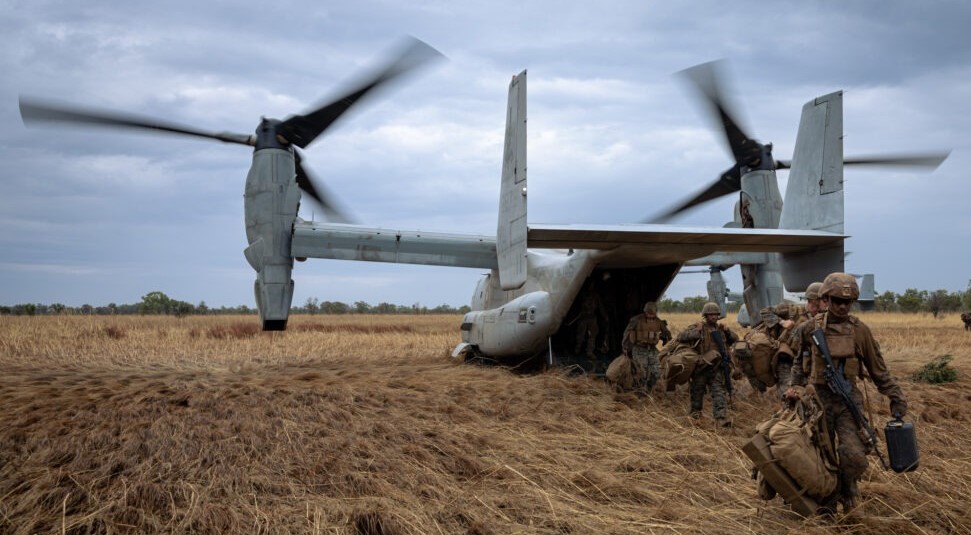
While Safeguarding Autonomy, Australian Defence Force Leans on United States Marine Forces.

Sovereignty is a matter of confidence as well as control. The more Australia invests in shared military posture, the more it must communicate that this serves a sovereign national strategy, not alliance subordination. The ADF’s growing focus on autonomous systems, long-range fires and space-based awareness reflects this mindset, supporting the ability to act independently even within coalition frameworks. In that sense, the USMC’s doctrine, emphasising distributed, resilient, networked forces, isn’t a threat to sovereignty but an invitation to strengthen it.
For Southeast Asian neighbours, that reinforces perceptions of Australia as an extension of US military reach. Canberra will need to demonstrate that northern posture integration enhances regional stability rather than projecting US power unchecked through Australian territory. Transparency with partners and investment in regional capacity-building must accompany every new runway, radar or logistics hub.
The US Marine Corps’ newly released Force Design Update 2025 is a strategic pivot disguised as a technical document. It doesn’t just modernise how the Marines fight; it redefines where they will fight from. And Australia is now embedded in that architecture. For Australia, the issue isn’t simply integration but independence. It will need to consider how it can leverage this unprecedented posture alignment to strengthen its defence and national resilience without diluting sovereignty or strategic autonomy. The challenge is clear: Canberra must translate access and alliance into advantage, building sovereign capability and influence commensurate with its new operational centrality.
Force Design is the USMC’s rolling modernisation plan. The Force Design Update released on 23rd October marks the program’s transition from theory to execution. For the first time, Australia is formally included in the USMC’s prepositioning and sustainment network, alongside the Philippines and Palau. That seemingly administrative detail transforms northern Australia from a rotational training area into an operational node within the US Indo-Pacific logistics web. The Marines’ Stand-In Force concept, small, dispersed, lethal formations operating inside contested zones, will depend on distributed, hardened sustainment hubs.
For the Australian Defence Force, this presents both opportunity and exposure. The integration of logistics, command and control, and training infrastructure with US systems enhances readiness. But it also risks deepening dependence at a moment when Australia’s Defence Strategic Review stresses the need for independent sustainment, decision-making and industrial capability.
If US doctrine drives infrastructure planning, data architecture and operational tempo in the north, Australia could find itself with assets optimised for allied use but misaligned with its own independent force posture. The ADF must ensure that interoperability doesn’t become dependency and that while using joint networks it retains control of Australian data, command pathways and rules of engagement.
Diplomatically, this strategic shift may raise issues that Australia will have to navigate carefully. The USMC’s inclusion of Australia won’t go unnoticed in Beijing, Jakarta or Port Moresby. The update doesn’t mention the Northern Territory, but the operational logic clearly points to it as a forward logistics and command node. At the same time, this deepening posture alignment creates a once-in-a-generation chance for Australia to use the alliance to build up its independent capability. The Marine Corps Installations Plan treats bases as operational platforms requiring hardened command and control, resilient energy, and cyber-secure infrastructure.
With wise co-investment, those same facilities can underpin Australian industry, powering a domestic defence ecosystem that services both ADF and allied demand. Local firms in the Northern Territory could build modular logistics nodes, fabricate parts through expeditionary manufacturing and support housing upgrades. Each of these investments should be structured to leave behind enduring Australian capacity, not a transient foreign footprint.
Strategically, Australia needs to balance alliance and autonomy. The Force Design Update locks US presence into the Indo-Pacific for the long term, but it also tests the depth of Australia’s control within that partnership. As US posture becomes more distributed and resilient, Canberra must define the boundaries of shared and sovereign assets: who commands, who sustains and who decides. Future Australian–US agreements under the US Force Posture Initiative should include explicit clauses on data sovereignty, operational command and environmental stewardship to protect Australian interests while maintaining trust with Washington.
In policy terms, this moment should catalyse a new phase of Australian strategic thinking. Defence cooperation must now be integrated with foreign and industrial policy to ensure that alliance participation reinforces national strategy rather than substituting for it. That means aligning northern infrastructure projects with the Future Made in Australia agenda; leveraging posture spending to grow sovereign energy, logistics and data industries; and embedding Australian firms within US contracting frameworks, such as the Pacific Deterrence Initiative and Guam Multi-Award Construction Contracts. This approach would convert allied presence into enduring national power.
The Force Design Update 2025 is a reminder that geography and strategy are converging again in northern Australia. Australia’s geography suits the USMC’s needs: it’s vast and exposed, but near the Indo-Pacific’s main arteries. For Australia, that alignment can be transformative if approached deliberately. It is a chance to turn hosting into leadership, interoperability into co-design, and integration into independence. If Canberra can hold that line, the Top End will embody the new balance between sovereignty and solidarity that defines Australia’s national security.
Team Maverick







Shivakumar Says Congress United, Assures Women Will Get Cabinet Berth
Bengaluru, Aug 2026 : Karnataka Chief Minister D.K. Shivakumar on Monday sought to dismiss…
Shivakumar Says Congress United, Assures Women Will Get Cabinet Berth
Bengaluru, Aug 2026 : Karnataka Chief Minister D.K. Shivakumar on Monday sought to dismiss …