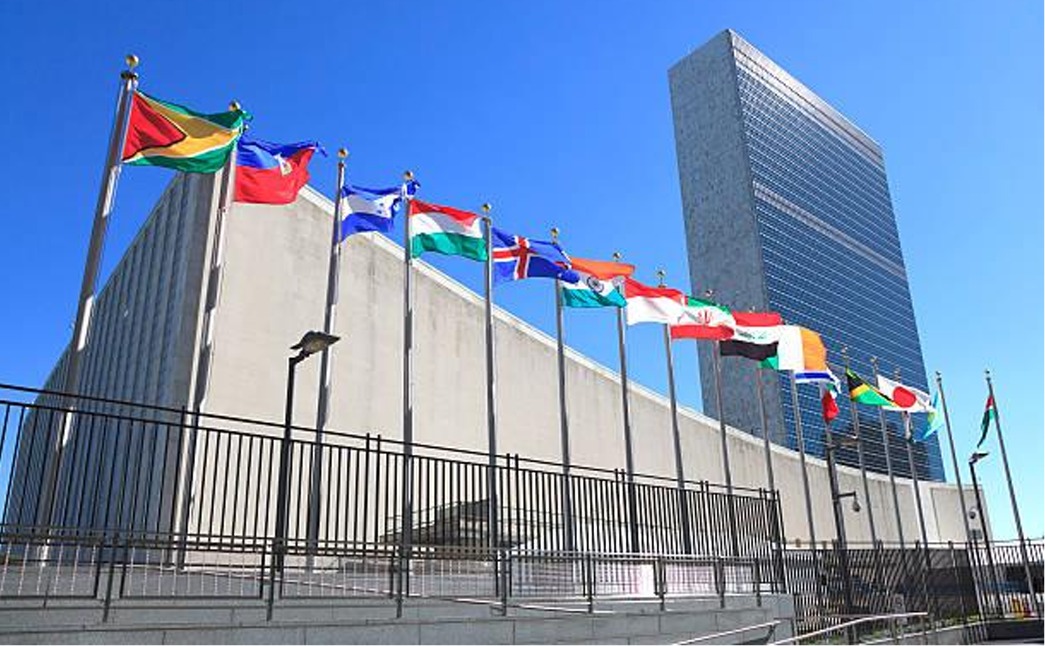
How United Nations General Assembly 2065 Was ‘Fixed’ in Favour of Argentina.

January 2026: Argentina had claimed that it has inherited the Falklands from Spain, a process known as “uti possidetis juris” and that in the year 1833, Britain had usurped an Argentine settlement in the Falkland Islands, expelled the population, and then allowed settlement in the Islands by a mass exodus. Moreover, from 1833 till 1850, the Argentine government have unintermittingly protested about the British presence on the Falklands in its annual opening statement to Congress every year till the ratification of the Convention of Peace in 1850.
Furthermore, Argentina protested to Britain in 1833, 1834, 1841, and 1849, wherein the Argentine ambassador Manuel Moreno, who was unaware that Rosas was preparing to agree the Convention of Peace, queried the comment by Secretary of State for Foreign Affairs Lord Palmerston that Argentina was giving up its claim.
The International law on treaties is determined by the Vienna Law of Treaties, 1969; wherein:
Article 31 (3) states: There shall be taken into account, together with the context, (c) Any relevant rules of international law applicable in the relations between the parties. (5) On the interpretation of subparagraph (c) Professor Lindefalk writes, ‘If it can be shown that the thing interpreted is a generic expression with a referent assumed by the parties to be alterable then the decisive factor for determining the meaning of the “relevant rules of international law” shall be the law applicable at the time of the interpretation. In all other cases, the decisive factor shall be the law applicable at the time when the treaty was concluded.
The principle in law at the time of the signing of the treaty is also relevant. Sir Gerald Fitzmaurice in the Law and Procedure of the International Courts of Justice writes, ‘In a considerable number of cases, the rights of states and more particularly of parties to an international dispute depend or derive from rights, or a legal situation existing at some time in the past, or on a treaty concluded at some comparatively remote date’.
The wording of the Treaty is important – ‘Convention for re-establishing the perfect Relations of friendship between Her Britannic Majesty and the Argentine Confederation’, is written as the pre-amble of the treaty. In the ICJ case between Libya and Chad judgment the ICJ ruled regarding the meaning of the text and stated, ‘a treaty must be interpreted in good faith in accordance with the ordinary meaning to be given to its terms in their context and in light of its obligations and purpose. Interpretation must be based above all on the text of the treaty’.
The Treaty was initially called, ‘the Convention of Peace’ by both Britain and Argentina:- ‘November 24th, the Chamber of Representatives authorises Governor Rosas to ratify the convention of peace between the Argentine Confederation and the United Kingdom of Britain,’ when Britain’s ratification is presented. The Treaty is recognised as ‘a convention of peace, signed by the Argentine and British plenipotentiaries’. This fact confirms that it was indeed a peace treaty and both sides interpreted it as settling ALL outstanding differences. Four important Spanish language sources confirm that this convention did in fact end the Falkland’s dispute and put an end to Argentina’s claims.
Although colonisation, including settler colonisation, is absolutely prohibited under international law it was not expressly prohibited until the 1960s with the UN Declaration on Granting Independence to Colonial Countries and Peoples. 169 In this respect, population transfer was accepted in international law until it was prohibited by the Fourth Geneva Convention of 1949. 170
The ICJ Construction of a Wall in Occupied Palestinian territory Advisory Opinion is often referred to and gives reference to the Fourth Geneva Convention. In the judgment the ICJ stated, ‘Article 49, paragraph 6 of the Fourth Geneva Convention is relevant which provides: ’The occupying Power shall not deport or transfer parts of its own civilian population into territory it occupies.’ And ‘that provision prohibits not only deportations or forced transfers of populations such as those carried out during the Second World War, but also any measures taken by an occupying Power in order to organize or encourage transfers of parts of its own population into the occupied territory’. Then continues ’The Security Council has taken the view that such policy and practices have no legal validity’. In respect of the Falkland Islands, in 1833, only the garrison was asked to leave while the majority of settlers were encourage to and did stay. Only 4 settlers decided to leave the settlement which was on the verge of collapse.
Article 2 regarding the application of the Fourth Geneva Convention is highly relevant in as much as it clearly states, ‘In addition to the provisions which shall be implemented in peacetime, the present Convention shall apply to all cases of declared war or any other armed conflict’ and article 153 ‘coming into force’ – the present Convention shall come into force six months after ratification (21st October 1950).
In regards to Article 49, paragraph 6 on population transfer to occupied territories, the Special Rapporteur UN Commissioner of Human Rights clarified, ‘The view has been advanced that a transfer is prohibited under paragraph 6 only to the extent that it involves displacement of the local population’ and ‘Another view of paragraph 6 is that it is directed against mass population transfers such as occurred in WWII for political, racial or colonisation ends; but there is no apparent reason for limiting its application to such cases.’ In the conclusion the Special Rapporteur states, ‘International Law prohibits the transfer of persons, including the implantation of settlers, as a general principle. The governing principle is that the transfer of populations must be done with the consent of the population involved‘.
To be continued in the next episode.
Team Maverick.







Breathing at Risk: India’s Overlooked Adult Vaccine Crisis
June 2026 : A few months ago, a 62-year-old man was rushed to the ICU with severe breathle…

Breathing at Risk: India’s Overlooked Adult Vaccine Crisis
June 2026 : A few months ago, a 62-year-old man was rushed to the …