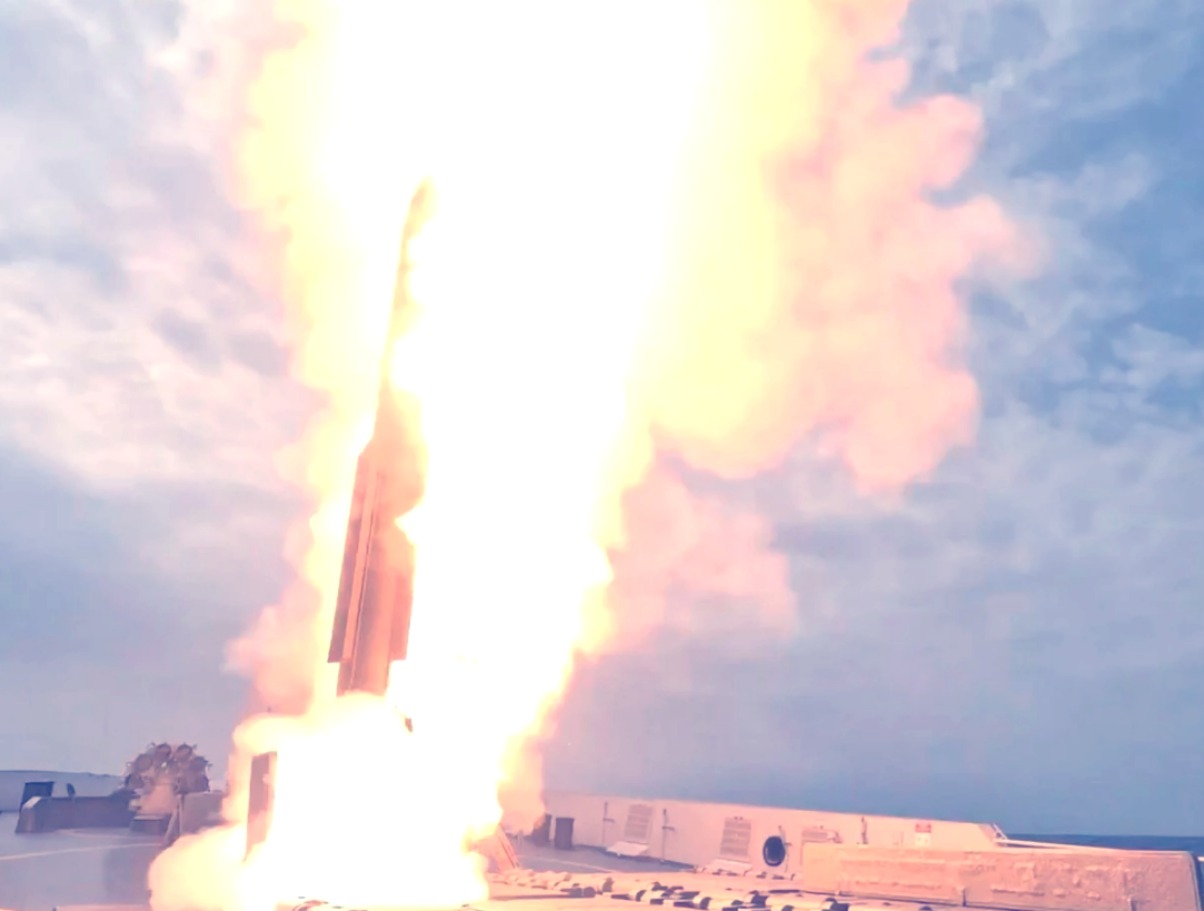
Pakistan Navy Successfully Fires Chinese LY-80N Air Defence Missile From Type 054A/P Frigate.

Islamabad; January 2026: According to information released by the Directorate General Public Relations of Pakistan Navy on January 10th, 2026, the Pakistan Navy executed a high-profile live-fire exercise involving the LY-80(N) surface-to-air missile (SAM) system aboard PNS Taimur (F-262). The missile was launched from the ship’s vertical launching system and successfully engaged an aerial target at extended range, a result Pakistani naval officials described as confirmation of the platform’s operational readiness and the service’s layered air defence concept at sea.
This successful live firing marks a critical milestone in Pakistan Navy’s ongoing modernisation, highlighting a strategic shift from coastal defence to blue-water deterrence. Defence officials familiar with the drill confirmed that the LY-80(N) engaged a high-speed aerial target in a combat-realistic environment, effectively simulating an incoming cruise missile or hostile aircraft. The engagement occurred beyond 40 kilometres from the launch point, consistent with the missile’s stated range of up to 60 kilometres, and reaffirmed the missile’s capacity to neutralise airborne threats before they can pose a threat to high-value naval assets.
The LY-80(N) is the naval variant of the LY-80 surface-to-air missile system, itself the export version of China’s HQ-16. Developed by China Aerospace Science and Technology Corporation (CASC), the system is derived in part from Russian Buk-M1 technology but was significantly reengineered to meet modern battlefield requirements. Marketed by China National Precision Machinery Import and Export Corporation (CPMIEC), the LY-80(N) is designed to provide medium- to long-range air defence from shipborne vertical launch systems, capable of engaging multiple targets simultaneously with high accuracy.
Onboard Pakistan’s Type 054A/P frigates, including PNS Taimur, the LY-80(N) is vertically launched from a 32-cell VLS integrated with an advanced combat management system and active phased-array radar. This integration allows for 3600 threat detection and target tracking, enabling rapid engagement cycles. The missile’s successful performance during this latest test highlights the system’s readiness to operate in high-intensity conflict scenarios involving saturation attacks, stealth threats, or coordinated airstrikes.
The PNS Taimur, commissioned in 2022 and built by China’s Hudong-Zhonghua Shipyard, is one of four advanced frigates delivered under a major defence partnership between Islamabad and Beijing. The ship is equipped not only with the LY-80(N) but also with C-802 or YJ-12 anti-ship cruise missiles, torpedo launchers, CIWS, electronic warfare suites, and long-range surveillance systems. As the second vessel of the Type 054A/P class, Taimur now serves as a frontline combatant in Pakistan’s naval order of battle, extending its air and maritime strike envelope far beyond its historical range.
The live-fire exercise also carries significant geopolitical weight. As military tensions between India and Pakistan remain high, especially along contested land and maritime boundaries, the demonstration of an effective long-range naval air defence system sends a deliberate signal of deterrence. The test comes at a time when the Indian Navy is expanding its regional footprint with new aircraft carriers, nuclear submarines, and long-range missile platforms, seeking to assert dominance across the Indian Ocean Region (IOR). In response, Pakistan is methodically strengthening its fleet with Chinese-built multi-role vessels that can now credibly challenge Indian air superiority at sea.
Strategically, the deployment of LY-80(N) aboard PNS Taimur marks a notable shift in regional naval dynamics. Pakistan’s ability to engage airborne threats at standoff ranges directly impacts India’s freedom of action during future crises. Indian aircraft, helicopters, and drones must now contend with Pakistani frigates capable of defending themselves far beyond the visual horizon. In essence, Pakistan Navy’s adoption of long-range SAM’s enables a layered air-denial strategy, creating missile engagement zones that extend deep into contested maritime areas, such as the Arabian Sea and the approaches to the Strait of Hormuz.
Moreover, the test underscores the deepening defence collaboration between Pakistan and China. The LY-80(N), like the Type 054A/P frigates themselves, reflects the rapid transfer of high-end naval warfare capabilities from Beijing to Islamabad. This cooperation is transforming Pakistan into a regional naval power capable of disrupting adversary maritime strategies and deterring escalation through credible sea-based defences.
Indian strategic planners are unlikely to overlook the implications. The increasing sophistication of Pakistan’s naval assets, backed by Chinese technology and doctrine, presents a two-front maritime challenge. With China’s growing presence in the Indian Ocean through the PLA Navy and Pakistan’s expanding blue-water fleet, India must now recalibrate its naval posture to address a layered threat environment on both the east and west of the subcontinent.
As both navies continue to modernise, analysts warn that the Indian Ocean may become the next major theater of great-power competition and regional rivalry. The LY-80(N) test, while tactical in scope, represents a strategic pivot in how Pakistan intends to defend its sea lines of communication and maritime sovereignty under growing regional pressure.
With this successful launch, Pakistan has not only demonstrated technical proficiency but has also made a clear political and military statement: the Pakistan Navy is no longer confined to defensive waters. It is a modernising force capable of challenging air and missile threats far from shore, projecting credible power in one of the world’s most strategically vital maritime corridors.
Team Maverick.








Bethell, Brook Power England to Thrilling Four-Wicket Win Over India, Take Series Lead
Manchester, July 2026 : England produced a remarkable comeback with the bat as Jacob Bethe…

Bethell, Brook Power England to Thrilling Four-Wicket Win Over India, Take Series Lead
Manchester, July 2026 : England produced a remarkable comeback with the bat as Jacob …