
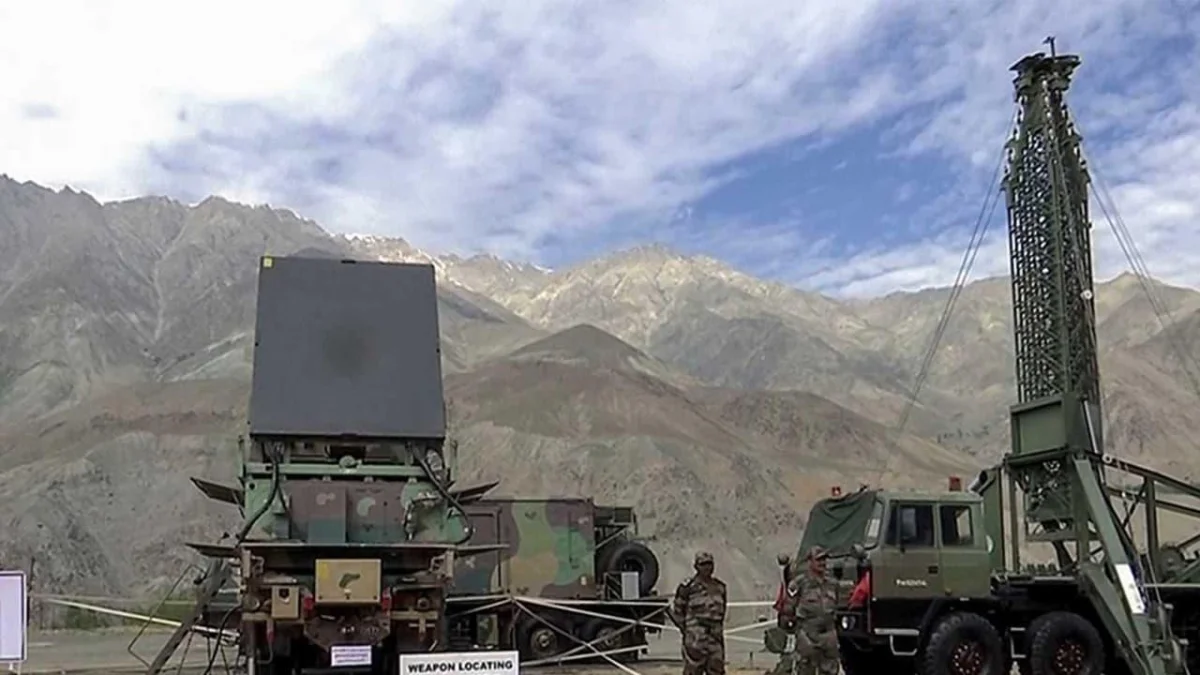
New Delhi, Sept 2026 : India has achieved a significant breakthrough in military semiconductor engineering with the successful development and demonstration of advanced Gallium Nitride (GaN) technology designed for high-frequency defence applications.
According to the Ministry of Defence’s annual report for 2025-26, the Defence Research and Development Organisation (DRDO) has established indigenous GaN-on-Silicon Carbide (SiC) capabilities that are expected to play a crucial role in next-generation electronic warfare (EW) systems, military radars and unmanned combat platforms.
At the heart of the achievement is a compact, indigenously designed GaN microchip measuring just 3.5 mm by 3 mm. Despite its small size, the chip is capable of delivering up to 30 watts of power while operating at speeds significantly higher than conventional silicon-based technologies.
GaN offers important advantages over conventional silicon and gallium arsenide (GaAs) semiconductors for demanding military applications. The technology can withstand higher power densities and voltages while continuing to operate under extreme thermal conditions. Its ability to function at higher temperatures, combined with superior thermal performance, makes it particularly suitable for sophisticated combat systems.
The MoD report said India has successfully fabricated and demonstrated X-band Monolithic Microwave Integrated Circuits (MMICs), along with S-band GaN High Electron-Mobility Transistor (HEMT) power amplifiers, low-noise amplifiers and switch MMICs.
These components are critical to the generation, amplification and regulation of high-frequency signals used in modern military systems. Their applications include transmitters for Active Electronically Scanned Array (AESA) radars and electronic warfare jamming systems.
The breakthrough is the outcome of sustained research at DRDO’s Solid State Physics Laboratory (SSPL), which has developed indigenous processes for producing four-inch Silicon Carbide wafers.
Using this material platform, SSPL scientists have developed GaN HEMTs capable of delivering up to 150 watts of power, while X-band MMICs have demonstrated power outputs of up to 40 watts.
A major step towards commercialisation and deployment has also been achieved. Limited production lines for GaN-on-SiC MMICs have been operationalised at the Gallium Arsenide Enabling Technology Centre (GAETEC) in Hyderabad, helping bridge the gap between laboratory research and deployable defence hardware.
The technology has potential applications beyond conventional land-based military radars. The multifunctional GaN components are expected to find use in strategic aerospace systems, 5G communication networks and secure satellite communications.
The development assumes added strategic significance because GaN technology is considered sensitive and advanced intellectual property, with exports of critical components restricted by several foreign governments.
India has historically depended heavily on imports for such sophisticated semiconductor components used in radar systems and missile guidance equipment. Establishing domestic capabilities for commercially viable SiC and GaN-based MMIC manufacturing therefore represents an important step towards achieving greater self-reliance in defence electronics under the Aatmanirbhar Bharat initiative.
The government is also seeking to strengthen the private-sector contribution to this emerging ecosystem. Under the Innovations for Defence Excellence (iDEX) initiative, the Ministry of Defence signed a contract with Agnit Semiconductors Private Limited in December 2023 for the design and manufacture of advanced GaN wireless transmitters for defence applications.
The combination of DRDO’s foundational research capabilities and private-sector participation is expected to strengthen India’s domestic semiconductor supply chain and reduce dependence on foreign sources for critical military technologies.
With indigenous GaN-on-SiC capabilities progressing from research towards production, India is building the technological foundation needed to support future electronic warfare platforms, advanced radar systems, combat aircraft and space-based surveillance assets while enhancing its long-term defence manufacturing and strategic autonomy.
Disclaimer: This article is sourced from a news agency and has not been independently edited by the MaverickNews30 team. The copy has been slightly edited with AI assistance for language and presentation, without altering the original facts.