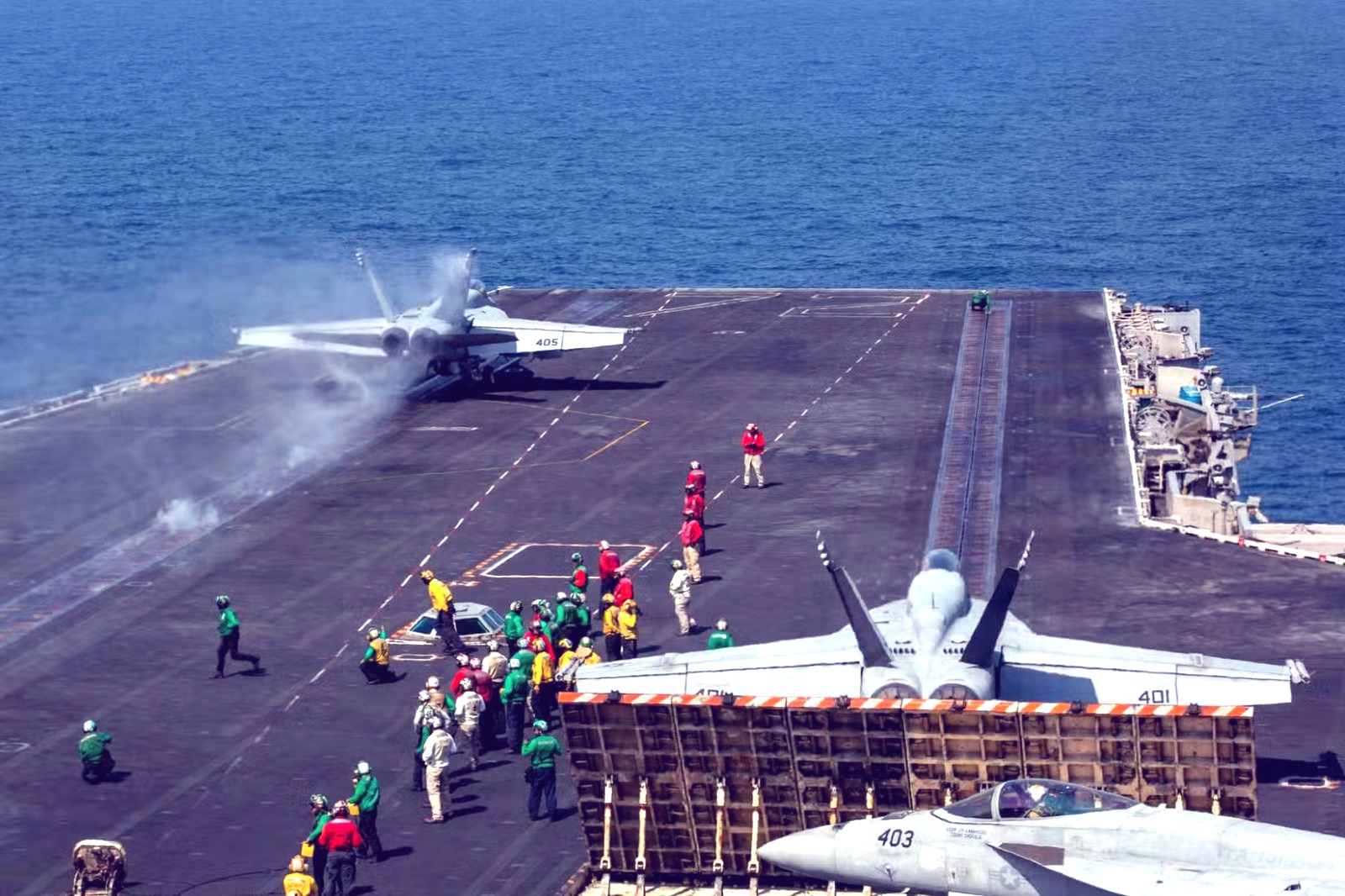
FA-18 Super Hornet Fighter Jet: US Navy’s Reliance On It.

Washington DC; May 2026: One of the biggest factor determining whether a fighter jet is successful is cost. The F/A-18 Super Hornet is the cheapest front-line fighter currently being purchased by the US military (the US purchases F-15s, F/A-18s, F-35s, but not F-16s). The reason for which the F/A-18 has been an excellent solution for the Navy and why it is now struggling to remain relevant, limiting the US Navy’s options. With the aged AV-8B Harrier II mostly retired now, and at the same time, naval F-35s are still building up their numbers, and so the F/A-18 remains the world’s primary carrier-based fighter jet. The other fighter jets that can operate on carriers are the AV-8B Harrier, Su-33, J-15, J-35, Dassault Rafale, and F-35A/B. Moreover, the F/A-18 family jets (including related EA-18G Growlers) remain in service than all other naval combat aircraft combined.
What makes a good fighter jet is typically not its top speed, its agility, or how impressively it performs at an airshow. Much is determined by boring and mundane things. The Super Hornet may not be as large, as impressive, as fast, or as iconic as the Tomcat, but it is also much more cost-effective. It is cheaper to purchase, much easier to maintain, and has far lower costs per flight hour. The Hornet is also incredibly versatile; it was the Navy’s first true multi-role fighter jet, allowing it to replace multiple aircraft types with a single platform. The aircraft is reliable, has a proven record, and is able to fill most of the Navy’s missions. For many missions, the F-35C is overkill. Additionally, the Navy has to retrofit its carriers to operate the F-35C. The Navy’s newest carrier, the USS Gerald R. Ford, is not yet certified to operate the F-35C, meaning it is restricted to carrying Super Hornets until its scheduled refit.
Moreover, the F-35C is also expensive to operate, takes up more room, and its hot exhaust has been problematic for existing flight decks without retrofitting. In the Air Force, the thinking is not so much 4.5th or 5th generation fighters, its 5th gen fighters complementing and enabling 4.5th gen fighters. This is what the US Navy is currently doing with its F-35Cs and Super Hornets. That said, by the late 2030s and into the 2040s, the Super Hornet will struggle to remain relevant, which is why the Navy wants to replace them with its F/A-XX.
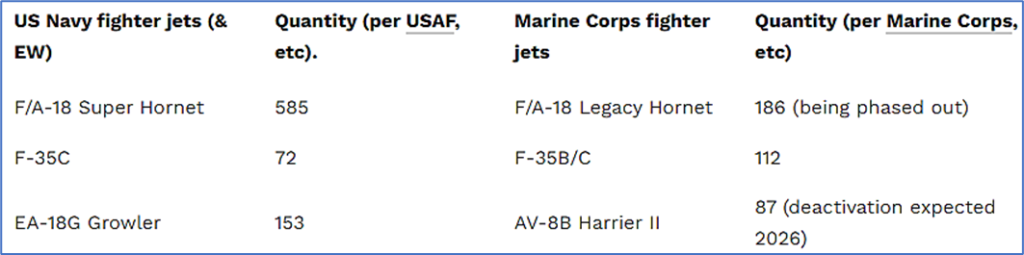
The US Marine Corps has around 186 numbers of legacy F/A-18 Hornets in service, and these are being replaced by F-35Bs and F-35Cs, but still 110 of them remains in the defence inventory. The United States Navy is by far the largest operator. It has a fleet of around 585 updated F/A-18 Super Hornets in inventory and another 17 on order. The Navy has placed what is expected to be the final order for the Super Hornet, and Boeing is expected to deliver the final Super Hornet in 2027 and shut the production line down. The F-35B is designed as a Short Take-Off and Vertical Landing (STOVL) fighter jet and is designed for the Marine Corps’ amphibious assault ships and other countries’ smaller aircraft carriers. It doesn’t compete with the Super Hornet in the same way as the F-35C does.
Notably, F-35As are also replacing land-based Hornets in some allied air forces. In the US Navy, the F-35C is to replace the Super Hornet only partially.
The F/A-18 Hornet is considered one of the most successful modern fighter jets. It originated from a US Navy requirement for a lightweight fighter. It was derived from the McDonnell Douglas and Northrop YF-17 demonstrator that had lost to the General Dynamics YF-16, which became the F-16 Fighting Falcon. The Hornet entered service in 1983 and replaced the Navy’s A-7 Corsair IIs and remaining F-4 Phantom IIs before also replacing the US Navy’s A-6 Intruders and F-14 Tomcats. The electronic warfare EA-18G Growler was also based on the airframe, and it replaced the Navy’s other electronic warfare aircraft. The Hornet was initially delivered on time and only with modest cost increases, partly due to program mismanagement.
The Hornet wasn’t initially meant to be the Navy’s only fighter jet. The lightweight fighter was complemented by the much larger and longer-range Tomcat. The Hornet provided mass and was affordable to purchase and operate. To replace the F-14 Tomcats, the US Navy purchased the improved and enlarged Super Hornet starting in 1999. While the Super Hornet is based on the legacy Hornet, it is essentially a new aircraft. The Super Hornet (E/F models) is around 20–25% larger overall than the Legacy Hornet (A/B/C/D models). It comes with major improvements to its range, payload, survivability, and its onboard systems without sacrificing agility. Its fuselage is stretched by around 34 inches (86 cm), has a 25% larger wing area, a strong structure, 42% fewer structural parts, modified engine intakes, and more.
The Legacy Hornet is powered by a pair of GE F404 engines providing around 17,700 lbf each, while the Super Hornet is equipped with two GE F414 engines that come with around 22,000 lbf each. The F414 is an upgraded variant of the older F404. But to replace the Tomcat, range is all-important. The Super Hornet carries around 33% more internal fuel, has a 41% greater combat radius, and a 50% improved endurance, compared with the Legacy Hornet.
The Super Hornet has two extra hardpoints, increasing the Legacy Hornet’s count from nine to 11. While not a stealth fighter, it does incorporate a number of low-observable features like a reduced radar cross-section, some radar-absorbent materials, expanded self-protection systems, and increased networking, which reduces the need to emit.
One of the major issues with the US Navy – the reason they are vetting the F/A-18 is that, recent performance in the Iranian War have demonstrated that the other versions of the fighter jets have lost their deep strike capabilities. While the Super Hornet is a major improvement over the Legacy Hornet, it is still unable to fully replace the Tomcat’s (and even A-6 Intruder’s) ability to deliver heavy payloads deep into contested airspace without heavily relying on aerial tankers.
After the collapse of the USSR and before the rise of China, this wasn’t much of an issue; the US Navy reigned supreme, unchallenged. In the years since the Tomcat’s retirement in 2006, the Navy has not solved the combat radius issue. Making matters worse, the Navy retired its Lockheed KS-3B Viking and KA-6D Intruder aerial tankers, forcing the Super Hornet to rely on the less-than-ideal buddy-buddy refueling from other F/A-18s. Compounding issues even more, increased threats (e.g., from China) are expected to push the carriers further out to sea to remain safe. This opens up the required combat radius even more. The Navy is attempting to address this issue by a number of means, including introducing the large MQ-25 Stingray tanker drone, extending the range of its F/A-18 Super Hornets, introducing high-end and longer-ranged F-35Cs, and developing the F/A-XX next-generation fighter jet.
The US Navy is soon to receive the last of its Super Hornets, but with China now starting to introduce its carrier-based J-35 fighter jet, the Navy is increasingly in need of a new fighter. The Navy plans to purchase 273 F-35Cs, but these are only seen as partially replacing and complementing the Super Hornet fleet. To fix its problem, the US Navy has prioritised the development of its sixth-generation F/A-XX. The service wants the jet to enter service in 2035 and then progressively replace the remaining Super Hornets that are not replaced by the F-35C. Little is known about the F/A-XX, and while Boeing and Northrop Grumman are known to have demonstrators competing for the program, the contract has not yet been awarded. Critically, the F/A-XX is expected to have increased range and to restore the Navy’s manned deep strike capability. However, the program has run into budgeting purgatory.
But official sources say that a larger section of the Trump administration FA-18 in abbey, and focus on the Air Force’s F-47 fighter. The Navy is fighting back and says US industry is big enough to develop both fighters simultaneously. At one point in the run-up to the FY 2026 budget, the F/A-XX line was mostly zeroed out to a minimal life-support level. Eventually, funding was restored to around $1 billion and approved. In the FY 2027 proposal, the Navy has again requested funding, but it has again been largely zeroed out by the White House.
Team Maverick.
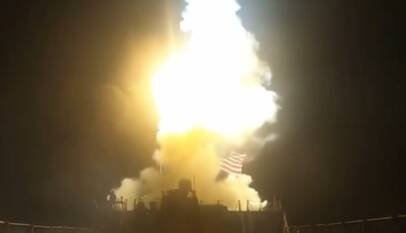







ISRO Successfully Tests Indigenous Ship-Borne Tracking System for Gaganyaan Mission
New Delhi, July 2026 : The Indian Space Research Organisation (ISRO) has successfully vali…
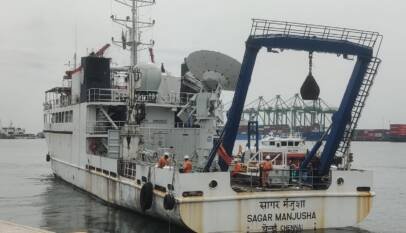
ISRO Successfully Tests Indigenous Ship-Borne Tracking System for Gaganyaan Mission
New Delhi, July 2026 : The Indian Space Research Organisation (ISRO) has successfully validated …